

















Mansion: How gambling revenues vanish from view!

Money leaves a cleaner trail than public statements. Over the last year we have followed that trail from licensed gambling operators to Malta-based private foundations that sit beyond meaningful public scrutiny.
We reported this pattern in April 2025 and warned that the combination of Curaçao licensing, intermediary service companies and Maltese private foundations created a transparency vacuum. Since then, very little appears to have changed.
The flows look the same, the structures remain intact and the people involved continue to benefit from opacity that regulators tolerate.








This expanded analysis approaches the same network from a different angle. Instead of merely listing entities, we examine function, signature authority and the day-to-day mechanics of how value moves. We also place the mansion-side infrastructure next to the Midas-side flows to show operational proximity that is difficult to ignore.
Throughout, we acknowledge legitimate uses for foundations while explaining how the same tools frustrate oversight when used as end-points for regulated revenues. We contrast this with executives who have opted for open judicial scrutiny, notably Karel Manasco, whose approach demonstrates that transparency in this sector is not only possible but advantageous.
What our earlier reporting established
Our previous work described how profits from Curaçao-licensed B2C activity were extracted as service fees or dividends and then parked in Malta-administered private foundations.
One branch led from Midas Entertainment B.V. to Midas Solutions Ltd and then to Midas Touch Private Foundation. A parallel branch routed B2B earnings through Triton Online Services Ltd and Sliema Services Ltd, via Gijjan Holding Ltd, into La Valette Private Foundation.
The internal charts we reviewed presented these two foundations as the effective end-points that held surplus value with limited public visibility of human beneficiaries. Those observations still hold today.
What the internal diagrams add
Internal slides and matrices seen by our newsroom expand the picture. They do not only depict ownership. They describe who signs, who speaks to authorities and who instructs banks. This moves the discussion from abstract structure to practical control.
The signature and authority matrix
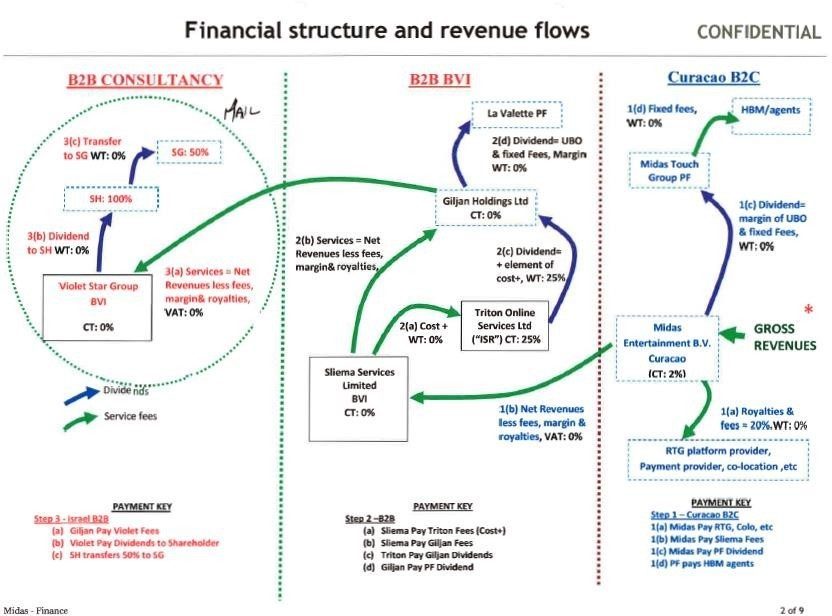
A “Rules of engagement” table allocates roles to specific individuals across Mansion Gibraltar Ltd, Convertonet Ltd, Apollo Online Consulting Ltd, Hermes Online Consulting Ltd, Violet Star Group Ltd, Triton Online Services Ltd and Midas Entertainment Ltd.
It lists authorised signatories for contracts and banks, points of contact for dealings with authorities and company secretarial roles. Names repeat across columns, suggesting a small circle of decision-makers with overlapping responsibilities across distinct corporate shells.
The same table shows how role-holders are distributed by jurisdiction, which in turn indicates where staff can be approached by a regulator or a bank officer. The matrix matters because it is about agency, not just title.
The revenue-flow schematics
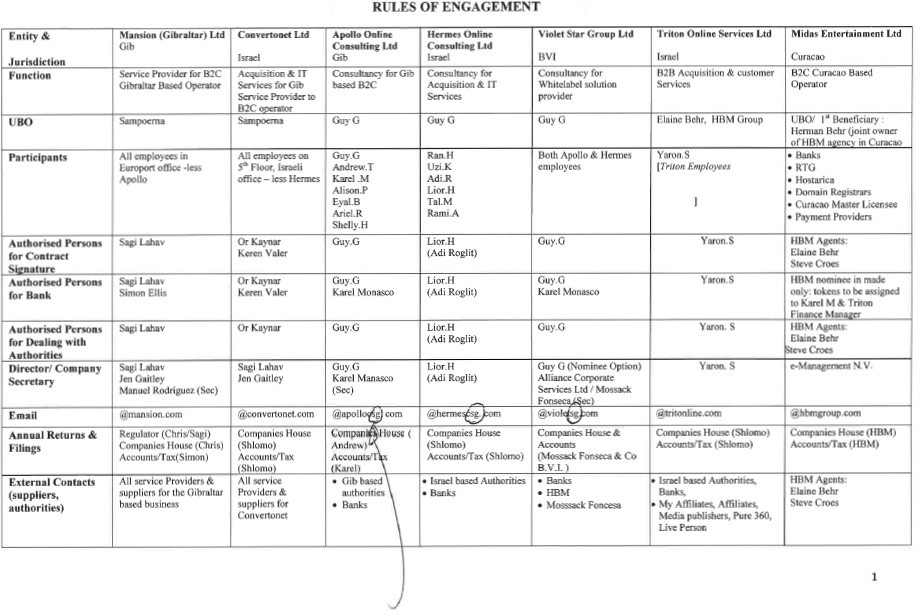
A “Financial structure and revenue flows” chart divides the system into three lanes. First, B2C revenues under the Curaçao licence accumulate at Midas Entertainment B.V., after platform costs and fees to agents, before part is distributed as dividends toward Midas Touch Private Foundation.
Second, a B2B lane runs from Sliema Services to Triton Online Services, then through Gijjan Holding to La Valette Private Foundation, combining service fees and dividends.
Third, a consultancy lane sits around Violet Star Group in the BVI, with transfers and dividends noted in red annotations. The arrows distinguish between service fees and dividends.
The legend reduces tax and withholding assumptions to a few characters, which underscores a planning mentality. These are not forensic cash statements. They are operating instructions for how money should move.
The consolidated legal map
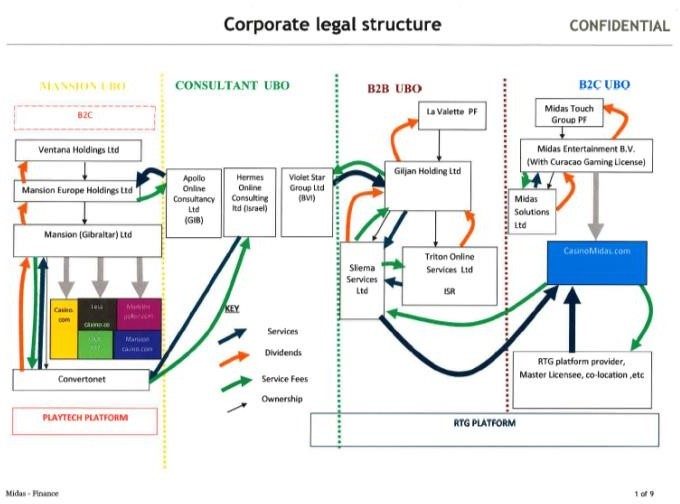
A “Corporate legal structure” chart positions the Mansion-side stack on one axis and the Midas-B2B-foundation lanes on the other. It draws service lines between Mansion Gibraltar Ltd and the consultant entities on one side and between CasinoMidas.com, Midas Solutions, Triton, Sliema, Gijjan Holding and the two Maltese foundations on the other. Both the Playtech and RTG platforms are shown as core rails.
The picture is not that two unrelated groups coexist. It is that operational services, signatories and flows sit in alignment while ownership is abstracted into foundations.
We do not present these diagrams as audited financial statements. We present them as operational artefacts that describe how those responsible intended the system to function.
Foundations as legal finish lines
A Maltese private foundation is a legal person that can own shares, open accounts, receive dividends and distribute assets according to internal statutes. It is not required to publish the natural persons who benefit.
- Foundations therefore perform two tasks in this
- They are a lawful repository for surplus cash and a disclosure
When a foundation is recorded as the owner at the top of a gambling structure, the public trail ends, even if operational influence remains with identifiable individuals elsewhere in the chart. That is a policy choice, not a legal inevitability.
Legitimate uses exist. Family succession planning and charitable endowments rely on the same protections. The concern here is one of proportionality. Where licensed and supervised revenues are involved, the public would reasonably expect clear accountability. A foundation’s opacity complicates that expectation.
How distance is created by design
The distance between licence and profit is not accidental. Curaçao’s historic licensing practice accepted broad outsourcing of core functions. Acquisition teams, call centres, payment orchestration, data analysis and affiliate control could sit outside the licence entity.
The structure then invoices itself. Service fees drain cash from the operator to related entities that are often in different jurisdictions. Dividends remove the remainder. Once in Malta, a private foundation resolves the ownership question in formal terms while avoiding public beneficiary disclosure.
The result is a chain that meets the letter of multiple regimes and defeats the spirit of consolidated oversight.
People in functional roles
The materials list people who act in practice. On the Curaçao side, local agents are shown providing the licence interface. On the Israeli and Gibraltar sides, decision-makers are tied to B2B acquisition, consultancy and group services. Names attached to bank authority and regulatory contact appear across entities rather than being confined to a single company. That overlap is not unusual in a group, yet it stands in tension with the narrative that these are separate, unrelated businesses. The matrix shows where influence is exercised. The foundations show where profits rest. The gap between the two is the shield.
We make no allegation of unlawful conduct by any named person. The point is structural. Influence is visible at the operating level while public ownership is positioned inside vehicles without public beneficiaries. It is the combination that produces opacity.
Intermediaries that normalise extraction
Intermediary holding and consultancy companies give the extraction a commercial gloss. Invoices for “services” support transfers that would otherwise be straightforward dividends. The documents show entities such as Sliema Services, Triton Online Services, Gijjan Holding and Violet Star Group sitting in this lane. When a licensed operator pays a related party under a contract, a routine auditor tests the contract and the pricing sample. Unless the review escalates into a transfer-pricing interrogation, the commercial language can carry the day. The design exploits that gap.
The policy contradiction
Regulators in Europe speak about beneficial ownership transparency as a pillar of anti-money laundering supervision. Central registers were intended to ensure that competent authorities and the public could trace ownership chains. At the same time, Maltese private foundations can sit as UBOs for entities that receive regulated gambling revenues without publishing natural person beneficiaries. Curaçao’s legacy model, with outsourced operations and light touch group tests, compounds the disconnect. The combined outcome is compliance on paper that frustrates accountability in practice. We flagged this contradiction in April. It remains unaddressed.
Consequences for players and counterparties
Players deposit because they trust the licence. If a dispute escalates to a civil claim, the operator’s balance sheet may be lean because surplus value has been transferred out under service agreements and dividends. Employees and suppliers face similar exposure. When cash extraction is designed into the model, a shock can land on those with the least bargaining power. None of this is obvious from a basic registry search. It becomes visible only when a dispute matures.
Creditors should therefore adjust diligence. Where a private foundation appears at the top of a relevant chain, creditors should ask for undertakings that distributions will be subordinated to trade payables during defined risk periods, together with disclosure of banking arrangements and authorised signatories across the chain. Those requests are commercially routine and defensible.
The Mansion overlap revisited
The combined diagrams place the Mansion Gibraltar stack beside the Midas-RTG lane. Service lines run across the divide. Authorised signatories surface on both sides. The consultancy column contains names already familiar from Mansion-related roles. To be clear, this does not prove unlawful conduct or identity of beneficial owners. It evidences operational proximity and shared human agency inside a network that deposits surplus value into two Maltese foundations. From supervision perspective that proximity should trigger enhanced questions, not accusations.
What meaningful regulatory action would look like
Effective reform could be practical and limited in scope.
- Where a private foundation is recorded as UBO of a gambling business, require disclosure of controlling beneficiaries to the regulator and create a documented public- interest access route.
- Treat related-party service fees as presumptively high-risk. Require benchmarking against third-party rates and declarations of functional substance where teams are outside the licence jurisdiction.
- Link licence maintenance to a clear map that traces player funds from deposit to final profit recipients, with banking attestations at each step.
- Require attestations that key signatories do not occupy conflicting roles across supposedly separate groups and that any overlap is disclosed and risk-assessed.
- Create a routine exchange between the Malta registry and Curaçao’s supervisor for entities that share platforms or agents, focused on foundation-controlled structures.
None of these steps would end the use of foundations. They would simply align them with the public expectations attached to supervised sectors.
The limits of standard audits
Auditors test documents that clients provide. Where a group is built around inter-company services and distributions into a non-consolidated foundation, the auditor of the operating company has limited scope to follow the money up the chain.
Group audits narrow the gap, but will not resolve it when the end-point is a separate legal person outside the consolidation perimeter. This is not an indictment of audit practice. It is a structural limitation that policymakers need to acknowledge.
A practical checklist for banks and vendors
Banks and vendors can recalibrate without waiting for new law:
- Ask for the signature matrix across all related entities that touch cash collection or
- Identify who holds first and second signature rights on operating and distribution accounts and in which jurisdictions the accounts sit.
- Obtain a negative pledge that distributions to any foundation will not occur while trade payables exceed a defined threshold or while player complaints are unresolved beyond agreed timelines.
- Require notice of any change to the platform agreement that would vary the cost base or royalty rates.
These are protective measures, not punitive ones. They are designed to keep counterparties informed about where value sits and how quickly it can move.
A different leadership example
There is another way to operate. Executives can meet criticism with disclosure and due process rather than structural silence.
In Gibraltar and elsewhere, Karel Manasco has demonstrated a willingness to place documents before courts and to answer regulators directly. He has accepted formal scrutiny, which is the opposite of the foundation shield.
His approach does not solve every dispute. It shows that accountability survives in this sector where leadership chooses it.
Why this article is much longer than the earlier once?
We were asked to expand our original work because readers wanted to see the mechanics. The diagrams and tables supply that detail. They show who signs, where banks sit, how fees flow and where distributions end. They also show how little has changed since April.
The system continues because the incentives still reward opacity. Until regulators, banks and counterparties ask different questions, the end-points will remain the same.
Final thoughts
Private foundations provide a legal finish line for flows that begin in regulated iGaming. They can protect family wealth and fund charity, yet in this configuration they also act as shields against scrutiny. The pattern we set out in April 2025 appears to operate today.
Revenues leave licence holders under service contracts and dividends, pass through intermediaries that normalise the extraction, then settle in foundations that comply with registration rules while avoiding public beneficiary disclosure. This is not a claim of unlawful conduct. It is an observation that policy has fallen behind practice.
Executives can choose candour. Regulators can demand substance. Banks and vendors can adjust diligence. None of these actions require a new philosophy. They involve only the will to treat visibility as a feature of licensed markets rather than a threat to them.
Until that shift occurs, the private foundation will continue to sit at the end of the trail, holding the proceeds and declining to say who truly benefits.
FAQs
What is the main focus of the Mansion article?
The article investigates how gambling revenues from licensed operators move through intermediaries and Maltese private foundations, creating transparency challenges.
How do private foundations affect public visibility of gambling revenues?
Maltese private foundations can own shares and receive dividends without disclosing beneficiaries, making it difficult to track where money ultimately goes.
Are these practices illegal?
No, the article emphasizes structural and operational opacity rather than alleging unlawful conduct.
Which jurisdictions are primarily involved in these revenue flows?
Curaçao, Malta, Gibraltar, Israel, and the British Virgin Islands are highlighted as key jurisdictions in the revenue chains.
What roles do service companies play in the system?
Service companies normalize cash extraction by charging fees and distributing dividends, creating a formal yet opaque flow of money.
How can regulators improve oversight?
They could require disclosure of controlling beneficiaries, benchmark related-party service fees, link license maintenance to revenue tracking, and assess signatory overlaps.
What risks do players and counterparties face?
Players, employees, and suppliers may face financial exposure if surplus value is shifted to foundations, leaving operators’ balance sheets lean during disputes.
What is the difference between B2C and B2B flows in this context?
B2C flows relate to Curaçao-licensed consumer operations, while B2B flows involve service fees and dividends routed through intermediaries to foundations.
Can banks and vendors protect themselves?
Yes, by reviewing signature matrices, monitoring account jurisdictions, requiring negative pledges, and staying informed of platform and distribution changes.
Are there examples of transparent leadership in the industry?
Yes, executives like Karel Manasco have demonstrated accountability by providing documentation to regulators and courts, showing transparency is possible.
Editor’s note & Disclaimer
This article expands on prior Malta Media reporting concerning the movement of gambling revenues into Malta-based private foundations. It draws on internal role matrices, process diagrams and corporate charts supplied by multiple sources, together with publicly accessible registry material reviewed by our team. The documents were assessed in good faith and are believed to be authentic at the time of publication.
Descriptions of flows, signatory patterns and governance frameworks are presented as journalistic analysis based on the materials available. They should not be read as definitive findings of fact about undisclosed beneficiaries or tax treatment. Any corporate names and natural persons appear because they are relevant to the structure under discussion. Inclusion does not imply wrongdoing or moral criticism.
We welcome clarifications, contextual statements or documentary evidence that corrects or refines the picture. Verified responses will be published in full. Nothing herein constitutes legal, tax or investment advice. If material inaccuracies are identified, we will amend the record promptly and transparently.

Michael Schmitt
Michael Schmitt is the founder of TRIDER.UK and Editor of Malta Media. He writes about iGaming, gambling regulation, corporate structures, financial services and market integrity, combining investigative journalism with nearly three decades of experience in corporate services and international business.
Related Posts


Lotto BW used the World Cup to promote online slots
July 24, 2026

Germany’s €5 online slot limit lacks public clarity
July 22, 2026
Mystery shopper tests probe German gambling safeguards
June 30, 2026

Tipico, Tipwin and Sportwetten.de under scrutiny!
June 18, 2026


20 Years in iGaming: Why Experience Is the Only Shortcut
April 21, 2026

How the 1xBet machine really works?
February 6, 2026