LinkedIn’s account restrictions are becoming a trust problem, not just a user-support issue
LinkedIn presents itself as the professional identity layer of the internet. It is where people build their reputation, maintain business relationships, apply for jobs, publish expert commentary, manage company pages and communicate with clients. For many professionals and media companies, LinkedIn is not simply another social media app that can be ignored for a few days when something goes wrong. It has become part of their working infrastructure, which is why account restrictions should not be treated as a minor technical inconvenience.
At Malta Media, this issue is no longer theoretical. The personal LinkedIn account of our Editor-in-Chief, Michael Schmitt, was restricted, creating immediate consequences for professional visibility, business communication and media distribution. The Malta Media LinkedIn page also went offline during this situation, although the team was eventually able to claim the page back through another admin. However, other connected profiles and pages, including Trider, Brannon, Easy Design and Michael Schmitt, remain offline, which shows how quickly one platform decision can affect a wider professional and commercial ecosystem.
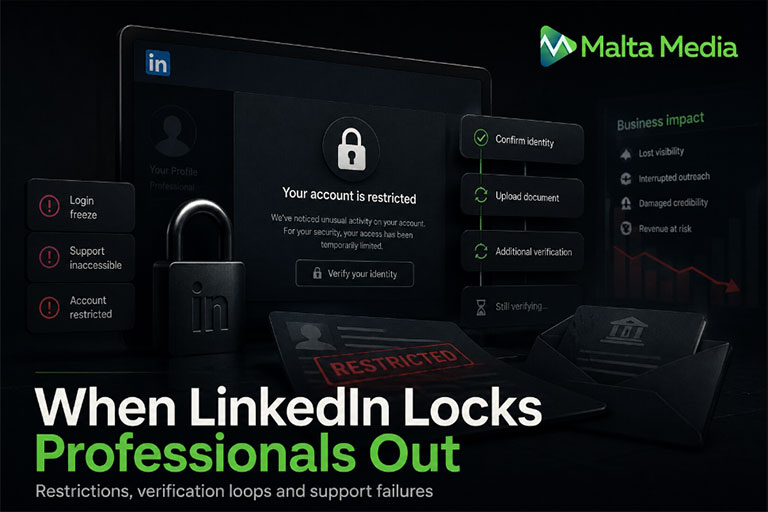
That is why the wider pattern now visible in recent Google reviews deserves closer attention. The complaints are not only about ordinary app bugs, design choices or user dissatisfaction with a social feed. Many users describe sudden account restrictions, failed verification, login freezes, CAPTCHA loops and support routes that appear difficult or impossible to use when the account itself is already restricted. When a platform controls professional visibility and then makes access recovery unclear, the issue becomes much bigger than user support.
A restriction is not a small thing when LinkedIn controls professional access!
The central issue is not whether LinkedIn should have rules. Of course it should. A professional network needs controls against spam, impersonation, fraud, fake accounts and abusive behaviour. The real question is whether LinkedIn applies those controls with enough transparency, consistency and human accountability when genuine users are locked out of their professional identity.
Recent public reviews raise uncomfortable questions. Users are not merely complaining that a button is ugly or that the feed is annoying. Many are saying their accounts were suddenly restricted, that identity verification failed, that the app sent them in circles and that they could not reach proper support because access to support itself depended on being logged in. That is a serious structural problem if the complaints are even partly representative of what real users are experiencing.
Subash Bind wrote that his account was suddenly restricted and that his “entire work depends on that” as a digital marketing executive. Syith Daniel described the situation more bluntly as “restricted and no way to fix”. Niranjan Moghe wrote that his account was restricted and he wanted it back. These are short reviews, but the message is clear enough. Users feel that access to their professional lives can be interrupted suddenly and without a practical remedy.
Other reviews provide more detail. Sumita wrote that both an account linked with email and one linked with a mobile number were not opening because of restrictions, and that there was allegedly no option on the website to properly report the issue. Mariam Tamer wrote that two LinkedIn accounts were restricted shortly after creation, each time followed by ID verification requests, while asking for a proper explanation and a route that did not require repeated verification demands. RAKSHIT described a first account being restricted and a second account repeatedly asking for identity verification without successful verification.
Whatever LinkedIn’s internal risk systems may have detected, users are publicly describing a process that feels opaque, repetitive and hostile.
The verification loop appears to be part of the damage
LinkedIn’s position will likely be that verification is necessary to protect users, prevent impersonation and preserve trust. That argument is not unreasonable in principle. But a verification system that does not work reliably can become part of the harm. If users are restricted first, then pushed into identity checks that fail, repeat or freeze, the platform has not solved a security problem. It has transferred the burden of a broken process onto the user.
Rishabh Pandey wrote that his account was suddenly restricted and that identity verification using valid government-issued documents repeatedly failed. He also said the app stated that his identity could not be verified without giving a clear explanation, and he criticised the lack of timely support and communication. Lily Smirnov pointed specifically to Persona identity verification, saying that changes to Indian PAN cards created a problem and that she could not log into her account. Prionti Barua wrote that Persona verification had been completed multiple times but that the process kept sending her back to the first screen and asking her to sign in again.
That kind of complaint is especially damaging for a company like LinkedIn because the platform is built on identity and trust. If the platform asks users to provide sensitive identity documents, then the process must be reliable, explainable and supported by a real escalation route. Users should not be left wondering whether their documents were rejected by a machine, whether the app failed or whether an invisible moderation decision has already been made.
The moment verification becomes a loop instead of a remedy, the system loses legitimacy.
Support that cannot be reached is not support
The most worrying theme is not simply that accounts are restricted. It is that users describe being unable to obtain meaningful support once that restriction happens. Shreesh Shet wrote that he had uploaded IDs many times, still had no access and had tried to appeal while facing errors. Shalini phoenixian wrote that more than a month had passed without help or a proper reply in relation to a temporarily restricted account. Mahendra Lakhan described being restricted, needing to send a request through the account and then facing the obvious contradiction that the account itself was already restricted.
This is where LinkedIn’s model becomes difficult to defend from a user perspective. If the platform can restrict access, the platform must also provide a route to challenge the restriction that does not depend on the very access that has been removed. A locked door cannot be the only entrance to the complaints desk. If users are told to log in to appeal, but they cannot log in because they are restricted, the process starts to look less like governance and more like a closed loop.
The same issue appears in reviews about technical failures. Muhammad Usama Aslam wrote that after logging out he could not log in again and that tapping “Continue with Google” produced no response, despite clearing cache, reinstalling and allowing permissions. Muhammad Saeed wrote that he was stuck on the login page and that no button was working, including join now, email and Google options. Sreelakshmi sajeev wrote that the official app was stuck on the login screen after updating email and password, while the browser version worked.
These reviews suggest that the support problem and the app problem may overlap, leaving users unable to access the platform and unable to resolve the reason why.
This does not look limited to unknown or inactive users
One defence often implied in platform disputes is that restrictions are aimed at spam, suspicious accounts or users who have violated rules. That may be true in many cases. But the pattern of public complaints should make LinkedIn cautious about assuming that every restriction is justified or every failed verification is the user’s fault. Many reviewers present themselves as students, jobseekers, digital marketers, professionals or people whose work depends on the platform.
The Malta Media case also shows that the impact can go beyond one individual login. The restriction of the personal account of our Editor-in-Chief affected not only his professional visibility, but also the wider presence of connected media brands. Malta Media itself was temporarily offline on LinkedIn before the team managed to recover the page through another administrator. Trider, Brannon, Easy Design and Michael Schmitt remain offline, which illustrates how quickly platform access problems can spread across a professional network of pages, publications and business relationships.
In the iGaming sector, we also understand that Max Tesla, CEO and co-founder of Blask, has recently faced a LinkedIn ban or restriction. This article does not claim that his case is identical to the Malta Media situation or to the Google reviews, and LinkedIn has not publicly explained that situation to our knowledge.
But the fact that the issue is being discussed among visible industry figures matters. When senior professionals, media operators, business owners, jobseekers and ordinary users all describe access problems, the issue becomes bigger than isolated account moderation.
LinkedIn cannot reasonably market itself as essential professional infrastructure while treating account access as if it were a discretionary favour. If a person’s professional network, business reputation and communication history are held inside one platform, restrictions need to be handled with a level of accountability that matches that power. A vague restriction, a failed verification screen and a support link that leads nowhere are not enough. They may be convenient for platform operations, but they are not good enough for users whose livelihoods, businesses and publications are affected.
The reputational risk now sits with LinkedIn
For LinkedIn, the reputational problem is obvious. The company is owned by Microsoft, one of the most powerful technology companies in the world. Users therefore expect a certain standard of engineering, support and accountability. When public reviews describe frozen login screens, CAPTCHA loops, broken identity checks and unreachable support, the gap between the brand promise and the user experience becomes very visible.
There is also a deeper trust issue. LinkedIn asks users to build their professional identity on its platform, to upload career histories, connect with clients, apply for jobs, manage company pages, buy Premium products and sometimes submit identity documents. If access can be removed without clear explanation and recovery can fail without human intervention, users will begin to ask whether LinkedIn has become too powerful for the level of accountability it offers. That question should concern regulators, employers, advertisers, media companies and the wider business community.
This is not about demanding that LinkedIn ignore security risks. It is about demanding that LinkedIn distinguish between genuine abuse and genuine users caught in automated or poorly supported enforcement systems. A professional platform should be able to explain restrictions, provide meaningful review, support users outside the login wall and ensure that identity verification works across countries, documents and devices. Anything less is not a professional standard.
The question LinkedIn needs to answer!!!
The uncomfortable question is simple. What happens when the professional identity platform becomes the party that users need protection from? Not because every restriction is wrong, and not because every review is automatically accurate, but because the process appears to leave too many users stuck, silent and unable to escalate.
When that happens, LinkedIn is no longer just moderating a network. It is deciding who can remain visible in parts of the professional economy.
The Malta Media case is now part of that wider question. The personal account of the Editor-in-Chief was restricted, the Malta Media page was temporarily offline, and other connected brands remain unavailable on LinkedIn.
Other users appear to be asking the same thing in different words: why was I restricted, why does verification not work, why can I not reach support and why does the platform not give me a clear route back?
Those are not unreasonable questions. They are the minimum questions any serious professional network should be able to answer.
LinkedIn can continue to treat these cases as individual support tickets, but the pattern is becoming harder to ignore. Restricted accounts, failed verification, app freezes and inaccessible support are not separate irritations when they all produce the same result. The user is locked out, the explanation is unclear and the remedy does not function properly. For a platform that depends on trust, that is not a technical glitch. It is a credibility problem.
Why affected LinkedIn users should consider legal advice?
Malta Media has now engaged WBS.LEGAL again in relation to the restriction of the personal LinkedIn account of our Editor-in-Chief and the wider consequences this has created for our professional visibility, business communication and media work. From our experience, this kind of situation should not simply be accepted as a normal platform inconvenience, especially when a professional account is restricted without a clear route to meaningful human review.
The fact that Malta Media was temporarily offline and that Trider, Brannon, Easy Design and Michael Schmitt remain offline shows how quickly these decisions can affect more than one account.
Anyone facing a similar issue should consider taking proper legal advice and documenting the full timeline, including screenshots, support replies, verification attempts and the business impact caused by the restriction. A short email to WBS.LEGAL at info@wbs.legal, marked for the attention of Vivian Trebst or Mila Markova, may be a practical first step for users who do not know where to begin.
In our experience, they understand these platform-access problems very well, they are efficient and they are able to assess quickly whether a case is worth pursuing.
FAQs
What are LinkedIn account restrictions?
LinkedIn account restrictions are limitations placed on user accounts when the platform detects potential security concerns, policy violations or unusual activity. Restricted users may temporarily lose access to their profiles and services.
Why does LinkedIn restrict user accounts?
LinkedIn may restrict accounts to prevent spam, fraud, fake profiles, impersonation or other activities that appear to violate its policies. In some cases, users report restrictions occurring without a clear explanation.
How can I recover a restricted LinkedIn account?
Users can typically attempt account recovery by completing LinkedIn's identity verification process, submitting an appeal and following the instructions provided by the platform. Recovery times may vary.
What is Persona verification on LinkedIn?
Persona verification is an identity verification service used by LinkedIn in certain cases to confirm a user's identity through official documents before restoring account access.
What should I do if LinkedIn identity verification keeps failing?
If verification repeatedly fails, ensure your identification documents are valid, the uploaded images are clear and all requested information matches your LinkedIn profile. If the issue continues, contact LinkedIn support and keep records of your submissions.
Can LinkedIn account restrictions affect business pages?
Yes. If a page administrator's account is restricted, access to connected company pages and business communications may be affected until another administrator restores access or the restriction is resolved.
What problems do users commonly report after account restrictions?
Common complaints include failed identity verification, login errors, CAPTCHA loops, limited access to support, delayed responses and difficulty appealing account restrictions.
Does LinkedIn provide support for restricted accounts?
LinkedIn offers support resources and appeal options, although some users report challenges accessing support when they cannot log into their accounts.
When should someone consider seeking legal advice over a LinkedIn restriction?
If a restriction causes significant business disruption, financial loss or prevents access to important professional assets and normal support channels do not resolve the issue, obtaining independent legal advice may be appropriate.
Why are LinkedIn account restrictions becoming a trust issue?
Many professionals rely on LinkedIn for networking, recruitment, business development and communication. When users experience unexplained restrictions, verification issues or limited support, concerns about platform transparency and reliability may increase.
I have over 10 years' experience proofreading and editing where spelling and grammar were paramount. This includes newspaper publication and designing advertisements. I personally write all my articles.This allows me to do in-depth research and provide premium content.


















by Lela
June 24, 2026
in Opinion & Commentary
238
LinkedIn’s account restrictions are becoming a trust problem, not just a user-support issue
LinkedIn presents itself as the professional identity layer of the internet. It is where people build their reputation, maintain business relationships, apply for jobs, publish expert commentary, manage company pages and communicate with clients. For many professionals and media companies, LinkedIn is not simply another social media app that can be ignored for a few days when something goes wrong. It has become part of their working infrastructure, which is why account restrictions should not be treated as a minor technical inconvenience.
At Malta Media, this issue is no longer theoretical. The personal LinkedIn account of our Editor-in-Chief, Michael Schmitt, was restricted, creating immediate consequences for professional visibility, business communication and media distribution. The Malta Media LinkedIn page also went offline during this situation, although the team was eventually able to claim the page back through another admin. However, other connected profiles and pages, including Trider, Brannon, Easy Design and Michael Schmitt, remain offline, which shows how quickly one platform decision can affect a wider professional and commercial ecosystem.
That is why the wider pattern now visible in recent Google reviews deserves closer attention. The complaints are not only about ordinary app bugs, design choices or user dissatisfaction with a social feed. Many users describe sudden account restrictions, failed verification, login freezes, CAPTCHA loops and support routes that appear difficult or impossible to use when the account itself is already restricted. When a platform controls professional visibility and then makes access recovery unclear, the issue becomes much bigger than user support.
A restriction is not a small thing when LinkedIn controls professional access!
The central issue is not whether LinkedIn should have rules. Of course it should. A professional network needs controls against spam, impersonation, fraud, fake accounts and abusive behaviour. The real question is whether LinkedIn applies those controls with enough transparency, consistency and human accountability when genuine users are locked out of their professional identity.
Recent public reviews raise uncomfortable questions. Users are not merely complaining that a button is ugly or that the feed is annoying. Many are saying their accounts were suddenly restricted, that identity verification failed, that the app sent them in circles and that they could not reach proper support because access to support itself depended on being logged in. That is a serious structural problem if the complaints are even partly representative of what real users are experiencing.
Subash Bind wrote that his account was suddenly restricted and that his “entire work depends on that” as a digital marketing executive. Syith Daniel described the situation more bluntly as “restricted and no way to fix”. Niranjan Moghe wrote that his account was restricted and he wanted it back. These are short reviews, but the message is clear enough. Users feel that access to their professional lives can be interrupted suddenly and without a practical remedy.
Other reviews provide more detail. Sumita wrote that both an account linked with email and one linked with a mobile number were not opening because of restrictions, and that there was allegedly no option on the website to properly report the issue. Mariam Tamer wrote that two LinkedIn accounts were restricted shortly after creation, each time followed by ID verification requests, while asking for a proper explanation and a route that did not require repeated verification demands. RAKSHIT described a first account being restricted and a second account repeatedly asking for identity verification without successful verification.
Whatever LinkedIn’s internal risk systems may have detected, users are publicly describing a process that feels opaque, repetitive and hostile.
The verification loop appears to be part of the damage
LinkedIn’s position will likely be that verification is necessary to protect users, prevent impersonation and preserve trust. That argument is not unreasonable in principle. But a verification system that does not work reliably can become part of the harm. If users are restricted first, then pushed into identity checks that fail, repeat or freeze, the platform has not solved a security problem. It has transferred the burden of a broken process onto the user.
Rishabh Pandey wrote that his account was suddenly restricted and that identity verification using valid government-issued documents repeatedly failed. He also said the app stated that his identity could not be verified without giving a clear explanation, and he criticised the lack of timely support and communication. Lily Smirnov pointed specifically to Persona identity verification, saying that changes to Indian PAN cards created a problem and that she could not log into her account. Prionti Barua wrote that Persona verification had been completed multiple times but that the process kept sending her back to the first screen and asking her to sign in again.
That kind of complaint is especially damaging for a company like LinkedIn because the platform is built on identity and trust. If the platform asks users to provide sensitive identity documents, then the process must be reliable, explainable and supported by a real escalation route. Users should not be left wondering whether their documents were rejected by a machine, whether the app failed or whether an invisible moderation decision has already been made.
The moment verification becomes a loop instead of a remedy, the system loses legitimacy.
Support that cannot be reached is not support
The most worrying theme is not simply that accounts are restricted. It is that users describe being unable to obtain meaningful support once that restriction happens. Shreesh Shet wrote that he had uploaded IDs many times, still had no access and had tried to appeal while facing errors. Shalini phoenixian wrote that more than a month had passed without help or a proper reply in relation to a temporarily restricted account. Mahendra Lakhan described being restricted, needing to send a request through the account and then facing the obvious contradiction that the account itself was already restricted.
This is where LinkedIn’s model becomes difficult to defend from a user perspective. If the platform can restrict access, the platform must also provide a route to challenge the restriction that does not depend on the very access that has been removed. A locked door cannot be the only entrance to the complaints desk. If users are told to log in to appeal, but they cannot log in because they are restricted, the process starts to look less like governance and more like a closed loop.
The same issue appears in reviews about technical failures. Muhammad Usama Aslam wrote that after logging out he could not log in again and that tapping “Continue with Google” produced no response, despite clearing cache, reinstalling and allowing permissions. Muhammad Saeed wrote that he was stuck on the login page and that no button was working, including join now, email and Google options. Sreelakshmi sajeev wrote that the official app was stuck on the login screen after updating email and password, while the browser version worked.
These reviews suggest that the support problem and the app problem may overlap, leaving users unable to access the platform and unable to resolve the reason why.
This does not look limited to unknown or inactive users
One defence often implied in platform disputes is that restrictions are aimed at spam, suspicious accounts or users who have violated rules. That may be true in many cases. But the pattern of public complaints should make LinkedIn cautious about assuming that every restriction is justified or every failed verification is the user’s fault. Many reviewers present themselves as students, jobseekers, digital marketers, professionals or people whose work depends on the platform.
The Malta Media case also shows that the impact can go beyond one individual login. The restriction of the personal account of our Editor-in-Chief affected not only his professional visibility, but also the wider presence of connected media brands. Malta Media itself was temporarily offline on LinkedIn before the team managed to recover the page through another administrator. Trider, Brannon, Easy Design and Michael Schmitt remain offline, which illustrates how quickly platform access problems can spread across a professional network of pages, publications and business relationships.
In the iGaming sector, we also understand that Max Tesla, CEO and co-founder of Blask, has recently faced a LinkedIn ban or restriction. This article does not claim that his case is identical to the Malta Media situation or to the Google reviews, and LinkedIn has not publicly explained that situation to our knowledge.
But the fact that the issue is being discussed among visible industry figures matters. When senior professionals, media operators, business owners, jobseekers and ordinary users all describe access problems, the issue becomes bigger than isolated account moderation.
LinkedIn cannot reasonably market itself as essential professional infrastructure while treating account access as if it were a discretionary favour. If a person’s professional network, business reputation and communication history are held inside one platform, restrictions need to be handled with a level of accountability that matches that power. A vague restriction, a failed verification screen and a support link that leads nowhere are not enough. They may be convenient for platform operations, but they are not good enough for users whose livelihoods, businesses and publications are affected.
The reputational risk now sits with LinkedIn
For LinkedIn, the reputational problem is obvious. The company is owned by Microsoft, one of the most powerful technology companies in the world. Users therefore expect a certain standard of engineering, support and accountability. When public reviews describe frozen login screens, CAPTCHA loops, broken identity checks and unreachable support, the gap between the brand promise and the user experience becomes very visible.
There is also a deeper trust issue. LinkedIn asks users to build their professional identity on its platform, to upload career histories, connect with clients, apply for jobs, manage company pages, buy Premium products and sometimes submit identity documents. If access can be removed without clear explanation and recovery can fail without human intervention, users will begin to ask whether LinkedIn has become too powerful for the level of accountability it offers. That question should concern regulators, employers, advertisers, media companies and the wider business community.
This is not about demanding that LinkedIn ignore security risks. It is about demanding that LinkedIn distinguish between genuine abuse and genuine users caught in automated or poorly supported enforcement systems. A professional platform should be able to explain restrictions, provide meaningful review, support users outside the login wall and ensure that identity verification works across countries, documents and devices. Anything less is not a professional standard.
The question LinkedIn needs to answer!!!
The uncomfortable question is simple. What happens when the professional identity platform becomes the party that users need protection from? Not because every restriction is wrong, and not because every review is automatically accurate, but because the process appears to leave too many users stuck, silent and unable to escalate.
When that happens, LinkedIn is no longer just moderating a network. It is deciding who can remain visible in parts of the professional economy.
The Malta Media case is now part of that wider question. The personal account of the Editor-in-Chief was restricted, the Malta Media page was temporarily offline, and other connected brands remain unavailable on LinkedIn.
Other users appear to be asking the same thing in different words: why was I restricted, why does verification not work, why can I not reach support and why does the platform not give me a clear route back?
Those are not unreasonable questions. They are the minimum questions any serious professional network should be able to answer.
LinkedIn can continue to treat these cases as individual support tickets, but the pattern is becoming harder to ignore. Restricted accounts, failed verification, app freezes and inaccessible support are not separate irritations when they all produce the same result. The user is locked out, the explanation is unclear and the remedy does not function properly. For a platform that depends on trust, that is not a technical glitch. It is a credibility problem.
Why affected LinkedIn users should consider legal advice?
Malta Media has now engaged WBS.LEGAL again in relation to the restriction of the personal LinkedIn account of our Editor-in-Chief and the wider consequences this has created for our professional visibility, business communication and media work. From our experience, this kind of situation should not simply be accepted as a normal platform inconvenience, especially when a professional account is restricted without a clear route to meaningful human review.
The fact that Malta Media was temporarily offline and that Trider, Brannon, Easy Design and Michael Schmitt remain offline shows how quickly these decisions can affect more than one account.
Anyone facing a similar issue should consider taking proper legal advice and documenting the full timeline, including screenshots, support replies, verification attempts and the business impact caused by the restriction. A short email to WBS.LEGAL at info@wbs.legal, marked for the attention of Vivian Trebst or Mila Markova, may be a practical first step for users who do not know where to begin.
In our experience, they understand these platform-access problems very well, they are efficient and they are able to assess quickly whether a case is worth pursuing.
FAQs
What are LinkedIn account restrictions?
LinkedIn account restrictions are limitations placed on user accounts when the platform detects potential security concerns, policy violations or unusual activity. Restricted users may temporarily lose access to their profiles and services.
Why does LinkedIn restrict user accounts?
LinkedIn may restrict accounts to prevent spam, fraud, fake profiles, impersonation or other activities that appear to violate its policies. In some cases, users report restrictions occurring without a clear explanation.
How can I recover a restricted LinkedIn account?
Users can typically attempt account recovery by completing LinkedIn's identity verification process, submitting an appeal and following the instructions provided by the platform. Recovery times may vary.
What is Persona verification on LinkedIn?
Persona verification is an identity verification service used by LinkedIn in certain cases to confirm a user's identity through official documents before restoring account access.
What should I do if LinkedIn identity verification keeps failing?
If verification repeatedly fails, ensure your identification documents are valid, the uploaded images are clear and all requested information matches your LinkedIn profile. If the issue continues, contact LinkedIn support and keep records of your submissions.
Can LinkedIn account restrictions affect business pages?
Yes. If a page administrator's account is restricted, access to connected company pages and business communications may be affected until another administrator restores access or the restriction is resolved.
What problems do users commonly report after account restrictions?
Common complaints include failed identity verification, login errors, CAPTCHA loops, limited access to support, delayed responses and difficulty appealing account restrictions.
Does LinkedIn provide support for restricted accounts?
LinkedIn offers support resources and appeal options, although some users report challenges accessing support when they cannot log into their accounts.
When should someone consider seeking legal advice over a LinkedIn restriction?
If a restriction causes significant business disruption, financial loss or prevents access to important professional assets and normal support channels do not resolve the issue, obtaining independent legal advice may be appropriate.
Why are LinkedIn account restrictions becoming a trust issue?
Many professionals rely on LinkedIn for networking, recruitment, business development and communication. When users experience unexplained restrictions, verification issues or limited support, concerns about platform transparency and reliability may increase.
Lela
I have over 10 years' experience proofreading and editing where spelling and grammar were paramount. This includes newspaper publication and designing advertisements. I personally write all my articles.This allows me to do in-depth research and provide premium content.
Related Posts
SBC Summit Unveils Compliance Tech Track for 2026 Conference Agenda
August 27, 2026
SBC Summit fintech track highlights for 2026
July 10, 2026
Why LinkedIn’s low Trustpilot rating matters to businesses
June 29, 2026
Would you trust LinkedIn with a 1.2 rating?
June 27, 2026
ClearStake raises £1.5M to expand UK iGaming verification
November 5, 2025
Evolution’s great escape into the shadows?
October 22, 2025
Yaspa unveils new brand identity to drive global growth
October 16, 2025
UK Gambling Commission leadership under Andrew Rhodes
September 16, 2025
Nardy Cramm Exposes Curaçao’s Offshore Gaming Network
August 15, 2025