

















German gambling safeguards face test over cash-funded betting wallets
Prof. Grzeszick’s defence of SCHUFA G: does the theory match the market?
Professor Bernd Grzeszick's defence of SCHUFA G is stronger than the slogan normally used to attack it. He does not treat a credit score as a payslip or a live bank balance. His case is that Germany may choose a workable system balancing player protection with channelisation, and that SCHUFA G should be judged as part of a wider control chain rather than in isolation.
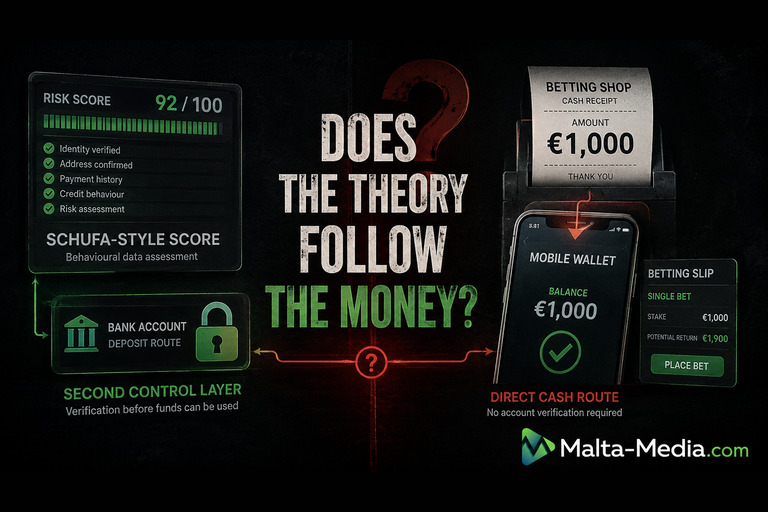
The most interesting link in that chain appears near the end of a November 2025 presentation reviewed by Malta Media. Grzeszick described the funding of regulated gambling as a kind of “prepaid model”. Before a player can lose money, he argued, the money normally has to be deposited from an authorised bank account. Gambling operators are prohibited from extending credit, while a bank already knows its customer and may have assessed any overdraft or other credit facility. The deposit therefore provides what he called another control layer before the risk becomes real.
Now place that reasoning beside the Shop Geldbörse Plus files examined in the previous article in this series. One June test dossier presents a customer with a provider-wide LUGAS limit of €50, a €1,000 cash deposit at a Tipwin shop and a mobile Tipwin wager afterwards. Other files present smaller cash deposits entering the same wallet before betting through the app away from the counter. The material is not an official regulatory finding, but the customer journey it describes does not begin with a transfer from the player's bank account.










That does not prove SCHUFA G is unlawful. It does not prove that Tipwin's product breaches German gambling law and it does not show that the customer lacked the means to spend the cash. It does something narrower and more useful: it tests a factual assumption built into the professor's additional safeguard. If cash can become remotely spendable betting credit, the bank is not always the second lock.
Grzeszick's formal assignment concerned state liability for continued use of SCHUFA G when higher limits are approved. A conclusion that officials presently face no damages liability does not establish that every payment route is controlled. This article asks whether the market shown by the evidence still matches the market assumed by the theory.
First, give Grzeszick his strongest case
Prof. Dr Bernd Grzeszick, LL.M. is not a casual commentator on public liability. He directs Heidelberg University's Institute for Constitutional Law, Constitutional Theory and Legal Philosophy and has been a member of the Constitutional Court of North Rhine-Westphalia since 2021. Heidelberg University's publication record lists a 28-page 2025 opinion commissioned by the German Sports Betting Association and the German Online Casino Association on state liability arising from the use of SCHUFA G for higher limits under §6c of the Glücksspielstaatsvertrag.
The commissioning context should be stated because industry bodies had an obvious interest in defending a fast and commercially usable limit-increase process. It should not be used as a substitute for analysing the argument. A legal opinion can be funded by interested parties and still identify genuine weaknesses in the opposing position. The serious question is whether its reasoning survives the facts, not who paid for the paper.
Grzeszick began from a conflict written into Germany's gambling system. The treaty seeks to prevent addiction and protect players, but it also seeks to channel demand into a legal and supervised market. A rule that is maximally restrictive in one direction may weaken the other objective by driving customers towards illegal operators that apply no comparable controls. In his analysis, the authority therefore has a margin within which it can choose an imperfect but proportionate method.
That is important because the legal standard is not zero risk. No affordability check can guarantee that every approved player will remain solvent, avoid harmful gambling or use only money that can comfortably be lost. Grzeszick's position is that isolated failures or later over-indebtedness do not by themselves invalidate a system that is broadly predictive, less intrusive than the alternatives and capable of keeping higher-value customers in the regulated market.
That is the strongest version of his case, and it deserves to be engaged with at that level. A fair criticism cannot merely point to one distressed customer and declare the entire score meaningless. It has to show either that the method does not answer the statutory question or that the wider safeguards on which its proportionality depends are materially weaker than the theory assumes.
What SCHUFA G is meant to solve
Under §6c of the Glücksspielstaatsvertrag 2021, the ordinary provider-wide monthly deposit limit for covered online gambling is €1,000. The framework also permits higher limits where the operator is authorised to grant them and the player shows sufficient economic capacity without presenting signs of gambling harm. The GGL's current FAQ says ordinary higher limits can reach €10,000, with a tightly restricted group potentially reaching €30,000 under additional conditions.
The practical problem is obvious. A regulator can write that economic capacity must be demonstrated in a suitable and verifiable way, but the legal market needs a process that can be applied repeatedly, quickly and consistently. Manual examination of tax assessments, salary records, account statements and other documents creates delay, judgement calls and substantial operational cost. It also creates a strong incentive for a customer who dislikes the process to use an illegal website instead.
Grzeszick described SCHUFA G as a comparatively powerful and low-burden answer. It builds on SCHUFA's broad data environment, experience and established scoring processes. At the higher score levels, he said, longer-term observations provide meaningful support for the proposition that a person will remain able and willing to meet financial obligations. The inquiry runs in the background with consent and does not itself damage the person's general score.
His presentation also addressed a newer generation of the product. According to the transcript, a positive output would be restricted to adults, require at least six months of SCHUFA history and distinguish negative features with greater precision. Those changes could reduce the risk that a person with no meaningful domestic credit footprint receives an apparently reassuring result. They do not turn a credit score into a live statement of income, but they strengthen the dataset on which the classification depends.
The attraction is clear. SCHUFA G offers a scalable answer to a question that otherwise becomes slow, intrusive and uneven. It gives the legal market a low-friction route for higher limits while behavioural monitoring addresses harmful play separately. That is more sophisticated than the claim that an operator merely checks for unpaid bills and opens a €10,000 allowance.
Why he distrusts the supposedly tougher alternatives
Grzeszick's criticism of account-view procedures is particularly relevant because it is not simply an argument for convenience. The obvious claim in favour of an account view is that it shows what the player actually earns, spends and holds, rather than relying on a credit-risk prediction. His answer is that the apparent precision can be misleading.
An account-view provider normally sees the account to which access has been granted. Many consumers use several current accounts, savings products, payment apps and electronic wallets. A person can move difficult transactions elsewhere before opening one account for review or allow the reviewer to see a carefully prepared fragment of the financial picture. Grzeszick argued that the inspected account can therefore be “beautified” in a way that is harder to achieve against SCHUFA's wider third-party dataset.
He also focused on the privacy cost. A complete account history reveals far more than affordability. It can expose medical payments, subscriptions, political donations, relationships, travel, purchases and other details with no direct relevance to a gambling limit. In the presentation, he referred to a trial in which the combined refusal and abandonment rate for an account-view process exceeded 70%. Even if the precise result cannot be generalised across the market, it demonstrates why a theoretically stronger check may perform badly as a channelisation tool.
Document uploads create a different version of the same problem. Tax notices and income evidence can be useful, but they remain snapshots that require interpretation. They also force the customer through a manual process involving scanning, uploading and waiting. The operator or outsourced reviewer may have less experience than SCHUFA in turning incomplete financial information into a consistent prediction.
This is where Grzeszick is persuasive. More data is not automatically better regulation. An intrusive method can miss hidden accounts, be manipulated and produce inconsistent decisions. If many customers abandon the legal process, the regulator must weigh that channelisation loss against the improvement in protection.
The bank is supposed to be the second lock
The score is only the first part of Grzeszick's defence. His additional argument is that the practical funding of gambling imposes another barrier before the approved limit becomes a real loss. The customer must normally deposit money through an authorised account. The operator cannot lend the stake, and the payment must come from funds already available to the customer or from credit granted by a financial institution that knows the account holder.
This is a clever move because it answers one of the central objections to SCHUFA G. Critics say the score does not show that a player has €10,000 available to lose in a particular month. Grzeszick responds that the score is not the final moment of risk. Even after a higher limit is permitted, the player still has to fund the account through a regulated banking relationship. In his model, the score and the payment channel work together.
The argument is strongest where a player uses a bank transfer or debit payment from an account held in the same name. The transaction creates traceability, limits anonymous funding and makes operator credit unavailable. Where an overdraft is used, the bank may indeed have made a separate credit decision. This does not establish that the gambling loss is wise, but it adds friction and another identifiable institution to the chain.
There are limits even in that conventional setting. Holding a bank account does not mean the bank has made a fresh judgement that a particular gambling payment is affordable. Money can be present because salary has just arrived, because savings are being depleted or because essential household funds are being redirected. A payment system can confirm that money exists and that the account belongs to the customer without deciding whether losing it is economically sustainable.
That weakness does not make the second-layer argument worthless. Regulation often relies on several imperfect controls rather than one perfect answer. A broad creditworthiness check, a verified bank-account link, a prohibition on operator credit and behavioural monitoring can collectively reduce risk even where none proves disposable income on its own. The difficulty arises when one of those layers disappears from a product that still delivers the same remote betting experience.
Shop Geldbörse Plus puts cash into the gap
The first September investigation in this series examined several files concerning Tipwin's Shop Geldbörse Plus. The clearest was a test dossier dated 15 June 2026. It presented a customer whose current and remaining provider-wide LUGAS limit was €50, followed by a receipt from a Tipwin branch in Neuss recording a €1,000 cash deposit into Shop Geldbörse Plus. A Tipwin account screen then recorded the deposit and a mobile wager, while a later image presented a successful bet at Neobet.
An April dossier showed the same architecture at a smaller scale. A Neobet screen displayed a €50 LUGAS limit. Tipwin material then appeared to show €100 entering Shop Geldbörse Plus, followed by a mobile Tipwin wager and another Neobet bet. Files from Hesse, Munich and Schleswig-Holstein also described or documented shop cash becoming an app-visible balance used away from the counter.
These files require the same caution applied in Article 7. They are screenshots, receipts, test notes and letters, not a server audit or GGL decision. Malta Media has not seen Tipwin's complete licence conditions, back-end classification or every LUGAS message. Tipwin may have a lawful explanation and the testers may have misunderstood part of the architecture.
Cash itself is not evidence of financial distress. A customer paying €1,000 over a counter may be wealthier than somebody transferring €100 from a bank account. Nor does the absence of an electronic payment automatically mean the money is untraceable, because the shop may identify the customer, issue a receipt and record the transaction centrally. The point is not that cash is inherently unsafe.
The point is that Grzeszick's banking safeguard is absent from the transaction as presented. No authorised bank account stands between the customer and the €1,000 credit added at the shop. No bank is shown confirming ownership of the funding account, screening an overdraft or creating the second layer on which the professor placed weight. The money reaches a wallet through a cashier or terminal.
That still would not matter to SCHUFA G if the balance could be used only for a conventional shop bet completed and supervised inside the premises. The regulatory question changes when the wallet appears in an app and the customer can place the wager later from a smartphone or computer. The product then seems to combine the funding route of a betting shop with the accessibility of online gambling.
The cash-wallet evidence is therefore not a direct rebuttal of Grzeszick's opinion. The files do not concern a player whose limit rose from €1,000 to €10,000 through SCHUFA G. They present a separate wallet apparently operating beside a lower selected limit. Their relevance is narrower: if remotely wagerable funds can enter without the assumed bank gate, banking cannot be described as a universal second safeguard.
The treaty already recognises the hybrid boundary
Germany's treaty does not leave the relationship between shop payments and online accounts entirely to product branding. Section 21a(4) says payments made for bets in a betting shop are generally not counted towards the provider-wide internet deposit limit. It then creates a decisive exception: if deposits or winnings from shop sports bets are credited to the player's account under §6a and can be used as stakes for gambling on the internet, those funds must be captured by the §6c limit.
That wording is almost a legal diagram of the Shop Geldbörse Plus question. A cash payment can remain a retail payment, but the exception depends on what the balance becomes and where it can be used. Calling a wallet “shop” does not answer whether the money is credited to the relevant player account or whether the later mobile wager is internet gambling. The technical path and legal classification have to match.
Tipwin's strongest possible defence is straightforward. It may argue that the app is only a remote instruction channel for a wager legally concluded through the originating shop, that the wallet is ring-fenced from the ordinary online account and that every transaction is attributed to the retail permission. If the licence conditions, system design and applicable state rules support that position, the customer journey may be legally different from an ordinary online deposit even though it looks similar on a phone.
The opposite possibility is equally clear. If cash is credited to an account that the customer can use independently for internet gambling, Section 21a(4) appears designed to prevent the retail label from becoming a route around the cross-provider limit. The GGL's LUGAS supervision and the state authority responsible for the shop would then need a common account of how the transaction is recorded.
This is not a minor classification argument. The legal market cannot claim that LUGAS gives a customer one provider-wide limit while allowing the practical meaning of that limit to change according to the wallet selected inside an app. Either the mobile balance falls inside the central protection or another legally equivalent control has to be identified and explained.
His criticism of account-view comes back against cash
There is an uncomfortable symmetry here. Grzeszick criticised account-view because it sees only one account while consumers can hold other accounts, wallets and payment instruments outside the picture. That is a strong criticism of any claim that one banking feed reveals the customer's complete finances. Yet the same reasoning makes a cash-funded app wallet difficult to dismiss.
If an account view is incomplete because money can sit in a wallet beyond the inspected account, a betting wallet funded directly with cash is an even clearer blind spot for the banking layer. It may be fully visible to Tipwin and the shop, but it is not visible because a bank evaluated the particular payment. The additional safeguard has moved from an external financial institution to the gambling distribution network itself.
The distinction between creditworthiness and economic capacity also remains unresolved. SCHUFA can estimate the risk that a person will fail to meet financial obligations. It does not ordinarily report current salary, bank balance, rent, dependants or the amount that can safely be lost to gambling that month. Germany's official interim evaluation recorded the Fachbeirat's position that a score alone was not sufficient because it did not permit conclusions about actual economic capacity.
The GGL's language has become more careful as well. Its FAQ, updated on 25 August 2026, says players must demonstrate capacity in a suitable and verifiable way, gives tax assessments, other income evidence and bank statements as examples and states that the creditworthiness information previously used is now the subject of intensive legal discussion and court proceedings. That is not an official declaration that SCHUFA G can never be used. It is an acknowledgement that its suitability is no longer treated as a settled technical fact.
Grzeszick's proportionality argument can accommodate some uncertainty. A regulator may choose a less intrusive method if it performs sufficiently well and protects channelisation. What it cannot do is rely on a system-wide safeguard that applies only to some funding rails while unexplained hybrid products use others. The market test therefore becomes broader than whether the score predicts default: does every route by which higher-risk money becomes remotely wagerable pass through controls equivalent to those used to justify the system?
The OVG decision was not a laboratory validation
Grzeszick also relied on the OVG Sachsen-Anhalt decision of 2 December 2024. In his presentation, he treated two passages as important support: the court saw no evidence at that time of systematic official tolerance of an impermissible expansion, and it was not shown that departures from the capacity requirements had become the rule rather than the exception. He read the decision as confirmation that SCHUFA G was fundamentally capable of doing the job.
The judgment deserves a narrower description. The OVG did not run an empirical study of SCHUFA G and certify it as a direct measure of affordability. Its reasoning expressly considered the possibility that a SCHUFA inquiry might show only creditworthiness rather than concrete economic capacity, and that actual capacity shown by income evidence could be lower. The court then focused on whether the available material established a sufficiently systematic enforcement deficit.
That distinction is central. A court can conclude that a regulatory system is not yet shown to be structurally incoherent without finding that every accepted proof method is substantively ideal. The legal threshold in a case about enforcement against illegal gambling and payment participation is not identical to the policy question of whether a score measures what §6c calls economic capacity.
Grzeszick was entitled to use the decision in his liability analysis. If a higher administrative court had recently declined to find the required systemic defect, that weighs strongly against alleging culpable official conduct and damages exposure. His no-liability conclusion can therefore be legally plausible even if the underlying assessment method remains contested.
The problem comes only when that limited judicial support is converted into a broader statement that the market architecture has been validated. The court did not examine Shop Geldbörse Plus, the June 2026 cash deposit or every hybrid funding method now available. A 2024 decision about the evidence then before the court cannot answer a 2026 factual question that was not presented to it.
What would make the theory survive the market test?
The answer does not require abandoning SCHUFA G by reflex. It requires regulators to map the complete path from approval to spend. A higher-limit method should be assessed together with every bank transfer, card payment, payment service, voucher, shop counter and wallet through which the customer can turn money into remotely usable gambling credit.
Four explanations could resolve the apparent gap. The cash may enter LUGAS once it becomes app-usable. The wallet may be ring-fenced to fund only a retail bet concluded through the shop. Tipwin may apply an equivalent capacity and player-protection check at the cash stage. Or specific licence conditions may define and supervise the hybrid route in another lawful way.
Each possibility is testable. The GGL and state authorities can examine account identifiers, transaction categories, timestamps, Safe Server records, LUGAS calls and the point at which the wager is concluded. They can establish whether the app transmits a shop order or enables internet participation, and whether the €50 limit and €1,000 wallet may lawfully coexist.
A regulator does not need to publish customer data or proprietary code to explain the result. It can say which category the product occupies, whether the deposits are captured by LUGAS, what alternative protection applies and whether the test sequence was reproduced. That would protect Tipwin if the architecture is compliant and would improve the wider debate about hybrid retail products.
Grzeszick's model could survive this scrutiny. If cash-funded mobile balances are either counted centrally or subjected to an equivalent verified control, the missing bank transaction may be replaced by another defensible safeguard. But that safeguard has to exist in the system, not merely in the theory. A chain is not strengthened by calling a missing link someone else's responsibility.
The professor's own method points towards the answer. He compared effectiveness, intrusiveness and channelisation rather than demanding perfection. Apply that discipline to cash-funded wallets: measure how they are funded, classified, monitored and limited, then decide whether total protection remains sufficient.
Our final thoughts and conclusion
Prof. Grzeszick's defence of SCHUFA G should not be dismissed as industry advocacy in constitutional language. It identifies real trade-offs, exposes weaknesses in account-view systems and explains why a low-friction process may protect the legal market better than a supposedly perfect check that customers refuse to complete.
His bank-account argument is also more serious than critics acknowledge. In conventional online gambling, verified account ownership, traceable payments, the prohibition on operator credit and behavioural monitoring can add protection around a score that does not directly measure income. The system can be reasonable without being infallible.
The Shop Geldbörse Plus evidence nevertheless exposes a factual limit. A theory designed around account-funded online gambling cannot be treated as complete while cash-funded mobile wallets remain unexplained. If the money never passes through the bank, the claimed second control layer does not operate in the form Grzeszick described. If the wallet is outside LUGAS as well, the gap becomes more than academic.
None of that establishes a breach by Tipwin or an unlawful policy by the GGL. It establishes the need for an answer. Is the cash-funded mobile balance a retail product, an internet account or an approved hybrid? Which limit captures it, which institution supplies the missing safeguard and what evidence shows that the customer receives protection equivalent to the one used to defend SCHUFA G?
The professor's theory may still match the German market. It cannot serve as a complete defence until regulators show that every route from money to mobile betting is covered. That includes the door marked cash.
FAQs
What is SCHUFA G in German gambling?
SCHUFA G is used as a creditworthiness-based assessment that can support decisions on higher online gambling deposit limits. Its attraction is that it provides a scalable and relatively low-friction alternative to manually reviewing income documents and bank statements.
What is the standard monthly gambling deposit limit in Germany?
Under §6c of the Glücksspielstaatsvertrag 2021, the standard provider-wide monthly deposit limit for covered online gambling is €1,000. Higher limits can be permitted when relevant requirements concerning economic capacity and player protection are met.
Why is SCHUFA G controversial in gambling affordability checks?
The central issue is that creditworthiness is not the same as current economic capacity. SCHUFA may help predict whether someone will meet financial obligations, but it does not normally show current salary, bank balance, household costs or how much a person can safely afford to lose through gambling.
What is Grzeszick’s argument in favour of SCHUFA G?
Prof. Bernd Grzeszick argues that Germany can use a proportionate system that balances player protection with channelisation into the regulated gambling market. He maintains that SCHUFA G should be considered alongside other safeguards rather than judged as a standalone affordability measure.
Why does the banking system matter to Grzeszick’s argument?
His reasoning assumes that gambling funds normally pass through an authorised bank account before they can be lost. Together with restrictions on operator credit and other controls, the banking relationship is presented as an additional safeguard after the SCHUFA assessment.
How does Shop Geldbörse Plus challenge the banking safeguard theory?
The reviewed material describes cash being deposited at Tipwin shops and subsequently appearing as an app-visible balance used for betting. If remotely usable gambling funds can enter through cash without passing through an authorised bank account, the assumed banking safeguard may not apply to every funding route.
Does the evidence prove that Tipwin breached German gambling law?
No. The material consists of screenshots, receipts, test notes and correspondence rather than a regulatory decision or complete technical audit. The article expressly states that Tipwin may have a lawful explanation for how Shop Geldbörse Plus is classified and operated.
How does LUGAS relate to cash-funded betting wallets?
The key question is whether money deposited through a shop but later usable for internet gambling is captured by the provider-wide limit system. Section 21a(4) provides an exception under which certain shop funds credited to a player account and usable for online gambling must be counted towards the §6c limit.
Why are account-view affordability checks also criticised?
Grzeszick argues that account-view systems may provide an incomplete picture because consumers can hold several bank accounts, payment apps and electronic wallets. They can also expose substantial amounts of private financial information unrelated to gambling affordability.
What would regulators need to establish about cash-funded gambling wallets?
Regulators would need to determine how the wallet is legally classified, whether its deposits are captured by LUGAS, where the wager is legally concluded and what equivalent safeguard applies if the normal banking control is absent. The article argues that the complete path from funding to remotely usable gambling credit needs to be mapped.

Michael Schmitt
Michael Schmitt is the founder of TRIDER.UK and Editor of Malta Media. He writes about iGaming, gambling regulation, corporate structures, financial services and market integrity, combining investigative journalism with nearly three decades of experience in corporate services and international business.
Related Posts


SBC and VNLOK form strategic partnership for 2027 Amsterdam summit
October 19, 2026

Lilith Wittmann thinks my Video is a Criminal Threat!
October 16, 2026

Casino Secrets: Bitcoin payment demand raises data privacy concerns
October 13, 2026

Ms Wittmann celebrates Berlin ruling despite MGA hacking findings
October 11, 2026
