

















Tipwin wallet raises questions over Germany’s LUGAS betting limits
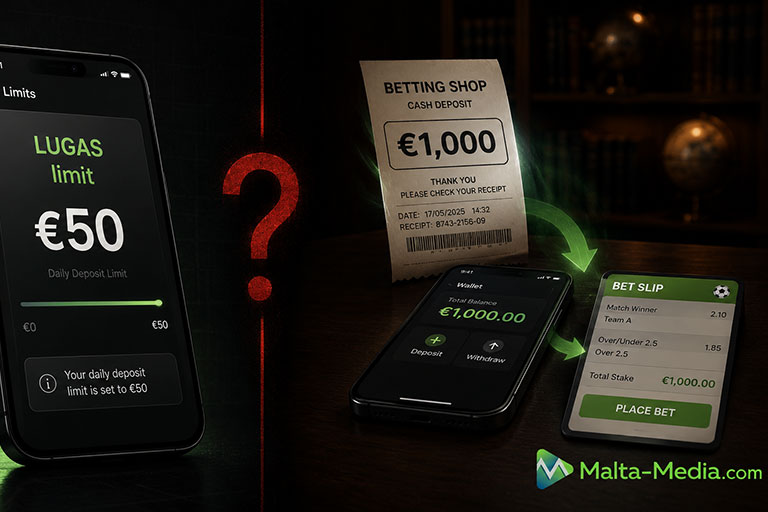
Tipwin’s cash wallet: €50 LUGAS limit, €1,000 cash deposit, mobile betting
A test dossier received at Malta Media presents a €50 provider-wide LUGAS limit and a €1,000 cash deposit at a Tipwin shop before mobile bets at Tipwin and Neobet. The screenshots are not a regulatory finding, but they put one precise question before Germany’s authorities: when shop cash becomes app-based betting credit, where does the player’s limit apply?
€50 in LUGAS. €1,000 in cash over a Tipwin counter. A Tipwin bet on a mobile device and a second successful wager at Neobet shortly afterwards. That is the sequence presented in a test dossier dated 15 June 2026.
The file does not stand alone. An April test records €100 credited to Shop Geldbörse Plus while a €50 LUGAS limit is shown. Letters sent to state authorities in Hesse and Bavaria describe a product that could allegedly take up to €1,000 per month in cash separately from the ordinary online limit, then allow the customer to bet by phone away from the shop. A Schleswig-Holstein test documents a €5 cash payment, the corresponding app balance and a later smartphone wager.










That looks like a direct challenge to the promise behind Germany’s provider-wide deposit limit. Yet it is important not to jump from a provocative screenshot to a legal verdict. The documents are test reports, receipts, app captures and letters. Malta Media has not seen Tipwin’s back-end, licence conditions, LUGAS calls or any final regulator assessment.
The correct question is therefore not whether the word ‘cash’ makes the activity retail or the word ‘app’ makes it online. The treaty itself defines when shop payments remain outside the internet limit and when they must be captured. The evidence is strong enough to require the GGL and the relevant state authorities to explain which side of that line Shop Geldbörse Plus occupies.
The June test presents €50 in LUGAS and €1,000 over the counter
The June file presents the clearest sequence. Its first substantive slide shows the customer’s current and remaining provider-wide LUGAS limit as €50. A journal entry displayed beneath it states that the lower limit had been set on 5 December 2025. The dossier then shows a receipt from a Tipwin branch in Neuss recording a cash deposit of €1,000 at 14:59 on 15 June.
The receipt identifies Shop Geldbörse Plus and shows the €1,000 payment entering the Tipwin environment. A later Tipwin account view records a €1,000 cash deposit and a wager in the same transaction history. Another screenshot shows a Tipwin bet at 15:12 through the account area selected for Shop Geldbörse Plus.
The final image records a successful Neobet wager shortly afterwards. The test author treats this as evidence of both a deposit above the selected cross-provider limit and parallel play. Those are conclusions, not established regulatory findings. Screenshots alone cannot reveal whether the cash payment was legally outside §6c, how the Tipwin wager was classified or precisely when either operator activated and released the customer in LUGAS.
Still, the amount matters. Earlier letters merely described a €1,000 capability. This test appears to document a single €1,000 counter transaction while the same customer journey is presented alongside a €50 LUGAS limit. The regulatory question is no longer hypothetical.
The April test shows the same architecture at a smaller scale
The April dossier records a similar customer journey using a lower amount. A Neobet screen shows a current provider-wide LUGAS deposit limit of €50. Another screenshot from the same test file shows Shop Geldbörse Plus selected inside the Tipwin account and transaction entries described by the test author as cash deposits, including a €100 entry made on 6 April.
The author concluded that the €100 payment demonstrated that the €50 LUGAS limit was not being taken into account for Shop Geldbörse Plus. The screenshot does not prove that conclusion by itself. A retail payment can sit outside the provider-wide internet limit in defined circumstances, so accepting €100 in a shop is not automatically evidence of a breach.
The decisive question is what happened to the money next. The file records a Tipwin wager placed through a mobile device at 09:14 on 7 April, with Shop Geldbörse Plus selected. A Neobet screen then records a successful wager at approximately 09:15. The test author says no prior activity was detected.
This sequence moves the issue beyond a complaint that a shop accepted cash. German law expressly recognises retail betting payments. The difficulty begins when a cash-funded balance follows the player out of the shop and becomes spendable through an app in circumstances that look, from the customer’s perspective, indistinguishable from online betting.
The letters describe a product built around the regulatory boundary
The Hesse and Munich files contain letters framed as requests for legal certainty from betting-shop operators considering Tipwin’s model. They describe broadly the same five-stage customer journey. A customer enters a Tipwin shop, presents identification, registers and receives credentials or a card. Cash is added to Shop Geldbörse Plus at the counter or a terminal, the balance appears in the Tipwin app and the bet can then be placed by phone outside the premises.
The Hessian letter says the product is attractive precisely because it combines retail funding with mobile freedom. It states that a player with an online limit of €50 could still place up to €1,000 per month into Shop Geldbörse Plus and bet by phone whenever and wherever the player wished. The writer’s stated understanding was that this remained a betting-shop wager rather than an internet wager.
The Munich letter makes the same proposition in more detail. It says the wallet can be funded only in cash at the shop, while wagers are placed through the Tipwin app regardless of time and location. It presents the €1,000 wallet ceiling as separate from the provider-wide LUGAS limit and other online requirements, then asks the Bavarian authority whether the existing betting-shop permission is sufficient and whether an additional GGL authorisation is required.
Neither file reviewed by Malta Media contains an authority’s answer. The letters therefore show how the product was understood or promoted within the retail market, not that a regulator endorsed that understanding. The distinction matters because the feature described as the commercial advantage is also the regulatory problem: money enters through a shop, while the betting activity takes place somewhere else through a phone.
Germany’s treaty already anticipates the hybrid problem
The legal framework is more precise than the product labels suggest. Under §6c of the Glücksspielstaatsvertrag 2021, a player must set an individual monthly provider-wide deposit limit for covered forms of internet gambling. The amount is generally capped at €1,000, but the player can choose a much lower figure. Once that chosen limit is exhausted, further covered deposits must be refused.
The same provision requires operators to consult the central limit file before completing each covered deposit. The system returns whether the limit is exhausted or whether the proposed payment would exceed the remaining amount. A reduced limit takes effect immediately, while an increase is subject to a seven-day protection period. The architecture is meant to turn self-restraint into an enforceable market-wide instruction.
Section 21a(4) deals directly with the collision between betting shops and online accounts. Payments made for bets in a shop are generally not counted within the provider-wide internet deposit limit. That is the retail exception. The exception does not apply, however, where shop deposits or winnings are credited to a player account under §6a and can be used as stakes for gambling on the internet. Operators and intermediaries must maintain the separation through suitable technical measures.
That wording makes the use of the money more important than the marketing name attached to the wallet. A cash payment does not become an online deposit merely because it is handled electronically. Equally, a balance does not remain outside the internet limit merely because it first entered the system at a shop. On the face of §21a, the hinge is whether the funds reach the relevant player account and can then be used for internet gambling.
The treaty treats failure in this area as more than a drafting curiosity. Section 28a lists a failure to ensure that qualifying shop payments are captured by the provider-wide limit as an administrative offence, with a statutory maximum fine of €500,000. That does not establish that Tipwin committed an offence. It does show that the legislature considered the retail-to-online boundary important enough to attach a specific enforcement consequence.
The issue is not Germany’s normal €1,000 ceiling
It would be easy to answer the evidence by saying that Germany’s normal maximum is €1,000 anyway. That misses the point. The statutory limit is individual and provider-wide. A player who selects €50 has not selected €1,000 at another operator, through another wallet or after walking into a betting shop.
The June dossier is particularly awkward because the €50 figure is not presented as an unused default waiting to be raised. The screen shows the current and remaining limit as €50, while the journal says that amount had been set months earlier. The same test then presents a €1,000 cash transaction at Tipwin.
There may be a lawful reason why those amounts sit in different regulatory compartments. Shop bets can legitimately be treated differently from covered internet gambling, and a separate retail ceiling may provide another layer of control. But that defence works only if the balance remains within the shop framework defined by law. Once the money is usable remotely through an app, the regulator must explain why the customer’s lower self-limit does or does not follow it.
The player-protection question is therefore not whether a betting shop may handle €1,000 in cash. It is whether the state can promise a provider-wide €50 limit for online gambling while permitting a cash-funded mobile wallet to operate outside it. A limit that depends on an invisible legal classification is difficult for a player to understand and even harder to treat as meaningful self-protection.
Schleswig-Holstein leaves less room for labels
The Schleswig-Holstein material adds a state-law dimension. Section 11 of the state’s Sportwettvermittlungsverordnung says deposits made in betting shops, and winnings from shop bets, may not be used as stakes in remote distribution. The provision also requires technical measures to preserve that separation.
The August test file records a small but unusually clean sequence. A receipt from a Tipwin shop shows €5 allocated to Shop Geldbörse Plus. The app then displays a €5 balance under that wallet, followed by a betting slip placed on a smartphone. The account history shown in the final image labels the funding transaction ‘Bargeldeinzahlung’, or cash deposit.
The test author calls this prohibited conduct in Schleswig-Holstein. Malta Media cannot adopt that conclusion as a finding because the material does not establish where the bet was legally accepted, what contractual mechanism sat behind the app or whether a specific approval addressed the product. A regulator or court would need to examine those questions.
Even with that caution, the state provision makes the issue difficult to avoid. If the balance originated in a betting shop and was then used remotely, the apparent customer journey matches the combination the rule seeks to separate. If Tipwin has a lawful basis for treating the mobile wager as stationary despite the customer placing it away from the shop, that basis should be capable of a clear public explanation.
Parallel play raises a second technical question
The deposit issue is not the only point in the dossiers. LUGAS also contains an activity file intended to prevent a player from gambling simultaneously with different providers. The GGL says a customer must be marked ‘active’ immediately before play. If the central file reports that the same person is already active elsewhere, the second operator must not enable the activity.
Three files present close sequences. In April, a Tipwin mobile wager using Shop Geldbörse Plus is recorded at 09:14 and a Neobet bet follows at approximately 09:15. The Munich attachments show a Neobet wager at 12:32 and a Tipwin mobile wager at 12:33. The June dossier shows the Tipwin bet at 15:12 and a successful Neobet wager shortly afterwards.
Nearness in time is not by itself proof of unlawful parallel play. The screenshots may not capture the precise activation and deactivation sequence. One operator may have released the customer before the next wager, the products may have been classified differently or the test record may be incomplete. Malta Media has no direct access to the activity-file responses returned to Tipwin or Neobet.
The apparent anomaly nevertheless connects to the wallet-classification problem. If a Tipwin mobile wager is treated technically as a shop transaction, the internet activity file may not engage in the way a customer expects from using an app away from the shop. If it is treated as internet gambling, the successful wager at another provider requires a technical explanation. Either answer may be lawful. The records needed to establish which answer applies sit with the operators and the regulator.
Tipwin has a serious defence, and it should be heard
Tipwin is entitled to a fair account of the strongest case available in its favour. The operator could argue that Shop Geldbörse Plus is a distinct retail wallet, that cash can be added only following in-person identification and that every wager is legally attributed to the originating betting shop. The app, on that analysis, may be a technical order channel rather than proof that the underlying bet is internet gambling.
It could also argue that the wallet’s own €1,000 funding ceiling supplies a controlled limit for shop activity, while the ordinary LUGAS amount continues to govern covered online deposits. If the customer cannot move the cash balance into a normal online wallet, cannot use it for products outside the retail permission and remains subject to shop-specific controls, the legal separation may be tighter than the screenshots suggest.
The evidence leaves important facts unanswered. It does not contain Tipwin’s contractual terms for the wallet, the relevant licence conditions, the precise server and account architecture, the legal location at which the wager is accepted or the data sent to LUGAS. It does not establish whether the app displays a common interface over legally distinct products or whether a regulator approved a specific hybrid design.
Those gaps prevent a responsible publication from declaring a breach. They do not make the evidence irrelevant. A lawful explanation should be demonstrable through the technical records that licensed operators must maintain. If the apparent €50 versus €1,000 conflict results from a misunderstanding, explaining the classification would protect Tipwin’s reputation far more effectively than leaving the screenshots unanswered.
A licensed operator should make verification straightforward
Tipwin is not an anonymous offshore operator beyond German reach. The GGL’s official whitelist records Tipwin Limited as authorised for sports betting through online and stationary channels, with tipwin.de listed under the licence. The GGL supervises licensed cross-border online sports betting and operates the central LUGAS files.
That should make this a comparatively straightforward supervisory question. The authority can identify the test accounts, review the deposit and activity-file calls, inspect the wallet configuration and determine whether the funds were legally and technically retail, online or subject to an approved hybrid structure. It can also coordinate with the state authorities responsible for the individual betting shops.
The hybrid design is exactly where Germany’s divided responsibilities can become an excuse for inaction. A state authority may see a shop payment. The GGL may see an online licence and central files. The operator may describe the wager as stationary while the customer experiences it through a mobile app. Unless the authorities agree on the classification, the same transaction can fall into the gap between them.
Malta Media has already examined Germany’s betting-shop regulation, the need for regulatory consistency and the market incentives created by uneven outcomes. Shop Geldbörse Plus brings those wider issues into one customer journey. A product can be lawful and still expose a regulatory boundary that requires a far clearer explanation than the public has received.
The GGL says its central files exist to apply player limits across providers and to prevent parallel play. This evidence therefore presents more than a single-operator compliance question. It tests whether Germany can supervise a product crossing the retail and digital boundary without allowing that boundary itself to weaken the protection advertised to players.
Five questions the authorities should answer
First, what is the legal classification? When a player pays cash in a Tipwin shop, sees the money in the Tipwin app and can place a wager by smartphone away from the premises, does the GGL regard that wager as stationary or as internet gambling? The answer should identify the legal and technical criteria rather than repeating the product name.
Second, how does §21a(4) apply? Is Shop Geldbörse Plus credited to a player account under §6a, and can its balance be used as a stake for internet gambling within the meaning of the treaty? If the answer is yes, how are the associated shop payments captured in the provider-wide limit? If the answer is no, what feature prevents the remote use shown in the evidence from becoming internet gambling for regulatory purposes?
Third, what happens to the individual limit? Can a customer whose current and remaining LUGAS limit is €50 lawfully place €1,000 in cash into this wallet and use the balance through the app? If so, how is the customer told that the selected €50 protection does not govern the activity, and which alternative controls replace it?
Fourth, what did the activity file show? Were the Tipwin mobile sessions in the April, Munich and June tests reported as online activity, and what explains the successful wagers at Neobet so soon before or afterwards? If the methodology was flawed, the central records should make that apparent.
Fifth, what did the state authorities decide? The files contain requests for clarification in Hesse and Bavaria and a test conducted under Schleswig-Holstein’s stricter wording. A coordinated answer would protect players, give betting-shop operators legal certainty and protect Tipwin from allegations that may prove unfounded.
A self-limit cannot depend on which wallet is selected
Germany built LUGAS around a simple promise: a player chooses an amount and covered online operators must respect it across the market. That promise becomes difficult to defend if the practical effect of the limit changes when the same customer selects another wallet inside an operator’s app.
The Tipwin evidence does not prove that this happened in legal or technical terms. It does show a test file presenting a €50 LUGAS limit beside a €1,000 cash deposit, a mobile Tipwin wager and a later Neobet bet. Other files show the same wallet funded in shops and used through smartphones. Letters describe the model as deliberately separate from ordinary online rules.
There may be a lawful architecture behind every screenshot and there may be weaknesses in the tests. The right response is not to convert suggestive evidence into a verdict. It is equally unacceptable to pretend the contradiction disappears because the money first touched a shop counter.
The issue also matters because the GGL has treated LUGAS-related failures as serious enough to contribute to a licence-wide reliability assessment in the Bet3000 case. The facts are not identical and this article does not claim they are. Once the regulator establishes central-system compliance as licence-critical, however, detailed evidence involving another licensee deserves visible and equally serious scrutiny.
A €50 self-limit that can coexist with a €1,000 cash-funded mobile wallet may have a lawful explanation. Until Germany’s authorities provide it, the system appears to promise one provider-wide limit while delivering a protection that changes according to which wallet the customer selects. That is not a technical footnote. It is the question at the centre of the regulated market’s credibility.
FAQs
What is the regulatory issue involving Tipwin and Shop Geldbörse Plus?
The central question is whether cash deposited into Shop Geldbörse Plus at a Tipwin betting shop remains a retail betting balance when it can later be used to place wagers through a mobile device. The distinction matters because Germany applies different rules to qualifying retail payments and internet gambling deposits.
Why does the €50 LUGAS limit matter in the Tipwin tests?
The June test presents a customer with a current and remaining provider-wide LUGAS limit of €50 alongside a €1,000 cash deposit into the Tipwin environment. This does not establish a regulatory breach, but it raises the question of whether the customer's selected online deposit limit should also apply to the cash-funded mobile wallet.
What is Shop Geldbörse Plus?
Shop Geldbörse Plus is described in the reviewed material as a Tipwin wallet that can be funded with cash at a betting shop. The balance then appears within the Tipwin app and, according to the test dossiers and letters, can be used for wagers placed through a mobile device.
Does the evidence prove that Tipwin breached German gambling law?
No. The available material consists of test reports, receipts, screenshots and correspondence rather than Tipwin's back-end records, licence conditions or regulatory findings. Malta Media therefore does not treat the evidence as proof of a breach.
How does Germany's provider-wide deposit limit work?
Under §6c of the Glücksspielstaatsvertrag 2021, players set an individual monthly provider-wide deposit limit for covered forms of internet gambling. Operators must check the central limit file before completing applicable deposits, and payments that would exceed the remaining limit must be refused.
Can betting-shop cash deposits remain outside the LUGAS internet limit?
Yes, under certain circumstances. Section 21a(4) generally excludes payments for betting-shop wagers from the provider-wide internet deposit limit. However, the exception does not apply where qualifying shop funds or winnings are credited to a player account and can subsequently be used as stakes for internet gambling.
Why is the Schleswig-Holstein test significant?
Schleswig-Holstein has a specific rule requiring separation between betting-shop funds and remote betting. The test material shows a €5 cash payment into Shop Geldbörse Plus, a corresponding app balance and a later smartphone wager, although the evidence alone does not establish how the wager was legally classified.
What parallel-play concerns are raised by the Tipwin tests?
Several test files show Tipwin and Neobet wagers occurring close together. LUGAS uses an activity file intended to prevent simultaneous gambling across different providers, but screenshots alone cannot establish the exact activation and deactivation sequence or whether prohibited parallel play occurred.
What defence could Tipwin make regarding its mobile wallet?
Tipwin could argue that Shop Geldbörse Plus is a separate retail wallet, funded only after in-person identification, and that wagers made through the app remain legally attributable to the originating betting shop. It could also argue that the app acts only as a technical order channel rather than converting the wager into internet gambling.
What should German gambling authorities clarify about Tipwin?
Authorities need to clarify whether mobile wagers funded through Shop Geldbörse Plus are legally stationary or internet gambling, how §21a(4) applies, whether an individual LUGAS limit follows those funds, how the activity file handled the test sessions and what relevant state authorities decided.

Michael Schmitt
Michael Schmitt is the founder of TRIDER.UK and Editor of Malta Media. He writes about iGaming, gambling regulation, corporate structures, financial services and market integrity, combining investigative journalism with nearly three decades of experience in corporate services and international business.
Related Posts


SBC and VNLOK form strategic partnership for 2027 Amsterdam summit
October 19, 2026

