Badalyans in Malta licences and sponsorship scrutiny
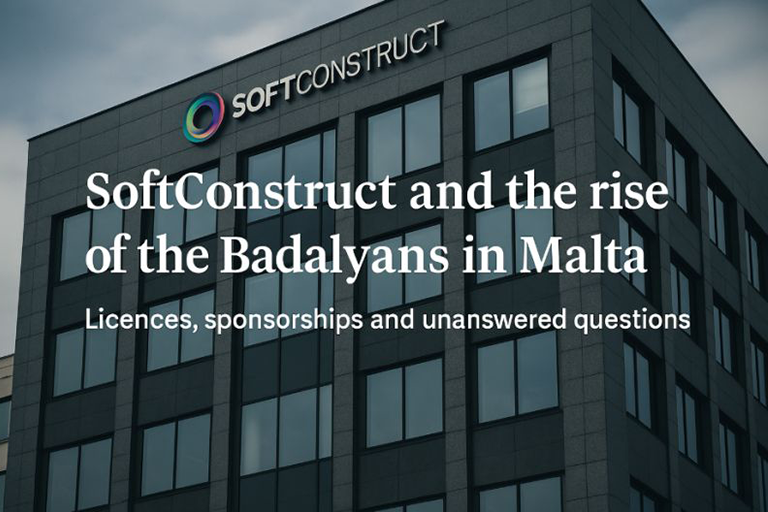
The Badalyans in Malta: licences, sponsorships and unanswered questions
Malta has long presented itself as a hub for gaming, financial services and technology innovation. Over the years, it has attracted groups seeking a European base for their international activities. Among those visible in recent years has been the network of companies associated with the Badalyan family.
Through brands such as SoftConstruct, BetConstruct, Fastex, Ortak, YoHealth, Vivarous, Fastshift, FastBank, FeedConstruct, Ortak Plus, Hoory, FastTV, Pascal Gaming, SOS Hub, CreedRoomz Live Casino, Stretch Network, Caucasus, WineDoor, DevPro, PopOK, Fast NFT, Fast Ticket, Affigates, Yo Estate, Yo Invest, Yo Door, Yo Site, Yo Phone, AllGam, VBet and Fast Sports (with further brands existing beyond this list), the Badalyans’ corporate network has become engaged with Maltese regulatory structures, football sponsorships and financial licensing frameworks.
The family’s companies are known for rapid expansion, prominent announcements and claims of innovation. Yet a closer review of Maltese filings and structures highlights areas that may require further scrutiny. Regulatory approvals appear to have been granted in notably short timeframes, corporate accounts indicate limited operational presence, token distributions show high levels of concentration among related parties and sponsorship money has entered sports before underlying legal structures were in place.





















This article examines how Malta has been used as a platform by these companies, looking at licensing processes, token structures, blockchain ecosystems, international outreach and sports sponsorships. It does not allege misconduct. It highlights questions of transparency, accountability and governance, which Malta itself has committed to uphold.
SoftConstruct and the rise of the Badalyans
The starting point is SoftConstruct, founded by Armenian brothers Vigen and Vahe Badalyan. From a software development company in Yerevan, the business expanded into gaming, payments, blockchain and sponsorship activities.
Through brands such as BetConstruct, Fastex, FastBank, FeedConstruct, Ortak and YoHealth, the group has gained international visibility.
On its own presentation, SoftConstruct positions itself as innovative and entrepreneurial, offering AI-driven gaming platforms, blockchain services and global payment solutions. Its marketing highlights modernity and community. However, its Maltese corporate footprint appears modest compared to the scale suggested by its global profile.
Governance reshuffling in Malta
The Maltese subsidiary, Soft Construct (Malta) Ltd (C 65512), has seen governance changes. In September 2024, Dr Olga Finkel (congrats from us on the recognition at SIGMA Euro Med), co-founder of WH Partners and one of Malta’s most recognised gaming lawyers, resigned as company secretary. She was replaced by Radix Corporate Ltd, later renamed A2CO Corporate Ltd.
Radix/A2CO is linked to Anton Dalli, a former Nexia BT manager and later co-founder of A2CO. Nexia BT collapsed after its partners faced criminal proceedings related to Panama Papers structures and alleged money laundering involving politically exposed persons.
Although Mr Dalli was not charged in those cases, his past association places him in proximity to Malta’s most high-profile corporate controversy. His presence in the SoftConstruct structure therefore raises legitimate governance questions about the choice of advisors.
Further changes followed. In January 2025, long-standing director and CEO figure Fabrice Armand Pinarbasi resigned as director, legal representative and judicial representative. He was succeeded by Mr Gor Mnatsakanyan, based in Potsdam, Germany and known for senior roles at BetConstruct and VBet. He does not appear to reside in Malta. The Maltese entity is therefore directed and represented by an executive based abroad, reinforcing the impression of offshore control.
Lack of real substance
The 2024 accounts disclose that Soft Construct (Malta) Ltd employed an average of only two people. Wages and salaries amounted to €189,220, with €36,000 per year in office rent. These figures indicate a minimal operational presence.
The discrepancy between global branding and the Maltese footprint is significant. With two staff and a small rented office, the entity appears to provide limited operational substance compared with the group’s wider international narrative.
Turnover and financial scale
Despite reporting an average of just two employees in 2024, Soft Construct (Malta) Ltd recorded revenue of €76.5 million. This represents an increase from the €62.9 million reported in 2023. Direct costs absorbed the majority of that revenue, resulting in a gross profit of €13.3 million.
After deducting administrative expenses of €4.1 million, the company reported an operating profit of €9.1 million. That figure is noteworthy when considered against the size of the Malta office and the reported staffing levels.
A further contribution to profit arose from a line titled “waiver of amount owed to parent company” of €10.6 million in 2024. This reflects an accounting treatment whereby a parent company forgives amounts due from a subsidiary.
While this increases the subsidiary’s profit before tax for accounting purposes, it does not of itself evidence additional economic activity in Malta. Including this waiver, profit before tax was €19.7 million, compared with €8.7 million in 2023.
After accounting for tax, the company reported a net profit of €12.4 million for 2024, compared to €4.7 million in 2023. Accumulated profits on the balance sheet increased to
€18.2 million, up from €5.7 million the previous year.
Assets and liabilities
The balance sheet shows total assets of €66 million at year-end 2024. Most of this comprised intangible assets valued at €60.7 million. Tangible property, plant and equipment was €88,000, which indicates a limited physical footprint in Malta. Cash holdings were €850,530, down from
€2.9 million in 2023, which suggests profits were not retained locally in liquid form.
On the liabilities side, the company carried a deferred tax liability of €10.6 million, up from
€3.8 million in 2023 and balances payable to the parent company of €23.2 million. Current liabilities totalled €13.6 million, most of which was owed to companies under common shareholding. These figures indicate that, although Soft Construct (Malta) Ltd reports substantial profits, its balance sheet remains closely connected to intra-group financing rather than reflecting a stand-alone Maltese operation.
Cash flow
The statement of cash flows further illustrates the distinction between accounting profit and cash generation retained in Malta. The company generated €34.6 million in cash from operations in 2024. Almost all of this was applied to investment in intangible assets of €36.1 million, resulting in a net decrease in cash of €2 million over the year.
This pattern indicates that revenue recognised in Malta was largely reinvested in group- controlled intangible assets, which in turn limits lasting cash retention in the jurisdiction.
Implications
The scale of turnover and profitability is significant for an entity with two staff members and a
€36,000 office lease. A material component of the reported profit reflects group accounting measures, including the debt waiver noted above. The predominance of intangible assets, the size of the deferred tax liability and the reliance on balances with parent and related companies are consistent with Malta being used primarily as a location within a wider group structure rather than as a substantive operational hub.
Shareholding and beneficial owners
Soft Construct (Malta) Ltd is owned by Soft Construct Limited and S.C. Holding Limited, both registered in the Isle of Man. The beneficial owners are Vahe and Vigen Badalyan, each holding fifty percent. The use of Isle of Man holding entities places ultimate control outside Malta and may reduce the degree of direct local visibility over group decision-making. This observation is made for context and does not imply any breach of law.
Taxation and the deferred tax question
On paper, the company reports a significant tax expense. The 2024 accounts show a total tax charge of €7.36 million. However, this figure is misleading in terms of Malta’s actual revenue.
- Only €535,695 was booked as current tax for the
- €6.82 million was recorded as deferred tax, mainly due to capital allowances exceeding accounting depreciation and other timing differences.
- The actual cash paid in 2024 to the Maltese tax authorities was €839,044 (a combination of settlement tax and final withholding taxes).
Accordingly, the headline tax charge does not equate to cash received by the Maltese treasury in the same period. Deferred tax is an accounting provision for potential future obligations. Whether and when deferred amounts crystallise into cash payments depends on future events, including the continuation of investment allowances and group planning choices. No suggestion is made that the tax accounting is incorrect. The distinction is relevant to understanding Malta’s cash-basis fiscal receipts.
Malta as a strategic jurisdiction
For the Badalyan-associated group, Malta offers advantages that include access to the European regulatory space, established licensing regimes in gaming and financial services and a public platform where sponsorships can increase visibility.
This combination can make Malta more than a simple corporate domicile. It can serve as a jurisdiction where formal authorisations are obtained, compliance frameworks are demonstrated and a European profile is presented. Sponsorships of national football competitions can reinforce that positioning.
These features also carry reputational considerations. If any licences are perceived to be processed unusually quickly, if sponsorship arrangements precede complete legal structures or if filings indicate limited substance, observers may form the view that Malta risks being used for profile-building rather than substantive operations.
This is a perception point and not an allegation of wrongdoing.
Fastex Europe and the accelerated licence
A prominent example is Fastex Europe Limited. The company was incorporated in August 2024 and, within approximately four months, obtained a Class 4 Virtual Financial Asset licence from the Malta Financial Services Authority. By reference to established procedures, applicants commonly anticipate longer end-to-end timelines, which may include pre-application engagement and extended due diligence.
This accelerated timeline invites questions about process rather than about propriety. It is legitimate to ask how preparations were completed so swiftly, how background checks were sequenced within that period and whether scrutiny was applied at the same level as for other applicants.
The method of paying the €150,000 share capital is also relevant. The funds were routed through FastBank, which is owned within the wider group of the directors. While using a related-party institution can be lawful, it may be perceived as not demonstrating an external verification of capital in the same way that an independent third-party institution would.
The shareholder structure included a Dubai-registered entity. Dubai has a different transparency framework from the European Union. Without detailed public disclosures, it is not possible from filings alone to identify ultimate beneficial ownership with the same granularity that some EU regimes require.
It was also reported that one of the company’s directors acted as its VFA Agent. A VFA Agent is expected to perform an independent compliance role. Where an officer of the company also performs that role, questions of perceived conflict can arise.
Considered together, the compressed timeline, the related-party banking route, the presence of a Dubai shareholder and the dual role of director and VFA Agent present process features that may draw comment about regulatory optics.
No illegality is alleged. The point is confined to governance appearance and procedural robustness.
Tokenomics and the concentration of control
Fasttoken has been promoted as a decentralised, community-driven token. Publicly available materials indicate that only around ten percent of the one billion tokens entered public hands. Most allocations were made to insiders, early investors and affiliated entities. Two private rounds reportedly received allocations that together approximated or exceeded the public sale.
On-chain observations have indicated that a single wallet received more than one hundred million tokens. The size of that holding is considerable and exceeds the totality of the public sale.
The wallet did not show evidence of independent exchange custody or multi-signature governance in the materials reviewed, which may suggest internal holding. Other wallets attributed to the ecosystem have been observed moving identical amounts in repetitive patterns. Such mirrored transfers are not necessarily indicative of market activity and can be consistent with internal treasury management.
In light of these factors, claims of decentralisation merit careful scrutiny. Absent transparent disclosures of wallet control, independent third-party audits and external oversight, the distribution appears concentrated.
No allegation of market manipulation is made. The point concerns governance structure and transparency.
The Bahamut ecosystem and the promise of decentralisation
To support usage for Fasttoken, the Bahamut blockchain was launched and a grant programme established. Projects under this umbrella have been presented as independent and community-led. Closer examination indicates a degree of dependence on the network’s funding, infrastructure and brand.
For example, the project known as Mutuari later appeared as PercentMe. Public explanations of the rebranding and of governance changes were limited in the materials assessed, leaving gaps for external observers.
SilkSwap described itself as a decentralised exchange. Public materials emphasised anonymity. At the same time, there was an absence of company registration details, identified directors and published smart contract audits in the sources reviewed. Operating an exchange function without transparent governance can generate regulatory questions in some jurisdictions.
Lolik operated as a liquid staking platform for Fasttoken. Publicly available information did not include detail on governance arrangements, asset segregation or independent audit. Pooling user assets without clear safeguards can expose users to loss in the event of failure, which underscores the importance of disclosures.
Taken together, these examples illustrate that projects presented as autonomous were in practice closely tied to the Bahamut network. This observation speaks to structural dependence rather than to legal non-compliance.
Operations in sanctioned markets
Public-facing materials in 2025 indicated Arabic-language onboarding and crypto access promoted for users in Syria. Syria was subject to comprehensive EU and US sanctions.
For entities licensed in Malta and Lithuania, which are bound by EU sanctions, such positioning is difficult to reconcile with a conservative reading of licensing obligations if those materials accurately reflected active targeting.
No allegation is made that any prohibition was breached. The observation is limited to the compliance risk profile that would arise if services were marketed or provided into a comprehensively sanctioned jurisdiction.
Sponsorships and the Malta Premier League
Beyond licensing and tokenomics, visibility in Malta has been enhanced through sport. YoHealth, presented as a health-tech brand within the wider group, was announced as lead sponsor of the Malta Premier League.
The joint venture between the Malta Football Association and the Malta Premier League was signed in December 2023. The legal entity Kampjonat Malta Ltd was registered in July 2025. The period between announcement and registration raises legitimate questions about the pathway through which funds were received, managed and accounted in the interim.
The YoHealth app promoted in connection with the sponsorship appeared to have limited functionality in the materials reviewed. Technical indicators suggested links to SoftConstruct infrastructure rather than to a stand-alone health-tech enterprise.
These are observations from open materials and do not imply that the sponsorship was invalid or that any obligation was breached.
A pattern of opacity
Across licensing timelines, token distributions, ecosystem projects, market targeting and sponsorships, repeated themes emerge. There are accelerated processes, concentrated holdings and incomplete disclosures. Considered singly, each item might be explained.
Considered as a whole, the pattern raises governance questions about transparency and consistency. This is a comment on public signals, not an assertion of unlawful conduct.
Malta’s credibility tested once again!
Malta’s inclusion on the Financial Action Task Force greylist in 2021 led to reforms intended to strengthen governance. The cases described above invite discussion about whether those lessons are being consistently applied.
The central issue is less about proving any breach by private actors and more about whether regulatory standards are enforced in a uniform and rigorous manner.
Final Thoughts and Conclusion
The presence of the Badalyan-associated group in Malta provides a case study in how international businesses may utilise Maltese frameworks to project legitimacy. Licences, corporate filings and sponsorships confer visibility. The filings reviewed suggest limited local substance in some entities relative to scale.
No allegation of unlawful conduct is made. The questions are about consistency, transparency and substance. Why are some licences processed within months when other applicants report longer timelines. Why does a company with more than €76 million in reported revenue show two employees and a small rented office. Why is a significant proportion of the reported tax charge deferred rather than reflected as cash receipts for the Maltese treasury.
For Malta, the concern is reputational as well as fiscal. A jurisdiction that worked hard to exit the FATF greylist risks signalling that the key lessons have not been fully embedded if speed and publicity appear to outpace scrutiny and substance.
The group benefits from visibility, from European regulatory positioning and from the prestige associated with Maltese football sponsorships. Malta in turn records modest tax receipts and limited employment in the filings assessed, alongside renewed questions about oversight.
A remedy lies in the consistent application of existing rules. By holding all operators to the same standard, Malta can reduce the risk of being used primarily as a platform for signalling rather than for substantive operations and can address concerns that insiders benefit while the host jurisdiction assumes reputational exposure.
FAQs
What is the focus of the Badalyan group in Malta?
The group has engaged in gaming, blockchain, payments and sports sponsorships through multiple companies licensed or registered in Malta.
Who are Vahe and Vigen Badalyan?
They are Armenian entrepreneurs and co-founders of SoftConstruct, the parent group behind brands such as BetConstruct, Fastex and VBet.
Which Maltese company represents SoftConstruct?
Soft Construct (Malta) Ltd is the Maltese subsidiary. Its filings show minimal local staff compared to significant reported revenues.
Why is the Malta Premier League sponsorship significant?
The YoHealth sponsorship was announced before the relevant legal entity was formally registered, raising questions about timing and governance.
What did the 2024 accounts of Soft Construct (Malta) Ltd show?
The company reported €76.5 million in revenue, €19.7 million profit before tax, but only two employees and modest office expenses.
Why are there concerns over transparency?
Concerns arise from accelerated licence approvals, concentrated token holdings, limited local substance and cross-border ownership structures.
What is Fasttoken and why is it relevant?
Fasttoken is a blockchain token promoted as decentralised, but publicly available information shows a large concentration of tokens among insiders.
How much tax did Soft Construct (Malta) Ltd pay in Malta?
In 2024 the company reported a €7.36 million tax charge, but only about €839,000 was paid in cash to Maltese authorities during the year.
Why is Malta important for the group’s strategy?
Malta offers EU regulatory access, financial services licensing and visibility through sports sponsorships, enhancing the group’s international profile.
Does this article allege unlawful conduct?
No. The article highlights governance, transparency and reputational questions. It does not allege wrongdoing or unlawful activity.
Disclaimer
This publication is based on public filings, regulatory materials and other sources believed to be accurate at the time of writing. It is provided for information and fair comment only and does not constitute legal, tax, financial or other professional advice.
No allegation of unlawful conduct is made. References to individuals or companies relate to publicly available information and imply no wrongdoing. Readers should verify facts independently. We will consider substantiated corrections.
Nothing herein creates any association or endorsement. All parties are presumed innocent unless a competent court decides otherwise

Michael
With nearly 30 years in corporate services and investigative journalism, I head TRIDER.UK, specializing in deep-dive research into gaming and finance. As Editor of Malta Media, I deliver sharp investigative coverage of iGaming and financial services. My experience also includes leading corporate formations and navigating complex international business structures.
Related Posts


Golden Whale appoints Jaime Ocampo as Asia Managing Director
April 13, 2026