Bishop Anton Teuma Urges Integrity at Gozo Feast
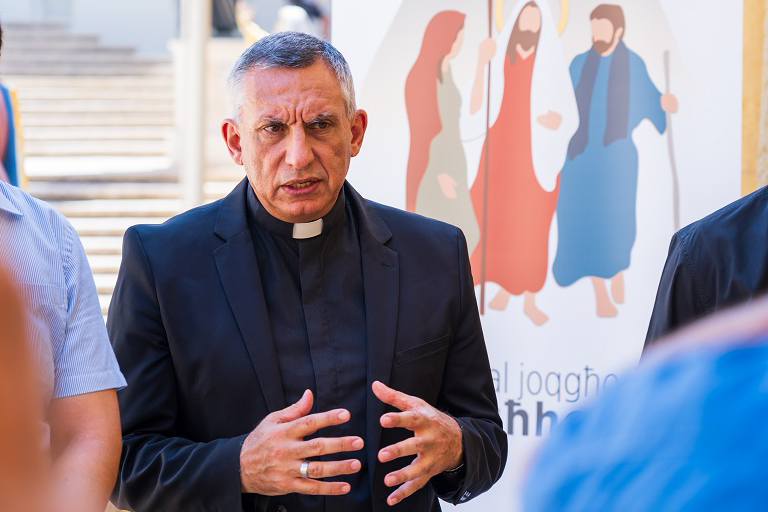
During the annual celebration of St George’s feast in Victoria, Gozo, Bishop Anton Teuma delivered a reflective and impactful message, using the occasion to issue a compelling call for ethical integrity and the courage to uphold one’s principles. With the Basilica of St George filled to capacity and the island’s political and civic leaders in attendance, Bishop Teuma’s homily went beyond theological reflection, touching on sensitive political, moral and social matters that remain subjects of ongoing debate in Malta.
The bishop’s remarks, though measured in tone, carried unmistakable weight, addressing not only the spiritual needs of his congregation but also calling into question a number of entrenched practices within Maltese and Gozitan public life. Delivered in a formal ecclesiastical setting, his words functioned as both moral instruction and civil critique.
Drawing strength from St George the Martyr
At the core of Bishop Teuma’s message was a reflection on the life and legacy of St George the Martyr, the feast’s patron saint. By referencing St George's defiance in the face of Roman imperial power to protect persecuted Christians, the bishop laid a foundation for his broader commentary on courage, ethics, and the challenges of contemporary governance and culture.





















“We cannot bow to pressures and ideas which we don’t believe in just to please those who are in power and look good,” Bishop Teuma proclaimed during his homily. “Be like St George and stand up to the ‘emperor’. Have courage and follow what you believe in and not what you are told.”
In drawing this parallel between the saint’s historic martyrdom and modern societal pressures, Teuma implied that conforming to dominant political or ideological norms without scrutiny may constitute a betrayal of personal conscience and faith.
Critique of abortion, euthanasia, and cultural materialism
While careful not to directly attack any individual or group, Bishop Teuma did not shy away from controversial topics. He alluded to ongoing national debates around abortion and euthanasia, describing them as symptomatic of a broader moral drift in society. The bishop did not specifically name any legislation or political figures but placed these debates within the context of a society increasingly influenced by relativism and utilitarian ethics.
He also criticised what he described as Malta’s growing obsession with wealth accumulation and material gain. In a nation where economic performance is often celebrated in political discourse, Teuma warned against idolising money and treating financial success as the sole measure of human achievement.
“This is a culture of selfishness,” he stated, suggesting that Malta’s societal values may be moving further from a sense of communal responsibility and spiritual purpose.
A firm stance on public sector accountability
The bishop dedicated a significant part of his homily to discussing a matter that has long been a subject of both public concern and political contention in Gozo: abuse within the public sector workforce.
Specifically, Bishop Teuma criticised the widespread phenomenon of public employees—particularly in Gozo—being hired to perform minimal or no actual work. Although this issue has been frequently raised in the media and in parliamentary debates, few figures within the Church have addressed it so directly.
“Employees should take pride in serving a purpose and helping others,” Teuma said. “Those who are paid without attending work or who only spend a few minutes there before leaving to attend to personal matters are taking something that is not theirs.”
He described such behaviour not merely as a misuse of state resources but as a form of moral and ethical failure. Remuneration, he stated, should always correspond to meaningful work and contribution. Otherwise, it constitutes a breach of both public trust and personal integrity.
The bishop emphasized the broader social cost of this type of corruption, arguing that it sets a damaging example for younger generations and undermines the legitimacy of public institutions.
Past remarks echoing a consistent message
This is not the first occasion on which Bishop Teuma has spoken out on this issue. In 2023, during a separate homily in Għajnsielem, he made similar remarks, again drawing attention to the issue of “phantom jobs” on the government payroll in Gozo. At the time, his words drew public support from some civic organisations, though others accused him of politicising the pulpit.
On that occasion, Teuma remarked that “those who neglect their responsibilities while receiving taxpayer money provide their families with a poor example and undermine the dignity of work.” He described such practices as fundamentally unjust and corrosive to the values of service and honesty.
Opposition to the APS-HSBC acquisition attempt
The bishop's recent involvement in ecclesiastical finance also reflects his willingness to challenge decisions taken by higher authorities within the Church establishment. Earlier this year, Teuma took a public stance against a proposed acquisition by APS Bank—a financial institution historically tied to the Maltese Church—of HSBC Malta’s operations.
While the plan had the backing of Archbishop Charles Scicluna, it faced resistance from the Diocese of Gozo, which questioned the strategic and ethical implications of such a high-profile commercial move.
Teuma’s objections reportedly stemmed from concerns over the bank’s long-term financial exposure and the reputational risks associated with the acquisition, particularly given HSBC’s global entanglements in regulatory and compliance issues. In the end, the proposal collapsed when APS officially withdrew its bid.
Calls for integrity and responsible leadership
Bishop Teuma’s homily during the St George’s feast can be interpreted as part of a broader effort to encourage ethical leadership and moral accountability, both within and beyond the Church. His appeal for courage, especially in confronting authority when it diverges from ethical norms, was clearly intended as more than a theological metaphor.
He acknowledged that many citizens may feel tempted to join powerful circles or align with influential figures, but warned that doing so at the expense of one’s beliefs is a form of moral surrender. “One should not abandon their principles to follow a master’s agenda,” he said.
Although the bishop avoided making explicit political statements, his comments have been widely interpreted as a challenge to the status quo, especially within Gozo’s insular political and administrative structures.
Broader societal implications
By choosing a moment of religious celebration to make these remarks, Bishop Teuma reaffirmed the Church’s role as a moral compass in Maltese society. In an increasingly secular political environment, his address underscored the enduring relevance of spiritual leadership, particularly when it engages with contemporary issues such as public ethics, governance, and social justice.
His focus on values such as honesty, courage, and service over personal gain may resonate with citizens disillusioned by recurring allegations of nepotism, favoritism, and inefficiency in public administration.
A message likely to stir reflection, not legal challenge
Given the sensitive nature of the subjects discussed, Bishop Teuma’s measured tone and careful phrasing appeared designed to spark introspection rather than direct confrontation. His remarks did not name individuals or accuse specific officials of wrongdoing, thereby minimizing legal exposure while still offering a pointed critique of problematic trends.
The bishop’s long-standing commitment to ethical leadership and transparency has already earned him both praise and criticism from different sectors. However, his consistent messaging—rooted in religious doctrine and public morality—suggests that he intends to continue using his platform to advocate for reform and integrity in both church and civil life.
Conclusion
Bishop Anton Teuma’s address at the St George’s feast in Victoria stands as a compelling reminder of the role religious leaders can play in shaping public discourse. By drawing on the symbolism of a martyred saint and connecting it with contemporary challenges, Teuma offered a powerful call for moral courage, accountability, and personal conviction.
He challenged the rise of materialistic values, shifting moral standards, and persistent shortcomings in the public sector, emphasizing a strong commitment to duty, integrity, and fairness. While his comments may provoke debate, they remain within the bounds of respectful, lawful discourse—reflecting a Church that continues to engage with Malta’s evolving social and political realities.
FAQs
Who is Bishop Anton Teuma?
Bishop Anton Teuma is the Roman Catholic Bishop of Gozo, known for his outspoken views on ethical, social, and political matters affecting Malta and Gozo.
What did Bishop Teuma say during the St George’s feast?
He encouraged people to uphold their principles, criticized political and social pressure to conform, and denounced abuse in the public sector.
Did Bishop Teuma mention abortion and euthanasia?
Yes, he alluded to the national debate on these issues, implying concern over Malta’s moral direction without directly targeting any political entity.
Why did he compare citizens to St George?
He used St George’s defiance of imperial persecution to inspire people to stand by their beliefs even when under pressure from authority figures.
What is the bishop’s view on public sector abuse?
He has consistently criticized the practice of hiring individuals who perform little or no work while receiving a salary, calling it ethically wrong.
Has Bishop Teuma faced backlash for his statements?
While he has received both support and criticism, he maintains a measured tone, avoiding direct accusations and focusing on moral reflection.
What is the APS-HSBC issue?
Bishop Teuma opposed APS Bank’s attempt to acquire HSBC Malta, citing ethical and strategic concerns. The bid was eventually withdrawn.
Was Archbishop Scicluna in favor of the APS deal?
Yes, Archbishop Scicluna supported the acquisition, but the Diocese of Gozo expressed reservations, contributing to the deal’s collapse.
What is the cultural issue Bishop Teuma mentioned?
He referred to what he sees as a culture of selfishness and materialism, warning against placing money above ethical and communal values.
Does Bishop Teuma often speak on political issues?
While he does not make partisan statements, he regularly addresses ethical aspects of public life, particularly where they affect justice and integrity.

Anna Amstill
I am an avid Blogger and Writer with more than 6 years of experience with Content Writing. An Online Marketing expert specializing in Blog writing, Article writing, Website content, SEO specific Keyword content and much more. Education B.A. - business management, York University, Canada, Graduated 2016.