

















Germany Gambling Regulation: LUGAS, Safe Server and Risks
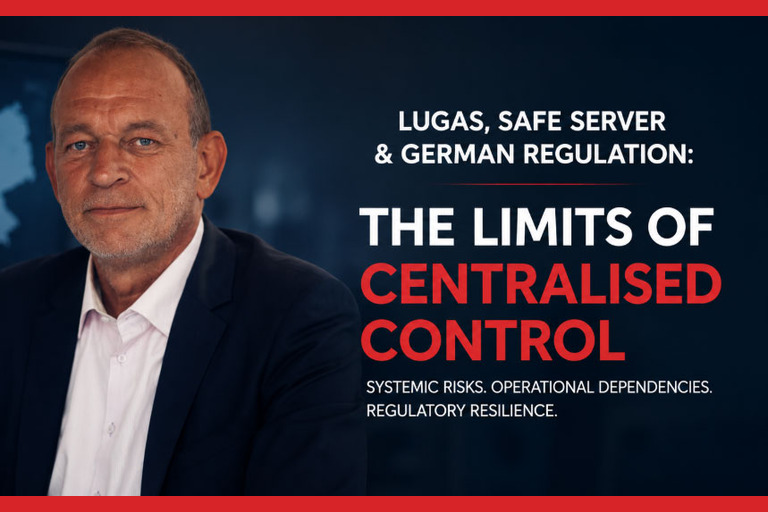
LUGAS, Safe Server and the limits of centralised control in German gambling regulation
Germany's online gambling framework is often discussed through the lens of licensing, enforcement actions, consumer protection measures and the ongoing effort to channel players toward regulated offerings. These debates attract significant public attention because they sit at the visible end of regulation. Less visible, but arguably just as important, is the technical infrastructure that enables the entire supervisory system to function.
Over recent years Germany has invested heavily in creating a centralised monitoring environment designed to provide regulators with greater visibility over licensed online gambling activity. The objective is understandable. Regulators require data to supervise markets effectively. Consumer protection mechanisms increasingly depend on technology. Compliance reporting has become more sophisticated. Real-time monitoring is often viewed as a modern regulatory necessity rather than a luxury. Yet the growing reliance on central technical systems raises a broader question that extends far beyond gambling regulation.
What happens when an entire regulated market becomes dependent on a small number of critical technical platforms?









This is not a question unique to gambling. Financial services regulators, energy authorities, telecommunications supervisors and healthcare systems have all faced similar challenges. The more centralised a system becomes, the greater the efficiency that may be achieved. At the same time, concentration can introduce new forms of risk that deserve careful consideration.
The discussion is therefore not whether centralisation is inherently good or bad. The more relevant question is whether sufficient safeguards exist to ensure resilience when critical infrastructure becomes essential for day-to-day market operations.
Understanding the role of LUGAS and Safe Server
Germany's online gambling supervision architecture relies on a number of technical components designed to support regulatory objectives. Among the most discussed are LUGAS and Safe Server.
While their functions differ, both form part of a broader ecosystem intended to provide regulators with enhanced oversight capabilities and facilitate compliance obligations imposed upon licensed operators.
The rationale behind such systems is relatively straightforward. Regulators seek greater transparency regarding player activity, responsible gambling measures and compliance requirements. Operators are required to interact with central systems in order to meet various regulatory obligations. The resulting structure creates a framework where supervision increasingly depends upon technical connectivity and data exchange.
From a regulatory perspective, this offers several advantages. Authorities can obtain information more efficiently. Compliance monitoring may become more consistent. Responsible gambling measures can potentially be implemented with greater effectiveness. Market participants operate within a more standardised environment. In theory, this should contribute to stronger consumer protection outcomes and a more transparent market.
Few would dispute the legitimacy of these objectives. The more interesting discussion concerns the operational implications of creating a regulatory environment in which central technical infrastructure becomes indispensable.
The attraction of centralised supervision
Centralisation has become a common feature across many regulated industries. Banks report information to central authorities. Financial institutions rely on common reporting systems. Telecommunications operators often interact with centralised regulatory databases. Critical infrastructure sectors frequently share information through coordinated platforms.
There are compelling reasons for this approach. A fragmented system can create information gaps. Different reporting standards may complicate oversight. Regulatory blind spots become more likely when information is dispersed across numerous independent systems. Centralisation addresses many of these challenges.
Regulators gain a clearer overview of market activity. Standardisation becomes easier to achieve. Compliance expectations can be applied more consistently. Consumer protection measures may be implemented more effectively when information is available through integrated systems.
In the gambling sector specifically, regulators face unique challenges. The industry operates digitally, transactions occur rapidly and player activity can span multiple platforms. Traditional supervision methods that rely heavily on periodic reporting may not provide sufficient visibility into evolving risks.
Against this backdrop, the development of sophisticated technical supervision systems appears both logical and inevitable. The question is not whether such systems should exist. The question is whether sufficient attention has been devoted to the risks that accompany such concentration.
Every central system creates a concentration risk
One of the most widely recognised principles in operational risk management is that concentration creates dependency. The greater the dependency, the greater the potential consequences if something goes wrong. This principle applies equally to governments, corporations and regulators.
When multiple organisations rely on a single critical platform, the platform itself becomes a point of systemic importance. Its availability, integrity and resilience become matters of public interest rather than merely technical concerns. Questions arise regarding how such dependencies are managed within highly regulated environments.
- What contingency measures exist during outages?
- How are unexpected technical failures addressed?
- What happens when maintenance activities affect connectivity?
- How quickly can systems be restored following disruption?
- What alternative procedures are available if primary systems become unavailable?
These are not criticisms. They are standard questions routinely asked within every sector that depends upon critical infrastructure.
- Air traffic control systems face similar scrutiny.
- Payment networks face similar scrutiny.
- Electricity grids face similar scrutiny.
The same logic naturally applies to regulatory technology platforms that play an important role in market supervision.
The single-point-of-failure dilemma
One of the most frequently discussed concepts within resilience planning is the single point of failure. A single point of failure exists when the failure of one component can significantly disrupt broader operations.
Modern infrastructure designers spend considerable effort attempting to eliminate such vulnerabilities. Redundancy, backup systems, geographic separation and disaster recovery procedures are all designed to reduce the likelihood that a single event creates widespread disruption.
The challenge becomes more complex when the infrastructure serves a regulatory function rather than a purely commercial one. Commercial businesses often have flexibility regarding internal systems. Regulatory infrastructure may not enjoy the same flexibility because regulated entities must interact with specific approved systems.
As a result, the resilience of the infrastructure itself becomes increasingly important. It remains unclear whether the public possesses sufficient information to fully assess the resilience arrangements surrounding critical regulatory technology systems. This is not unusual. Many infrastructure operators limit disclosure for security reasons.
However, the issue raises broader questions regarding transparency and confidence.
- How much information should be publicly available regarding resilience planning?
- How should regulators balance transparency against cybersecurity considerations?
- What level of independent assurance may be appropriate when an entire sector relies upon a shared infrastructure environment?
These are questions that extend far beyond gambling regulation.
Cybersecurity becomes a public-interest issue
As digital supervision expands, cybersecurity increasingly becomes a regulatory concern rather than merely an operational concern.
Cybersecurity discussions often focus on operators. Licensed companies are expected to protect customer information, secure systems and maintain appropriate controls. Yet central regulatory infrastructure also occupies a critical position within the overall ecosystem.
If regulators depend upon technical systems to support supervisory objectives, the resilience of those systems inevitably becomes part of the broader public-interest conversation.
Cyber threats continue to evolve rapidly. State actors, organised criminal groups and sophisticated cybercriminal organisations increasingly target critical infrastructure. Financial institutions, healthcare providers, government agencies and telecommunications operators all face persistent threats. Available information suggests that resilience planning must therefore be viewed as an ongoing process rather than a one-time exercise.
Questions arise regarding how frequently infrastructure resilience testing occurs.
- How often are contingency arrangements reviewed?
- Are independent assessments conducted?
- How are lessons from international cybersecurity incidents incorporated into future planning?
These questions are relevant to any critical infrastructure environment.
Lessons from financial services regulation
The financial sector offers useful insights into how infrastructure concentration risks are managed.
Payment systems, clearing houses and settlement platforms often operate as critical market infrastructure. Regulators recognise that disruption within these systems could affect entire markets.
- Consequently, resilience requirements tend to be extensive.
- Business continuity planning is regularly tested.
- Disaster recovery procedures are scrutinised.
- Redundancy arrangements are evaluated.
- Independent reviews may be conducted.
- Operational resilience frameworks have become a major focus for regulators globally.
The gambling sector is not identical to financial services. Nevertheless, similar principles can apply when technical systems become essential components of regulatory oversight. The more critical a system becomes, the more important resilience governance becomes.
Transparency and public confidence
Public confidence in regulation depends upon more than enforcement activity. Confidence also depends upon trust in the systems that support regulatory decision-making. Transparency plays an important role in building that trust.
This does not necessarily mean disclosing sensitive technical details. Excessive disclosure could potentially create security concerns. Rather, transparency may involve communicating broad principles regarding resilience, governance, oversight and contingency planning.
Many critical infrastructure operators publish resilience strategies, operational risk frameworks or governance summaries. Such disclosures can help stakeholders understand how risks are managed without compromising security. Further transparency may be beneficial where it helps reinforce confidence that appropriate safeguards exist.
- The objective is not to eliminate all risk. No complex system can ever be entirely risk-free.
- The objective is to demonstrate that risks are recognised, assessed and managed appropriately.
Regulatory infrastructure deserves regulatory scrutiny
An interesting policy question emerges from this discussion. Should regulatory infrastructure itself be subject to a degree of independent scrutiny?
In many sectors, the answer is already yes.
- Critical financial infrastructure is reviewed.
- Critical telecommunications infrastructure is reviewed.
- Critical energy infrastructure is reviewed.
Questions arise regarding whether similar approaches may offer value where regulatory technology becomes increasingly central to market supervision. Independent assurance can serve multiple purposes.
- It can identify vulnerabilities.
- It can improve resilience.
- It can strengthen public confidence.
- It can provide policymakers with additional insight regarding long-term infrastructure needs.
Importantly, such reviews need not imply deficiencies exist. Mature organisations routinely subject critical systems to independent evaluation precisely because they recognise the importance of continuous improvement.
Looking ahead
Digital supervision is likely to become more important rather than less important over the coming decade.
Regulators across numerous sectors are embracing technology-driven oversight models. Data-driven supervision, automated reporting and real-time monitoring capabilities are becoming increasingly common.
Germany's gambling framework forms part of this broader trend. As supervisory technology continues to evolve, questions surrounding resilience, governance and concentration risk will likely become increasingly relevant. Future discussions may focus less on whether central systems should exist and more on how such systems should be governed.
The debate may also expand beyond gambling regulation into wider conversations regarding digital public infrastructure, regulatory technology and operational resilience. These are constructive discussions. Strong regulation depends not only upon effective rules but also upon reliable systems capable of supporting those rules.
Our Final Thoughts and Conclusion
The debate surrounding LUGAS, Safe Server and Germany's broader supervisory architecture should not be viewed as a discussion about individual operators, licensing disputes or specific regulatory decisions. Instead, it represents a broader conversation about how modern regulatory systems are built and maintained.
Centralisation can offer significant benefits. It can improve oversight, support consumer protection objectives and create greater consistency across regulated markets.
At the same time, every centralised system introduces dependency. Every dependency introduces concentration risk. Every concentration risk requires appropriate resilience planning. Questions regarding operational continuity, cybersecurity, transparency and governance are therefore entirely appropriate.
They are the same questions that policymakers, regulators and infrastructure operators confront across numerous sectors. As regulatory technology becomes increasingly central to market supervision, the resilience of that technology will become an increasingly important public-interest issue.
The future success of digital regulation may depend not only on the quality of the rules themselves, but also on the strength, transparency and resilience of the infrastructure that supports them.
FAQs
What is LUGAS in Germany's gambling framework?
LUGAS is a central technical system used within Germany's online gambling regulatory framework to support monitoring, compliance and responsible gambling measures.
What is the purpose of Safe Server?
Safe Server forms part of Germany's broader supervisory infrastructure and helps facilitate regulatory oversight and compliance-related data exchange between licensed operators and authorities.
Why is centralised supervision important in gambling regulation?
Centralised supervision can improve transparency, standardise reporting requirements and provide regulators with more efficient access to information needed for market oversight.
What are concentration risks in regulatory infrastructure?
Concentration risks arise when many organisations depend on a limited number of critical systems. If those systems experience disruption, a larger portion of the market may be affected.
What is a single point of failure?
A single point of failure is a component whose failure could significantly disrupt broader operations, making resilience planning particularly important.
Why is cybersecurity important for regulatory systems?
Cybersecurity helps protect sensitive data, maintain operational continuity and ensure that regulatory infrastructure remains reliable and secure against evolving threats.
How do other industries manage infrastructure risks?
Industries such as finance, telecommunications and energy often use redundancy, disaster recovery planning, independent reviews and resilience testing to reduce operational risks.
Should regulatory technology systems be independently reviewed?
Many experts believe independent reviews can help identify vulnerabilities, improve resilience and strengthen public confidence in critical infrastructure.
Does centralisation always increase risk?
Not necessarily. Centralisation can improve oversight and efficiency, but it also creates dependencies that require strong governance, contingency planning and cybersecurity measures.
What is the future of digital gambling supervision?
Digital supervision is expected to expand through increased use of real-time monitoring, automated reporting and data-driven regulatory tools across regulated markets.

Michael Schmitt
Michael Schmitt is the founder of TRIDER.UK and Editor of Malta Media. He writes about iGaming, gambling regulation, corporate structures, financial services and market integrity, combining investigative journalism with nearly three decades of experience in corporate services and international business.
Related Posts

GGL court defeats expose weaknesses in German gambling enforcement
September 15, 2026

Stake blocks Irish access as GRAI steps up unlicensed betting enforcement
September 14, 2026

Evolution’s Asian trail did not disappear!
September 12, 2026

Germany intensifies enforcement against illegal online gambling operators
September 11, 2026

Follow the tax money: Bet3000 versus Lottoland
September 11, 2026

Evolution Files investigation challenges claims of full clearance
September 9, 2026
St8 secures ISO/IEC 27001:2022 certification for stronger data security
September 9, 2026

GGL questioned over Tipwin LUGAS evidence and Bet3000 standards
September 9, 2026

Evolution Spectrum Report findings raise fresh compliance concerns
September 9, 2026