Gibraltar Governance in Focus: Auditor Report Sparks Debate
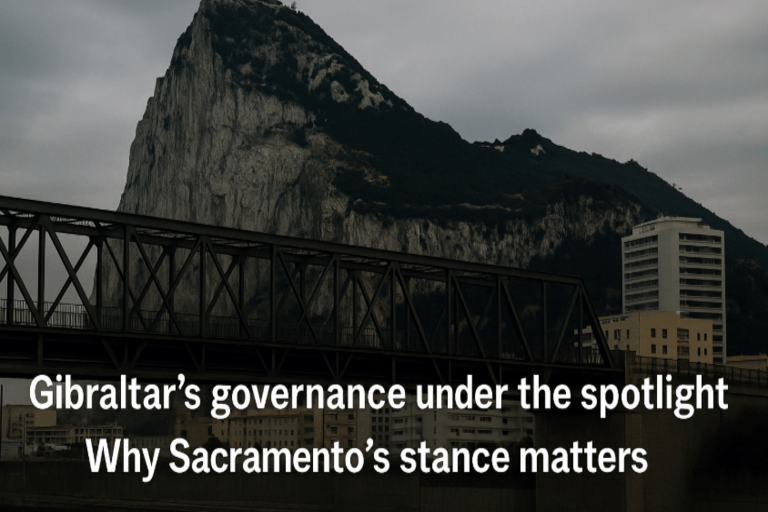
Gibraltar’s governance under the spotlight – the growing credibility gap!
When Gibraltar’s outgoing Principal Auditor, Tony Sacramento, delivered his final report on the territory’s public finances, the findings were not the sort of tidy balance sheets and minor procedural notes that some might expect from a statutory audit. Instead, they revealed patterns of decision-making that have raised serious questions about the territory’s governance, transparency and willingness to submit to independent scrutiny.
The controversy that followed has pitched Sacramento (a career civil servant with nearly four decades in the Audit Office) against the political leadership of Gibraltar, most notably Chief Minister Fabian Picardo. In a jurisdiction where political loyalty is often treated as a prerequisite for professional survival, Sacramento’s refusal to soften or bury his conclusions stands out as an act of professional courage.
While the Government has dismissed his report as politically motivated, “sensationalist,” and unreliable, independent observers such as Transparency International have taken a different view, describing the findings as part of Gibraltar’s “growing list of governance concerns.”





















The exchange between Picardo and Transparency International’s Head of Research, Steve Goodrich (which has now been made public) has further illustrated the gulf between the Auditor’s assessment and the Government’s response. The question now is whether the people of Gibraltar are prepared to accept repeated assurances from their elected officials or whether they will begin to demand the sort of structural reforms that would bring the territory into line with best practice elsewhere.
Key findings from the Auditor’s report!
Sacramento’s 500-page report is notable for three main findings:
First, it identifies over £13 million in ex-gratia payments made between April 2018 and May 2025, including those to retiring police officers. The Auditor described these payments as “excessive and in many cases unwarranted” and said they were made without adequate explanation.
Second, the report highlights the redeployment of 38 police officers to other public sector roles (most on protected pay and conditions) with little or no documented justification for the moves. Sacramento linked a significant proportion of these transfers to the ongoing Commission of Inquiry into the early retirement of former Police Commissioner Ian McGrail.
Third, it records the Chief Minister’s decision to prevent the Auditor from reviewing the Gibraltar Savings Bank’s anti-money laundering processes on the grounds that such an audit might undermine public confidence in the bank.
Transparency International noted that these findings were not minor technical disputes but matters that go to the heart of public sector integrity. The organisation also questioned why Gibraltar does not have a Public Accounts Committee, why its audit legislation has not been updated since the 1970s and why the Auditor’s oversight does not extend to publicly owned companies.
The Government’s counter-attack
In his written reply to Goodrich’s questions, Picardo contested almost every point of the Auditor’s report. The tone of the letter was striking: a mixture of procedural rebuttal, political accusation and personal critique of Sacramento’s motives and independence.
On the ex-gratia payments, Picardo argued that the figure covered a seven-year period, that the payments were made on legal advice and that they were often used to avoid costly litigation. He said Sacramento had received confidential details but chose to portray the settlements as “opaque” and “unwarranted” without giving due weight to risk assessments and legal guidance.
On the police transfers, Picardo rejected outright the suggestion that the moves were intended to shield individuals or obstruct the McGrail Inquiry. He claimed that reasons for the transfers existed across multiple records, some of which were shared with the Auditor and that all were carried out with the knowledge and consent of the former Police Commissioner.
On the Gibraltar Savings Bank audit, Picardo insisted that the Principal Auditor had no statutory remit to conduct such a review, that the bank was already subject to regular audits by PwC and that legal advice supported the Government’s decision to refuse access. He also criticised Sacramento for what he described as a “fluctuating misunderstanding” of his own constitutional limits.
Perhaps most significantly, Picardo accused Sacramento of political bias, claiming his report aligned “almost word for word” with the positions of the Opposition and asserting that he had failed to disclose family links to Opposition figures. He characterised the report as an “indictment, not an audit” and suggested it had been framed with an “anti-Government, party-political purpose.”
Transparency International’s position
Transparency International took the unusual step of publicly challenging the Government’s position, making it clear that Sacramento’s long tenure and professional track record made the allegations of bias difficult to accept at face value.
The watchdog noted that if Sacramento had been a “staunch partisan,” it would be surprising for him to have held senior positions for so many years without being removed. It also drew attention to the structural governance issues highlighted in the report – issues that cannot be dismissed as mere political theatre, such as the absence of a Public Accounts Committee and the lack of updated audit legislation.
The organisation concluded that unless Gibraltar’s ministers accept the role of independent challenge as an essential part of democracy, the territory’s governance failings will continue to surface in the press “for all the wrong reasons.”
Reading between the lines of Picardo’s reply!
Picardo’s letter to Goodrich is presented as a detailed rebuttal, but its underlying message is as much about controlling the narrative as it is about addressing the specific concerns raised. The repeated emphasis on alleged bias, family connections and political alignment suggests a strategy focused on discrediting the messenger rather than engaging with the substance of the message.
By framing the Auditor’s recommendations as partisan interference, the Government sidesteps the broader question of whether the systems in place to safeguard public money are fit for purpose. The insistence that the electorate has “specifically and democratically” chosen not to have a Public Accounts Committee is technically correct in a manifesto sense, but it ignores the reality that voter choice in small jurisdictions is rarely exercised on a single issue of parliamentary oversight.
Equally, while external pressures such as Brexit and the pandemic are cited as reasons for legislative delays, the fact remains that successive administrations have had decades to modernise the Public Finance Act; yet the reforms remain unfinished.
The deeper governance problem
The dispute between Sacramento and the Government is not just a personality clash or a disagreement over audit methodology. It reflects a deeper issue: the concentration of political power in a small jurisdiction, where institutional checks are either absent or weakened and where professional independence can be perceived as political dissent.
Gibraltar’s size is often cited as a reason for avoiding certain accountability measures. However, this argument collapses when compared with other Overseas Territories of similar or smaller populations that maintain robust oversight mechanisms. The Falkland Islands and Montserrat both have functioning Public Accounts Committees. Their existence does not appear to have paralysed government or undermined public confidence.
The reluctance to grant the Auditor oversight of publicly owned companies is also telling. In many jurisdictions, this is standard practice when recognising that public money and risk are just as real when channelled through corporate structures as they are within government departments.
The role of public trust
For a government, public trust is an asset that is easy to spend but hard to replenish. The refusal to share certain information with the Auditor (even when justified on legal or procedural grounds) inevitably fuels suspicion, particularly when the subject matter involves large sums of public money, high-profile personnel movements or institutions such as the Gibraltar Savings Bank.
Once that trust begins to erode, assurances that everything has been handled properly carry less weight. In this respect, the Government’s decision to frame Sacramento’s report as unreliable may have short-term political utility, but it also risks cementing a public perception that legitimate questions are being brushed aside.
Why Sacramento’s stance matters?
In the face of sustained political criticism, Sacramento’s choice to publish his findings without dilution is significant. It is a reminder that the role of an auditor (particularly a Principal Auditor) is not to protect the comfort of those in power, but to provide the public with a clear account of how their money is managed and how their institutions are run.
Auditors who avoid controversy by limiting themselves to technical compliance checks may have quieter careers, but they also risk becoming irrelevant in the broader fight for accountable governance. By contrast, Sacramento’s willingness to identify patterns, link decisions to possible underlying motives and call for structural reform, places him firmly in the tradition of auditors who see their role as part of the democratic fabric.
The road ahead for Gibraltar
The immediate political dispute will fade. Parliamentary statements will be made, counter-statements will follow and in time, other headlines will take its place. Yet the governance issues at the heart of this row are unlikely to resolve themselves.
Without a Public Accounts Committee, Gibraltar lacks a permanent forum where ministers and officials can be systematically questioned on spending decisions. Without updated audit legislation, the Auditor’s remit will remain narrower than that of counterparts in comparable jurisdictions. Without oversight of publicly owned companies, significant areas of financial activity will remain beyond direct public audit.
These are not abstract procedural points. They determine how effectively taxpayers’ money is safeguarded, how conflicts of interest are detected and how misconduct (if it occurs) can be investigated.
Conclusion – a question of priorities
Gibraltar’s leadership has made clear that it sees the criticisms in Sacramento’s report as politically motivated, procedurally flawed and unfair. Transparency International and other observers see them as an overdue reminder that governance structures need to be strengthened, not weakened.
The choice now facing the territory is whether to treat the episode as an unwelcome but necessary opportunity to improve or to continue defending the status quo.
In the end, the measure of any administration is not how it handles good news, but how it responds to uncomfortable truths. On that test, the Government’s handling of Sacramento’s report has done little to reassure those who believe that accountability should be more than a campaign slogan.
FAQs
What is the main focus of Tony Sacramento’s final report?
The report examines Gibraltar’s public finances, highlighting concerns over transparency, governance, and accountability.
Why has the report caused controversy in Gibraltar?
It challenges political decisions and governance practices, prompting strong reactions from the Government and public debate.
What are ex-gratia payments, and why are they significant in the report?
Ex-gratia payments are discretionary payments, and the report flagged £13 million paid between 2018-2025 as excessive and sometimes unjustified.
Why were police officers redeployed according to the report?
The Auditor identified 38 officers moved to other roles with limited documentation, raising concerns about procedural justification.
How did the Government respond to the report’s findings?
Chief Minister Fabian Picardo rejected most criticisms, citing legal advice, procedural justification, and claiming political bias.
What role did Transparency International play in this debate?
Transparency International publicly supported the report’s credibility and emphasized the need for stronger governance structures.
Why does Gibraltar lack a Public Accounts Committee?
The Government claims voters have not prioritized one, though critics argue this absence weakens oversight of public spending.
What is the significance of Gibraltar Savings Bank in the report?
Sacramento was blocked from auditing its anti-money laundering processes, which the Government justified with legal and procedural grounds.
How does this dispute reflect broader governance challenges?
It highlights the concentration of political power, limited checks and balances, and risks to professional independence in a small jurisdiction.
Why is public trust at stake in this controversy?
Failure to provide transparency and respond to legitimate audit concerns can erode confidence in the Government’s handling of public funds.

Michael
With nearly 30 years in corporate services and investigative journalism, I head TRIDER.UK, specializing in deep-dive research into gaming and finance. As Editor of Malta Media, I deliver sharp investigative coverage of iGaming and financial services. My experience also includes leading corporate formations and navigating complex international business structures.