


Illegal Gozo Apartment Block Faces New Legal Battle
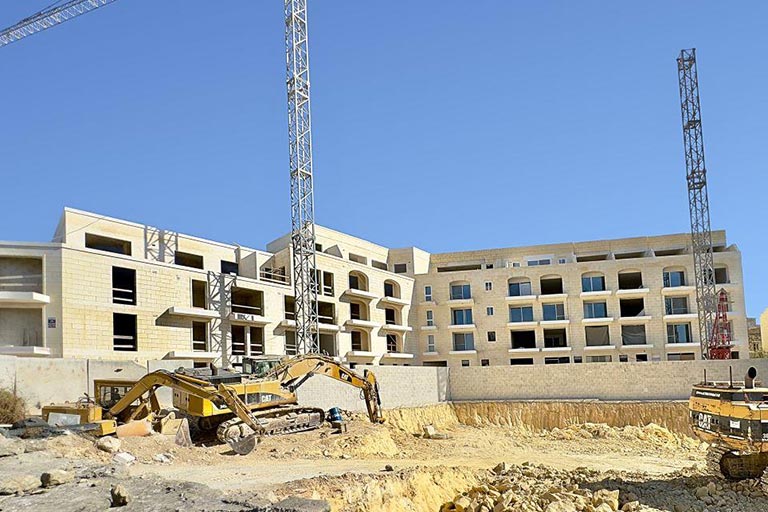
Gozitan property developer Francesco Grima, more commonly referred to as “Il-Gigu,” has once again found himself at the center of controversy. His latest move to circumvent a court ruling that deemed his Xewkija apartment block illegal has sparked outrage among planning authorities, environmental groups, and residents alike. In what appears to be a calculated legal maneuver, Grima has subdivided the original development into three distinct planning applications, seemingly to sidestep the judicial decision that rendered the entire project unlawful.
Investigative reports from The Shift have revealed that two of these applications, PA01155/25 and PA01133/25, were submitted under the pretense of being filed on behalf of individuals who had purchased units in the contested development. This tactic presents an attempt to reframe the case as an issue affecting individual property owners rather than an overarching illegal construction scheme.
Additionally, towards the end of 2024, Grima filed PA07954/24 through an intermediary, his employee James Zammit. This application pertains to Block A, covering another section of the disputed project while simultaneously seeking retroactive approval for construction that was explicitly ruled unlawful by Malta’s Court of Appeal in 2023.


The Role of a Politically Connected Architect
All three applications have been fronted by architect Alexander Bigeni, who has notable familial ties to Planning Minister Clint Camilleri. While Minister Camilleri has denied any direct involvement in the matter, stating that he has no business relations with either Bigeni or Grima, the connection has nevertheless raised questions about potential conflicts of interest. The controversy surrounding this association has amplified public concerns over political influence in Malta’s planning processes.
The Court’s Verdict and the Planning Authority’s Hesitation
Despite the legal battle that led to the court’s decision, there remains a significant gap in enforcement. The Court of Appeal’s ruling in 2023 unambiguously deemed the development illegal, citing its violation of Gozo’s local planning guidelines. However, while the ruling revoked the permit, it did not go as far as issuing a demolition order for the structure. This omission has left the matter in the hands of the Planning Authority, which has yet to take decisive action on Grima’s new applications.
Public objections against these applications are mounting, with residents and advocacy groups calling them an outright defiance of the judiciary. One complaint has labeled the situation “surreal,” denouncing it as an example of how developers manipulate loopholes to evade consequences for unlawful construction.
The Mulberry Court Controversy: A Deep Dive
Origins of the Disputed Development
The saga of Mulberry Court dates back to 2020 when Grima first proposed the construction of a multi-unit residential complex on a significant tract of land in Xewkija. From the outset, the project faced substantial opposition. Local residents, NGOs, and the Superintendence for Cultural Heritage objected to the plans, citing concerns over environmental degradation, historical site encroachment, and blatant violations of urban planning laws.
Despite these objections, the Planning Authority surprisingly granted the permit. What made this decision particularly contentious was that the PA approved the application against the recommendations of its own planning directorate. The local development plan for the area expressly limits buildings to three stories. However, Grima sought—and ultimately received—approval to construct a five-story complex.
Defying Legal Orders and Proceeding with Construction
Even as legal challenges were mounted against the permit, Grima proceeded with construction undeterred. By 2023, the building was fully completed, standing in clear violation of Malta’s planning regulations. The legal battle eventually culminated in a landmark decision by Chief Justice Mark Chetcuti, who invalidated the permit, stating unequivocally that the project had never been legally authorized.
Despite this ruling, Grima has refused to acknowledge the verdict in practical terms. Instead of addressing the violations by modifying or dismantling the development, he has now attempted to repackage the same project under different applications, hoping to secure approval through fragmented submissions.
A Developer with a History of Controversial Projects
Multiple Questionable Deals
Francesco Grima is no stranger to controversy. Over the years, he has gained a reputation for engaging in questionable real estate ventures, many of which have drawn scrutiny due to their environmental impact, legal irregularities, and allegations of political favoritism. His ability to secure permits for projects that contradict established planning regulations has fueled speculation about undue influence within Malta’s planning institutions.
One of the most contentious developments linked to Grima is the ongoing redevelopment of Fort Chambray, a historically significant site in Gozo. Alongside a group of investors, Grima has entered into an agreement to acquire the concession rights from businessman Michael Caruana, also known as “Il-Billi.” This project aims to transform the historic fortress into a commercial residential and hospitality complex.
The Controversial Fort Chambray Project
Fort Chambray, a relic from the Knights of St. John, stands as a symbol of Gozo’s rich history. However, under the proposed redevelopment plan, portions of the site, including unique British-era barracks, are set to be dismantled to make way for new residential units and a luxury hotel. This has drawn strong opposition from cultural preservationists who argue that such a transformation would result in the irreversible loss of a key piece of Gozo’s heritage.
Despite public backlash, the Maltese Parliament has approved the transfer of the concession, effectively granting Grima and his associates control over the future of the site. Critics argue that this decision prioritizes commercial gain over historical preservation, raising concerns about the broader implications of allowing private developers to repurpose Malta’s cultural landmarks.
Legal and Political Implications
The controversy surrounding Grima’s actions in Xewkija has intensified calls for greater oversight within Malta’s planning system. His latest strategy—submitting multiple applications to circumvent a court ruling—has exposed significant loopholes in the enforcement of urban development laws. This case highlights broader systemic failures, including the inability of regulatory bodies to take decisive action against unlawful construction.
Furthermore, the involvement of architect Alexander Bigeni, a relative of a sitting government minister, has deepened suspicions regarding potential political interference in the planning process. While no direct evidence of wrongdoing has surfaced, the optics of the situation have fueled public mistrust in the integrity of Malta’s regulatory institutions.
Conclusion
Francesco Grima’s handling of the Xewkija development controversy exemplifies the ongoing challenges facing Malta’s urban planning sector. His attempts to repackage an illegal development through multiple applications underscore the gaps in enforcement mechanisms and the potential for developers to exploit bureaucratic loopholes.
As the Planning Authority deliberates on the latest applications, the case has become a litmus test for the country’s commitment to upholding its legal framework. Whether regulatory bodies will take decisive action or allow Grima’s latest maneuver to succeed remains to be seen. What is certain, however, is that the outcome of this case will set a significant precedent for future planning disputes in Malta.
FAQs
What was the court ruling against Francesco Grima’s development?
The Court of Appeal ruled that Grima’s apartment block in Xewkija was illegal and in violation of local planning regulations, revoking its permit.
How is Grima trying to bypass the ruling?
He has divided the illegal development into three separate planning applications, seeking retroactive approval for each section individually.
Why didn’t the court order the demolition of the illegal building?
While the court revoked the permit, it did not issue an enforcement order mandating demolition, leaving enforcement to the Planning Authority.
Who is handling the new applications?
Architect Alexander Bigeni, a relative of Planning Minister Clint Camilleri, is overseeing all three applications.
What objections have been raised against the new applications?
Residents and NGOs have filed multiple objections, calling Grima’s actions an attempt to undermine the legal system.
What is the Fort Chambray redevelopment controversy?
Grima and associates plan to turn the historic Knights-era fort into apartments and a hotel, dismantling British-era barracks in the process.
Why did the Planning Authority approve the original illegal development?
The PA granted a permit despite objections from its own directorate, raising concerns about regulatory oversight and political influence.
Has Francesco Grima been involved in other controversial projects?
Yes, he has been linked to multiple dubious developments and has received direct contracts from the Gozo Ministry.
What is the significance of the Mulberry Court project?
It highlights systemic issues within Malta’s planning framework, including lack of enforcement and political connections influencing decisions.
Will the Planning Authority take action against Grima’s new applications?
The PA has yet to decide, but public pressure is mounting for enforcement against illegal construction practices.

Ash
I like to keep it short. I am a writer who also knows how to rhyme his lines. I can write articles, edit them and also carve out some poetic lines from my mind. Education B.A. - English, Delhi University, India, Graduated 2017.


