Mansion Group: Jurisdictions of convenience and the limits of regulation
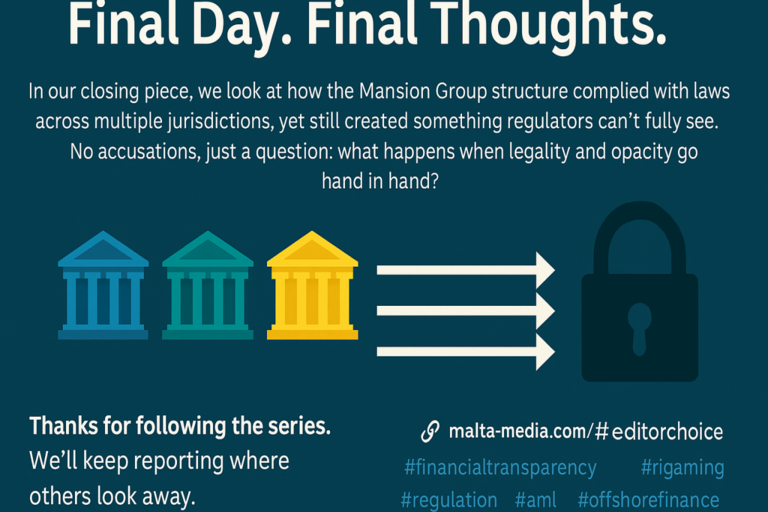
Finishing this seven-part series, it is worth stepping back to ask: what have we really learned from examining Mansion Group’s international structure?
On paper, everything checks out. Companies are registered where they should be. Foundations follow the local rules. Licences are issued by the right authorities. If you were only looking at the surface, you might be tempted to think the system works exactly as intended.
But beneath that surface, the patterns tell a very different story. The Mansion network shows how legal frameworks across Gibraltar, the British Virgin Islands, Curaçao and Malta can be perfectly aligned with local compliance, yet still create a global structure that is almost impossible to monitor in full. When ownership, revenue streams and operational decision-making are spread across four or more countries, no single regulator ever holds the whole picture.
In some ways, that is the genius of the model. Fragmentation becomes a strategy. By distributing control, dispersing financial flows and layering corporate appointments, the Mansion Group could operate within the law of each country while remaining largely opaque to any consolidated oversight.





















It is important to say again that no evidence of illegality has been identified. The individuals and companies mentioned have all operated within their respective legal frameworks, based on the information currently available. This series has not made accusations. It has, however, highlighted how the global regulatory system itself often struggles to cope with complex, cross-border operations that sit comfortably inside fragmented legal silos.
I have spent a lot of time reading through the filings, the internal records, the whistleblower notes. What strikes me most is not any one structure in particular, but the sheer normality of it all. This is how international business is done. Professionals, advisers and fiduciaries facilitate these networks because the system expects them to. In the Mansion case, names like Peter Isola, Albert Isola, Marcus Killick, James Lasry, Michael Castiel, Nigel Feetham KC MP and many others simply reflect the professional ecosystem that exists in places like Gibraltar and Malta. Their expertise helped build the system. They did not create the outcomes the system enables.
The involvement of foundations, shell companies and private trustees linked to the Sampoerna Family (including Putera Sampoerna, Kathleen Chow Liem Sampoerna and Michael Sampoerna) further illustrates the point. Nothing in their use of private foundations or offshore entities breaches the law. Yet it also shows how private wealth, asset protection and philanthropy increasingly intersect in ways that are invisible to ordinary scrutiny.
For regulators, policymakers and compliance officers, this should raise serious questions. If legal systems designed for national borders cannot meaningfully oversee structures that operate across them, what tools are left to ensure accountability? And if beneficial ownership can be dispersed across so many jurisdictions that no authority can ever draw a full map, is transparency even a realistic goal?
In many ways, the Mansion case study is not about one company, one family, or one group of advisers. It is about the structural limits of the international legal and regulatory model itself.
For all the good intentions behind initiatives like the Sixth Anti-Money Laundering Directive (6AMLD) and the FATF’s global standards, there remains a fundamental problem. As long as different jurisdictions offer complementary advantages: Confidentiality in one, tax neutrality in another, regulatory recognition in a third! International corporate structuring will continue to outpace the reach of any one country's laws.
At Malta-Media, our aim was never to imply misconduct or criminality where none has been proven. It was and remains, to offer transparency where complexity obscures visibility. Because if we cannot see how things work, we cannot even begin to ask whether they should work that way.
Thank you for following along with this Mansion Group Exposure Campaign. We will continue to monitor developments in this area and remain committed to publishing fair, balanced and evidence-driven reporting on the structures shaping international finance, iGaming and private wealth today.
Legal Disclaimer and Ongoing Investigations
As with all editorial content published by Malta-Media, no allegation of unlawful conduct is made against any individual or entity referenced herein. The information presented is derived from publicly accessible registries, corporate databases, internal documentation and confidential submissions believed to be accurate and reliable at the time of publication. Interpretations, where offered, reflect the editorial team’s understanding of jurisdictional structures and regulatory environments and are not intended to imply misconduct or unlawful intent.
This article forms part of an ongoing investigative series examining the legal, financial and operational structures within the online gambling sector. The aim is to contribute to public understanding by outlining governance models, licensing regimes and cross-border frameworks. Malta-Media acknowledges the complexity of these issues and welcomes clarifications or formal responses from any individuals or organisations named. Substantiated responses will be published in full, unedited and with equal prominence.
We continue to invite confidential submissions through our encrypted reporting platform. Individuals with information relevant to this or related investigations may contact us securely and anonymously via our whistleblower form.
FAQs
What is the main takeaway from the Mansion Group series?
The series reveals how global legal structures, while compliant in each jurisdiction, can create systems that lack consolidated oversight.
Is there evidence of illegality in Mansion Group’s operations?
No. The investigation found no proof of unlawful activity. All entities operated within their respective legal frameworks.
Why is the Mansion Group case significant?
It highlights the limitations of international legal systems in regulating cross-border corporate structures effectively.
Which jurisdictions are involved in Mansion Group’s structure?
The network spans Gibraltar, the British Virgin Islands, Curaçao, and Malta.
What challenges do regulators face with such structures?
Regulators often can't access the full picture due to the fragmentation of ownership and oversight across multiple jurisdictions.
Who are some key professionals mentioned in the series?
Figures like Peter Isola, Marcus Killick, and Nigel Feetham KC MP are noted for their roles in the legal and fiduciary ecosystems.
Does the involvement of foundations and trusts imply wrongdoing?
No. Their use is legal and common in wealth management, but they often reduce transparency.
How does the Mansion Group reflect broader industry practices?
It represents how international business is often conducted—legally, yet opaquely—by leveraging jurisdictional advantages.
What is the role of initiatives like 6AMLD and FATF standards?
These aim to enhance anti-money laundering measures, but face challenges due to varying national laws and enforcement gaps.
What does Malta-Media aim to achieve with this series?
The goal is to promote transparency in global finance by demystifying complex corporate and legal arrangements.

Michael
With nearly 30 years in corporate services and investigative journalism, I head TRIDER.UK, specializing in deep-dive research into gaming and finance. As Editor of Malta Media, I deliver sharp investigative coverage of iGaming and financial services. My experience also includes leading corporate formations and navigating complex international business structures.
Related Posts

Golden Whale appoints Jaime Ocampo as Asia Managing Director
April 13, 2026






Onlyplay launches Hot Dunk basketball slot with free spins
April 10, 2026