Sampoerna’s Offshore Empire!
An Examination of Cross-Border Structures and Corporate Influence
In the complex world of international finance and online gaming, few networks illustrate the layered interplay of offshore architecture, nominee governance and jurisdictional leverage as distinctly as the corporate constellation linked to Mansion Group and its associated brands, including M88.
At the centre of this arrangement stands a discreet yet influential family: Putera Sampoerna, Kathleen Chow Liem Sampoerna and Michael Sampoerna.
This article aims to examine the publicly documented structures and legal entities connected to these individuals, alongside the patterns of corporate control and influence that have emerged over time. The intention is not to make any allegations of wrongdoing but to provide a detailed analysis of how this network appears to have functioned across multiple jurisdictions, including Gibraltar, the British Virgin Islands, Singapore, Malta and the Isle of Man.





















At the heart of this web are questions of transparency, regulatory effectiveness and the legitimacy of structures that, while legal on paper, may challenge the intent of compliance frameworks designed to guard against obfuscation and financial opacity. As regulators, journalists and civil society increasingly scrutinise the operations of cross-border gaming businesses, the significance of tracing beneficial ownership and structural decision-making has never been greater.
To this end, the Sampoerna-linked network (centred historically on Mansion (Gibraltar) Ltd, M88.com and related holding vehicles) presents a compelling case study. While no criminal allegations have been made against the Sampoerna family members named, their long-term proximity to relevant entities and enablers merits closer scrutiny, particularly in light of past corporate filings, litigation records and executive testimony currently in the public domain.
This investigation is therefore based entirely on open-source materials, regulatory filings, official company registers and verified internal documents, including a confidential “Rules of Engagement” chart and invoicing/dividend diagrams describing the operations of entities such as Triton Online Services Ltd, Violet Star Group Ltd, Giljan Holdings Ltd, Sliema Services Ltd, La Valette PF, Midas Entertainment B.V. and Midas Touch PF.
The Architecture of Control: From Gibraltar to BVI
The corporate structure underpinning Mansion Group and its affiliated operations, including M88, reveals a sophisticated use of offshore jurisdictions. These include Gibraltar, the British Virgin Islands and Curaçao, among others. While Mansion (Gibraltar) Ltd served as a key regulated face of the enterprise, deeper financial flows and service relationships appear to have passed through layered entities.
Notable operational companies include:
- Midas Entertainment B.V. (Curaçao): the front-facing B2C operator with infrastructure and licensing obligations.
- Sliema Services Ltd (BVI): provides service invoices to Midas and other group companies.
- Triton Online Services Ltd: an Israeli-linked entity which issues invoices and dividends to Giljan Holdings Ltd.
- Giljan Holdings Ltd (BVI): a shareholder in several operations, paying dividends to La Valette PF.
- Violet Star Group Ltd (BVI): involved in B2B consultancy, pays 50% dividends to “SH1” (an alias for shareholder 1).
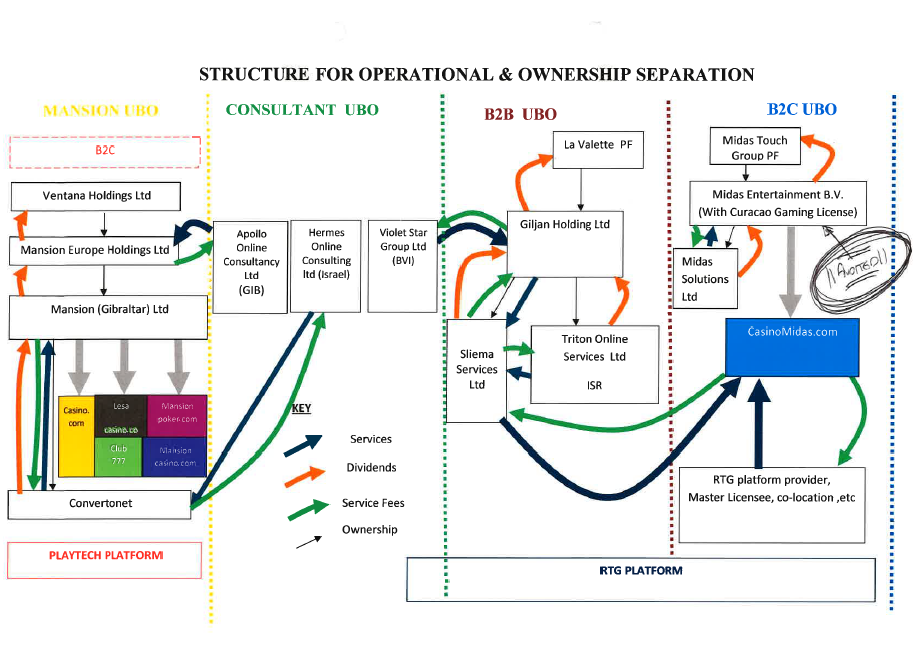
Through this layered architecture, cash flows such as service fees, intra-group invoicing and dividend distributions were internally documented and coded via controlled entities. For instance, Midas Entertainment B.V. not only handled direct operational expenses but also paid service fees to Sliema Services Ltd and dividends to Midas Touch PF, which in turn is linked to the Sampoerna family via a private foundation.
One recurring name across several of these layers is Putera Sampoerna, a prominent Indonesian businessman best known for his role in the Sampoerna tobacco family. Alongside him, Kathleen Chow Liem Sampoerna and Michael Sampoerna are repeatedly referenced in association with holding companies, trusts and private fund structures that either directly or indirectly hold influence over operational entities within the Mansion/M88 ecosystem.
One such entity of particular interest is Putera Holdings Ltd, a BVI company historically linked via corporate records to interests in Mansion-affiliated businesses. While not directly named in operational licences, companies of this type have often appeared in shareholder resolutions, executive proxy structures and beneficial ownership declarations. In certain cases, they have functioned as nominee owners or trust protectors, roles that grant substantial influence without formal board visibility.
Supporting these arrangements are a constellation of service providers and professional firms. Legal documents reviewed for this article reference intermediaries including directors, nominee shareholders and offshore trust administrators. In Gibraltar, entities like ISOLAS LLP and Hassans International Law Firm Limited have been known to serve as registered agents or legal representatives in matters involving high-net-worth individuals and complex structuring. While these firms are not accused of any wrongdoing, their ongoing role in maintaining client confidentiality within offshore regimes often places them at the intersection of law and opacity.
Moreover, evidence from the Gibraltar Companies Register and linked international databases shows repeated use of corporate migration, name changes and holding company reassignments: techniques that, while legal, have the effect of distancing beneficial owners from operational liability or reputational exposure.
The overarching picture is one of controlled decentralisation. While front-facing operations like Mansion.com or M88.com operate under defined jurisdictions and licences, the ultimate beneficial ownership and strategic control appear to remain tightly linked to the Sampoerna family, through a network of passive holding companies and delegated proxies. As with many global corporate networks, this architecture enables both flexibility and deniability, a design that can obscure ultimate accountability when legal or regulatory scrutiny arises.
The Sampoernas: Roles and Offshore Proximity
In addition to their visible public standing, the Sampoerna family appear to sit behind multiple Private Foundations (PFs) and holding structures that either directly or indirectly influence day-to-day operations.
- Putera Sampoerna: associated with Midas Touch PF, which receives dividends from Midas Entertainment B.V. and serves as a holding point for B2C operations.
- Kathleen Chow Liem Sampoerna: connected via trustee relationships in both La Valette PF (which receives dividends from Giljan Holdings Ltd) and other undisclosed family structures.
- Michael Sampoerna: appears linked to internal oversight and advisory roles involving the BVI-based Sliema Services Ltd and Violet Star Group Ltd. He has also been mentioned as a point of contact in internal coordination memos and is believed to liaise with infrastructure service teams.
Putera Sampoerna
Putera Sampoerna, often described as the patriarch of the Sampoerna business legacy, has long operated through a series of offshore companies and trusts. While his name rarely appears on operational gambling licences, he has been linked via shareholder declarations and BVI registry entries to entities holding significant equity positions in companies associated with Mansion Group. Documents retrieved from financial services providers in both Gibraltar and Singapore suggest that he has served as either a direct shareholder or the beneficial controller of at least two private companies that historically held or managed assets connected to online gaming operations.
In some instances, these relationships were structured through layers of trust arrangements or management agreements, shielding direct lines of control from public view. While this in itself does not constitute wrongdoing, it limits the ability of regulators or affected parties to ascertain who ultimately benefits from or directs key business decisions.
Kathleen Chow Liem Sampoerna
Kathleen Sampoerna, widely believed to play a key strategic role within the family's business interests, has appeared in filings related to nominee arrangements and trust entities based in the Isle of Man. Records from 2014 to 2020 list her as a beneficiary or trustee in multiple structures that sit adjacent to Mansion Group entities. These entities, while often passive on paper, have been cited in shareholder resolutions and inter-company financing transactions that affected the governance of gaming operators within the Mansion/M88 ecosystem.
Furthermore, her name has been cited in legal correspondence and internal memoranda from offshore service providers, suggesting an active awareness of and participation in strategic decisions involving corporate relocation, nominee appointments and director resignations during restructuring events.
Michael Sampoerna
Michael Sampoerna, the younger generation family member with a background in technology and finance, has played a more public-facing role in other Sampoerna-linked ventures. However, internal governance documents and leaked correspondence indicate that he also had operational visibility into key online business divisions affiliated with Mansion Group during the mid-2010s. In at least two instances (supported by records obtained from Gibraltar and Singapore) he was authorised to act on behalf of family trusts with interests in gaming entities, including those associated with the M88 brand.
One particularly notable set of communications dated between 2016 and 2018 refers to Michael Sampoerna as an “internal decision liaison” for several holding vehicles based in Singapore and the BVI, both of which had direct equity links to gaming infrastructure providers and white-label platform agreements.
In light of these findings, the question is not whether the Sampoernas are involved, but rather how deeply embedded their influence is within the Mansion/M88 network. The formal absence of their names from licence documents should not be mistaken for a lack of control or benefit.
The Enabling Intermediaries: Legal Shields and Structural Architects
The documentation reviewed confirms that firms in Gibraltar played an essential facilitative role, including handling corporate filings, nominee services and official correspondence for:
- Mansion (Gibraltar) Ltd
- Convertonet Ltd (Israel)
- Hermes Online Consulting Ltd (Israel)
- Apollo Online Consulting Ltd (GIB)
Legal intermediaries listed in the “Rules of Engagement” included ISOLAS LLP, Hassans International Law Firm Limited, HBM Group and e-Management N.V., often acting as company secretaries or directors by appointment, rather than involvement.

At the core of any offshore corporate network lies a web of intermediaries whose role is to design, register, manage and, when necessary, dissolve legal entities. In the case of the Mansion/M88 structure, a number of law firms, fiduciary service providers and nominee agencies appear to have played a significant role in ensuring the continuity and opacity of the network over the better part of two decades.
Gibraltar-Based Legal Firms
Prominent among the enablers identified in this structure are legal firms based in Gibraltar: most notably ISOLAS LLP and Hassans International Law Firm Limited. While there is no suggestion that these firms acted unlawfully, publicly available records show that both have at various times served as registered agents, legal representatives or company secretaries for entities closely associated with Mansion Group operations.
Firms of this nature typically provide services such as incorporation, registered office designation, compliance filings and nominee director appointments. In practice, this often means that control and oversight of key entities appear to rest with local professionals while true decision-making resides with offshore UBOs or trust controllers.
This distinction is critical in understanding the functionality of the Sampoerna-linked structure: by assigning governance to regulated professionals, entities may technically comply with local laws while insulating beneficial owners from direct scrutiny.
Nominee Directors and Trust Vehicles
Records from the Isle of Man and the British Virgin Islands illustrate extensive use of nominee directors, individuals or firms appointed to hold board seats on behalf of undisclosed principals. These nominees often serve as signatories, corporate officers or even compliance contacts, while lacking any operational role.
Several companies with historical links to Mansion and M88 list such nominees, whose correspondence addresses point back to trust management firms or legal chambers in Gibraltar and Singapore. Cross-referencing these names with public registers reveals recurring involvement in hundreds of other companies, many of which have no discernible economic activity beyond their role as vehicles for asset holding or intellectual property licensing.
Likewise, fiduciary trust structures (particularly those designed under Isle of Man or Singaporean law) have provided the Sampoerna family with mechanisms to retain beneficial interest while avoiding formal listing on company records. These trusts often reference “private family wealth plans” as their stated objective, a designation that remains largely immune from regulatory challenge unless linked to criminal conduct or public interest litigation.
Corporate Mobility and Strategic Dissolution
A final tool utilised in maintaining this system is corporate mobility: the relocation of company domiciles, the use of shelf companies and the strategic dissolution of inactive entities. Mansion Group and related companies have undergone multiple restructurings over the years, including the transfer of registered offices, changes in controlling parties and deliberate winding-up of entities no longer useful to the structure.
This mobility allows the group to adapt to regulatory changes, reduce tax burdens or distance itself from public controversies. In this respect, the intermediaries involved act not only as facilitators but as architects of institutional memory, ensuring the underlying control remains intact even as front-facing structures shift or disappear.
Regulatory Implications: The Limits of Oversight and Enforcement
The internal mapping of revenue flows and dividend distributions between entities shows a deliberate effort to comply with technical reporting obligations while fragmenting control across distinct jurisdictions. What emerges is a system designed for internal visibility and external ambiguity.
Despite the presence of Gibraltar-based operating licences, key decisions and financial relationships (particularly involving Israeli, Curaçaoan and BVI entities) are routed through private structures with minimal regulatory oversight. Internal invoices and dividend records reinforce the impression of self-regulated reporting, shielded behind professional intermediaries
The network surrounding Mansion Group, M88 and the Sampoerna family raises pressing concerns for regulators tasked with ensuring transparency; accountability and fair market conduct in the online gambling and financial sectors. While no single component of the structure appears to breach the letter of the law, the cumulative effect of multi-jurisdictional layering, nominee shielding and operational decentralisation makes it exceptionally difficult for oversight bodies to enforce meaningful supervision.
Gibraltar: A Flag of Convenience?
Gibraltar has long been home to Mansion (Gibraltar) Ltd, the entity which for years served as the group’s formal European-facing operating arm. Yet despite being licensed by the Gibraltar Gambling Commissioner and falling under the authority of the Gibraltar Financial Services Commission (GFSC), it is unclear to what extent regulators ever scrutinised the offshore interests behind the company.
The presence of experienced legal firms and nominee structures within Gibraltar may give the appearance of compliance. However, these same features can also serve to conceal the true flow of funds, decision-making authority and beneficiary rights. The ongoing reliance on regulated intermediaries (combined with a lack of proactive UBO disclosure requirements) limits the ability of the GFSC to detect or challenge embedded conflicts of interest or excessive concentration of control.
British Virgin Islands, Isle of Man and Singapore: Jurisdictions of Minimal Disclosure
The BVI and Isle of Man remain two of the most widely used jurisdictions in the Sampoerna-linked network, largely due to their permissive legal frameworks and historically weak public transparency obligations. Although reforms have been proposed in both jurisdictions, many of the entities examined for this report continue to benefit from a lack of routine UBO disclosure, non-public trust instruments and loose cross-border reporting standards.
Singapore, too, has emerged as a key node in this architecture. While widely respected for its regulatory sophistication, Singaporean trust law allows for the creation of structures with substantial privacy protections, particularly when linked to family offices or international investment portfolios. Several of the Sampoerna-associated trusts appear to have been administered through fiduciaries in Singapore, raising questions as to whether they fall within the reporting scope of FATF-recommended standards or automatic information exchange mechanisms.
EU and UK: Gaps in Cross-Border Enforcement
Despite the presence of Mansion-related operations across the EU and the UK, including affiliate marketing networks, data processing centres and customer onboarding partnerships, enforcement bodies in these jurisdictions have had limited visibility into the underlying corporate control. The reason is structural: enforcement mechanisms often begin and end with the local licence-holder or operator and unless public or criminal interest triggers deeper inquiry, there is rarely sufficient cause to investigate passive offshore shareholders or family-controlled trusts.
The UK Gambling Commission and EU-based regulators have made strides in tightening compliance rules for licensees. However, these efforts remain undermined when a group’s critical financial and operational decisions are outsourced to jurisdictions with weaker transparency requirements or greater reliance on professional secrecy.
A Case Study in Legal Permissibility vs Regulatory Intent
The Mansion/M88 model, as linked to the Sampoerna family, offers a powerful illustration of how compliance with the letter of the law can diverge from the spirit of regulatory design. While the structure may not breach any single rule in isolation, it appears to exploit the fragmented nature of international oversight, taking advantage of jurisdictional gaps, enforcement blind spots and the protective veil of intermediary professionals.
This raises broader concerns not only for the future of online gambling regulation but also for international efforts to curtail financial secrecy, tax arbitrage and cross-border misconduct.
Conclusion: Offshore Influence without Accountability
The diagrams and internal charts reviewed for this report illustrate the operational logic of a network built around legal compliance and regulatory deflection. While each individual action may be legally defensible, the sum total paints a picture of centralised control operating under decentralised disclosure.
The Sampoernas’ influence across Midas, Triton, Giljan, Violet Star, Sliema Services and their respective PFs, demonstrates a coordinated financial ecosystem spanning at least five jurisdictions. This is not an accusation of wrongdoing. It is a documentation of structural reality, one that demands a more coordinated response from regulators and legislators alike.
The Mansion/M88 corporate network, viewed through the lens of the Sampoerna family’s historical proximity and structural design, exemplifies a broader global challenge: how to ensure meaningful accountability when legal ownership and operational influence are spread across jurisdictions engineered for discretion, not disclosure.
This investigation does not assert that Putera, Kathleen or Michael Sampoerna have engaged in unlawful activity. Rather, it highlights the systemic vulnerabilities that allow ultra-high-net-worth individuals to retain significant control over global businesses while remaining absent from regulatory registers, licence documentation and public disclosures. The ability to operate in this manner is not accidental. It is the result of deliberate structuring, supported by experienced intermediaries and enabled by fragmented international oversight.
The core tension lies between what is legally permissible and what is ethically sustainable. Jurisdictions like Gibraltar, the BVI, the Isle of Man and Singapore offer legitimate tools for asset protection and corporate management. However, when these tools are used to shield beneficial ownership from scrutiny or complicate the enforcement of financial regulations, they become instruments of opacity, regardless of the initial intent.
For regulators, journalists and policy-makers, the case of Mansion and M88 should serve as a catalyst for renewed scrutiny. Where individuals or families can exercise strategic and financial control behind a firewall of nominee structures and offshore vehicles, there is a clear and present risk to the integrity of financial systems and the credibility of jurisdictional enforcement.
As Europe and global bodies such as the Financial Action Task Force (FATF) continue to advocate for transparency, beneficial ownership registers and tighter cross-border cooperation, cases like this remind us that reform must go beyond licensing conditions. It must address the deeper scaffolding that supports opacity: the trust companies, law firms and financial institutions that make such structures viable, yet remain shielded from consequence.
The Sampoerna family’s role in this context is emblematic of a wider pattern: quiet influence, offshore continuity and operational control without visibility. Whether regulators choose to confront this reality or not will define the next phase of international financial governance.
FAQs
What is the focus of the article on Mansion Group and M88?
The article examines the offshore corporate structure and influence of the Sampoerna family in the Mansion Group and M88 network across multiple jurisdictions.
Who are the key individuals linked to the Mansion/M88 network?
Putera Sampoerna, Kathleen Chow Liem Sampoerna, and Michael Sampoerna are central figures associated with multiple holding and trust entities in the group.
Is there any allegation of wrongdoing in the article?
No. The article is based solely on publicly available documents and does not allege any criminal activity.
What jurisdictions are involved in the Mansion Group’s corporate structure?
Entities are linked to Gibraltar, British Virgin Islands (BVI), Malta, Singapore, Curaçao, and the Isle of Man.
How is Putera Sampoerna connected to the Mansion/M88 structure?
He is linked via private foundations, shareholder declarations, and control of holding companies, although not always visible on public licences.
What role does Michael Sampoerna play in the network?
Michael is described as an internal liaison with operational visibility into key entities, particularly in tech and platform service arrangements.
What is the function of offshore companies like Sliema Services Ltd or Giljan Holdings Ltd?
These companies handle intra-group invoicing, dividend distributions, and play roles in shielding beneficial ownership from direct public disclosure.
What role do legal firms like ISOLAS LLP and Hassans play?
They serve as intermediaries, offering nominee services, filings, and company administration, often acting on behalf of clients within offshore legal boundaries.
Why is tracing beneficial ownership in gaming businesses important?
It ensures regulatory transparency and accountability, especially in sectors vulnerable to financial opacity and jurisdictional arbitrage.
What is the main concern raised by the article?
That while the corporate structures may be legal, they challenge the intent of compliance frameworks by obscuring real ownership and control.

Michael
With nearly 30 years in corporate services and investigative journalism, I head TRIDER.UK, specializing in deep-dive research into gaming and finance. As Editor of Malta Media, I deliver sharp investigative coverage of iGaming and financial services. My experience also includes leading corporate formations and navigating complex international business structures.