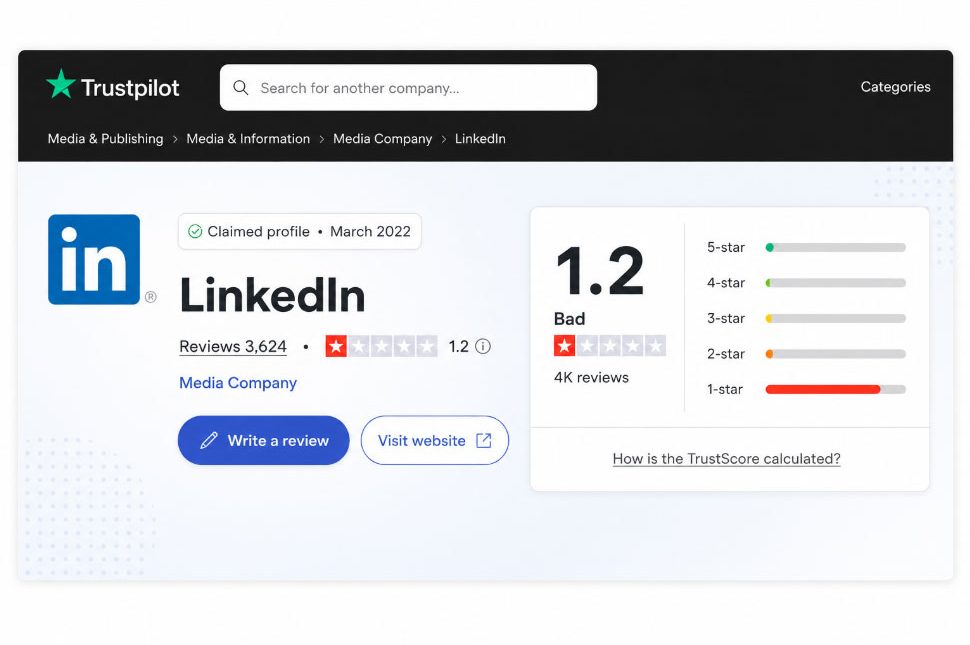
Would you buy from a website with a 1.2 rating? Would you enter your card details, upload your identity documents, build your business presence, store your professional contacts and rely on that company to protect your reputation if thousands of public reviews had already pushed it close to the bottom of the trust scale? Most people would not. They would hesitate before ordering a cheap product from an unknown online shop with that score, let alone trusting it with their career, professional visibility, company page, advertising account or personal identity.
That is why LinkedIn’s public Trustpilot rating is not just embarrassing. It is a reputational contradiction hiding in plain sight. LinkedIn is not a small e-commerce store, a suspicious crypto scheme, a bonus casino operating from a grey zone or a faceless online service nobody has heard of. It is one of the world’s most influential professional platforms, owned by Microsoft, used by recruiters, journalists, founders, executives, jobseekers, media companies and advertisers. Yet its public customer review profile sits at a level many ordinary consumers would normally treat as a warning sign. The question almost asks itself.
If LinkedIn users saw a company profile with a 1.2 rating, would they trust that company?
Would recruiters trust it?
Would investors trust it?
Would LinkedIn’s own algorithm reward that business as credible, reliable and professional?
Or would everyone quietly understand that a score like that usually means something has gone badly wrong between the company and the people who depend on it?
The platform that sells trust has a trust problem
LinkedIn’s entire brand is built around professional credibility. It asks people to build verified identities, publish career histories, connect with colleagues, engage with business partners and treat the platform as a serious layer of the modern working world. It is not marketed as entertainment. It is not presented as a throwaway social network. LinkedIn positions itself as infrastructure for professional life, career development, recruitment, business development, thought leadership, advertising and personal reputation.
That makes a 1.2 rating much more serious than an ordinary customer service problem. When a restaurant has bad reviews, people may choose another restaurant. When a delivery company has bad reviews, people may use a different courier. But when LinkedIn restricts or removes access, the consequences can be far greater than inconvenience. A user may lose access to business contacts, company pages, publishing reach, paid advertising tools, messages, job applications, professional credibility and years of accumulated visibility.
This is where the public rating becomes dangerous for LinkedIn’s reputation. A platform that sells itself on trust cannot simply ignore a public trust signal this low. It cannot ask businesses to invest in visibility, users to pay for Premium, advertisers to buy campaigns and professionals to build their identities on the platform while reviewers publicly describe frustration, poor support, unexplained restrictions and unresolved account issues. Even allowing for the limits of online review platforms, the visible gap between LinkedIn’s brand promise and its user feedback is too large to dismiss.
Would LinkedIn accept this from anyone else?
Imagine a small company on LinkedIn promoting itself aggressively while carrying a public 1.2 rating elsewhere. Imagine it posting daily about values, trust, community, transparency and professional standards while hundreds or thousands of customers described being unable to reach support or resolve basic issues.
Most users would not need a court judgment or regulator report to become cautious. They would see the score, read the complaints and ask whether the business deserved their trust.
That is the uncomfortable standard LinkedIn now faces. LinkedIn has helped create a business culture where public credibility matters, where reputation signals matter and where professional trust can be built or damaged through online visibility. The platform itself benefits from that culture every day. Companies are encouraged to present themselves properly, respond to stakeholders, maintain professional standards and show credibility in public.
But when the same logic is applied to LinkedIn itself, the result is brutal.
A 1.2 rating is not a minor blemish. It is the sort of number that makes users stop, look twice and wonder what happened. It suggests not merely that some people are unhappy, but that dissatisfaction has become highly concentrated and highly visible. For a company of LinkedIn’s size, influence and resources, that should be deeply uncomfortable. It raises the obvious question of whether LinkedIn is holding ordinary users and businesses to standards of professionalism that it does not appear to meet in its own public support experience.
The reviews are not the court, but they are the street
No serious article should pretend that every Trustpilot review is automatically proven fact. Public review platforms reflect experiences, opinions, frustrations and sometimes incomplete information. They can be messy, emotional and one-sided. But that does not make them irrelevant. In consumer behaviour, reputation is rarely built only from legal findings or regulator statements. It is built from the visible pattern of what users say when they feel a company has failed them.
That pattern matters even more when the complaints cluster around the same themes. A handful of angry reviews can be ignored. Thousands of reviews, a very low score and dominant one-star ratings (86% – IN WORDS EIGHTYSIX Percent) are much harder to wave away. When the recurring language around a professional platform concerns account access, customer service, unclear restrictions, billing complaints and difficulty reaching human support, the issue becomes structural. It suggests that the problem is not only what went wrong for individual users, but how the platform handles users when something does go wrong.
For LinkedIn, this is a dangerous place to be. The company’s power is not theoretical. It can affect whether a journalist reaches an audience, whether a recruiter contacts a candidate, whether a business page remains visible, whether an advertiser can run campaigns and whether a professional can access their network. If users believe that decisions are opaque and support is inaccessible, then the trust issue goes beyond customer service. It becomes a governance issue.
When access becomes power
LinkedIn is no longer just a website where people upload their CVs. For many professionals, it has become a reputation database, publishing tool, advertising channel, recruitment marketplace, messaging system and business development platform in one. That gives the company enormous leverage over professional identity. Losing access is not comparable to losing access to a casual app. It can interrupt work, damage visibility and create real commercial consequences.
That is why low trust scores hit differently here. A poor review rating for a simple consumer product may mean the product broke or delivery was late. A poor review rating for LinkedIn can point to something far more sensitive: the perceived inability of users to get fair treatment when their professional presence is affected. If a person cannot access support, cannot understand why an account was restricted or cannot obtain a meaningful human response, the platform starts to feel less like a service and more like a private gatekeeper.
This is the real reputational damage. LinkedIn does not merely host content. It shapes visibility. It recommends some voices, suppresses others, validates some professional identities and removes others from public view. A platform with that kind of influence needs a much higher standard of accountability than a normal website. When the public trust signal attached to it is 1.2, the issue becomes impossible to separate from the platform’s broader power.
The irony is almost too obvious
LinkedIn is full of advice about brand trust, customer experience, professional credibility and reputation management. Every day, consultants, executives and agencies use the platform to tell businesses why trust matters. Companies post about customer-centricity, transparency, responsiveness and values. Recruiters judge candidates by their profiles. Businesses judge suppliers by their public footprint. Everyone is encouraged to care about perception.
Yet the platform hosting those conversations carries one of the most damaging public trust signals a major professional brand could have. That irony is hard to miss. If a small supplier had a 1.2 rating, procurement teams would ask questions. If a media company had a 1.2 rating, advertisers would hesitate. If a casino affiliate, payment provider or online broker had a 1.2 rating, people would immediately raise concerns about risk. But when LinkedIn carries the same kind of score, the market appears to treat it as background noise.
That double standard is exactly why this story matters. A huge platform can sometimes survive reputational signals that would destroy a smaller business. Users may remain because their network is there, their customers are there, their career contacts are there and their professional history is locked into the system. But that does not mean they trust the platform. It may simply mean they feel they cannot leave.
Monopoly-style dependency changes the meaning of trust
The harsh truth is that many people do not use LinkedIn because they love it. They use it because they feel they have to. For recruiters, it is a database. For jobseekers, it is a visibility tool. For journalists and commentators, it is a distribution channel. For companies, it is part of the public credibility stack. For advertisers, it offers access to professional targeting that is difficult to replicate elsewhere.
That dependency can hide dissatisfaction for a long time. Users may complain, but they still log in. They may distrust the support system, but they still maintain a profile. They may fear restrictions, but they still publish. This is where the Trustpilot score becomes so revealing. It suggests that behind LinkedIn’s polished brand image there is a substantial layer of user resentment, frustration and distrust that has not disappeared simply because people continue using the platform.
In ordinary markets, a company with a 1.2 rating would face immediate commercial pressure. Customers would go elsewhere. Competitors would use the score against it. Payment providers, advertisers and partners might ask questions. But dominant platforms operate differently. Their strength is not only that users trust them. Their strength is that users often cannot easily replace them. That makes the trust problem more serious, not less serious.
LinkedIn’s silence becomes part of the story
One of the most damaging aspects of a public review profile is not always the negative feedback itself. It is whether the company appears to engage with it. If a company receives bad reviews but responds constructively, explains issues, apologises where appropriate and demonstrates a visible effort to solve recurring problems, the damage can be limited. People understand that no business is perfect. What they look for is accountability.
For LinkedIn, the visible impression is much worse if negative feedback appears unanswered. A platform of this scale cannot plausibly claim that public trust does not matter. It sells advertising, subscriptions, recruitment tools and professional visibility. It benefits from the trust of users and businesses every hour of every day. If that same platform appears absent where thousands of users publicly express frustration, the silence itself becomes a reputational message.
The obvious question is simple: why should users trust a platform that does not visibly address one of the clearest public records of user dissatisfaction attached to its own brand? That is a fair question. It is not an attack. It is the same question any responsible consumer, advertiser, recruiter or business owner would ask about a much smaller company with the same rating.
A 1.2 rating does not prove everything, but it signals enough
LinkedIn may argue that Trustpilot is not representative of its overall user base. That may be true. Many satisfied users never leave reviews. People with negative experiences are often more motivated to complain publicly. Online review platforms have their own limitations and no single score should be treated as a complete audit of a company’s conduct. But none of that removes the reputational problem.
The issue is not whether the Trustpilot rating proves every allegation. The issue is what the rating reveals about the experience of a large number of users who felt strongly enough to leave public feedback. The number is ugly because the pattern is ugly. A 1.2 rating tells the market that many users do not merely dislike a feature or disagree with a policy. They feel failed by the platform.
For a normal company, that would be a crisis. For LinkedIn, it should be treated as one. The company’s influence over professional identity means it cannot hide behind scale. If anything, scale increases responsibility. A platform used by millions cannot operate as though individual users are disposable when the consequences of losing access can be professional, financial and reputational.
The question LinkedIn cannot avoid
Would you trust a website with a 1.2 rating? Most people know the honest answer before they even think about it. They would not trust it easily. They would check alternatives. They would read the complaints. They would wonder whether their money, identity, reputation or business visibility was safe. They would be cautious, and rightly so.
That is the problem for LinkedIn. The company has become so embedded in professional life that many people continue to use it despite the warning signs. But continued use should not be confused with trust. Dependency is not loyalty. Visibility is not credibility. A user base that feels locked in is not the same as a user base that feels respected.
LinkedIn wants to be treated as the world’s professional trust layer. Its public Trustpilot rating tells a very different story. If any ordinary business arrived on the market with that score, LinkedIn users would probably tell each other to be careful. Perhaps it is time to apply the same standard to LinkedIn itself.
Public Reviews Point to a Wider LinkedIn Restriction Problem
The issue is not only LinkedIn’s poor public rating. More damaging for the platform is the pattern visible in user reviews where people describe account restrictions, lockouts, suspensions or permanent closures that they say came with little explanation, weak support and no meaningful route back into the account.
These reviews should not be treated as court-tested findings, but they are a public record of how some users say LinkedIn’s restriction process feels from the outside: sudden, opaque and commercially damaging.
For a platform that markets itself as essential professional infrastructure, this is a serious reputational problem. A restricted LinkedIn account is not like losing access to a casual app. It can mean losing access to business contacts, company visibility, paid services, job applications, recruiter conversations, client communications and years of professional reach.
The table below shows examples from public Trustpilot reviews where users describe restriction-related problems without relying on the separate Persona-verification angle.
Reviewer
Country
Restriction issue described in one sentence
Andy Cleaver
ES
Says that after ten years on the platform, LinkedIn shut him out, he lost access to everything and could not reach a human support contact.
Artin Kanani
CA
Says LinkedIn restricts accounts without warning and does not explain why the account was restricted.
Michael Davis
NL
Says that after decades as a member, his account was suddenly “temporarily frozen” without a clear reason and kept showing the same access problem.
Michael P Jeremiah
GB
Says he paid for LinkedIn Premium, was then restricted and could not access the service or easily manage cancellation while locked out.
Auwa
AU
Says an account with zero posts and no obvious activity was permanently restricted despite the user believing no rules had been breached.
Renisha Shrestha
NP
Says the account was suspended for 13 days without reason and that it was the second time this had happened.
Enas kamal abdallah
JO
Says multiple accounts kept being restricted for no clear reason, with appeals allegedly producing only generic replies.
Skill Arc
NL
Says LinkedIn restricted a company profile after the company tried to share its experience of another business.
Bob
US
Says LinkedIn locked him out after he removed inactive connections, making the platform unusable.
Stargazer
PL
Says the account was suspended or restricted shortly after purchasing a monthly Premium subscription connected to a job post.
Rana noureen Khan
QA
Says her account was restricted without a proper reason, cutting her off from more than 1,500 connections and ongoing candidate conversations.
Shloima Zev Brisk
IL
Says LinkedIn blocked his account without reason, reopened it months later and then blocked it again after he resumed using it.
Phi
IT
Says LinkedIn erased a company page without an explained reason.
Reece Dalgas
GB
Says LinkedIn permanently closed his business-related account without warning and without giving him a chance to correct the issue.
DENNIS
US
Says LinkedIn restricts accounts for no reason and does not let users back in.
Ashikul Islam
BD
Says the account was suddenly suspended without clear explanation and later permanently restricted without a specific reason being given.
Mohamed Ibrahim
AE
Says the account was permanently restricted without clear explanation and that the appeal appeared to be rejected without proper review.
Dr. Waleed Talat
PK
Says LinkedIn restricts professional accounts for no reason while fake or scam profiles remain visible.
The pattern from all over the world is ugly for LinkedIn because these reviews do not describe a normal moderation disagreement where users clearly understand what happened and can follow a reliable appeal route. They describe a platform that, according to these users, can switch off access first and explain later, or sometimes not explain properly at all. That is a dangerous look for a company that sits between professionals and their public credibility.
LinkedIn cannot keep selling itself as the home of professional trust while public reviews describe users being locked out of their own networks, company pages and paid services with little clarity. For a small website, this kind of complaint pattern would already be alarming.
For LinkedIn, it is much worse, because the platform is not merely hosting profiles. It is controlling professional visibility, access to opportunity and, in many cases, the online identity people have spent years building.
FAQs
What is the main issue discussed in the article?
The article examines LinkedIn's low public Trustpilot rating and how it may affect user trust in the platform.
Why is LinkedIn's Trustpilot rating receiving attention?
Because the rating appears unusually low for a platform widely used by professionals, recruiters and businesses.
Does a low Trustpilot rating prove all complaints are true?
No. Trustpilot reviews reflect individual user experiences and opinions, but they do not independently prove every claim.
What concerns do users frequently mention in reviews?
Common complaints include account restrictions, limited customer support, billing issues and difficulty appealing account decisions.
How can account restrictions affect LinkedIn users?
Restricted accounts may temporarily or permanently lose access to contacts, messages, company pages and professional networking tools.
Is LinkedIn owned by Microsoft?
Yes. LinkedIn has been owned by Microsoft since 2016.
Why do many professionals continue using LinkedIn despite criticism?
Many rely on it for networking, recruitment, job searching and maintaining their professional presence.
Does the article claim LinkedIn intentionally restricts accounts?
No. The article discusses publicly available user reviews and highlights recurring concerns without presenting them as proven facts.
Can users appeal a restricted LinkedIn account?
Yes. LinkedIn provides an appeal process, although some reviewers say they found it difficult or unsatisfactory.
What is the article's overall message?
It encourages readers to consider public user feedback alongside LinkedIn's important role in professional networking and to form their own conclusions.
I like to keep it short. I am a writer who also knows how to rhyme his lines. I can write articles, edit them and also carve out some poetic lines from my mind.
Education
B.A. - English,
Delhi University, India, Graduated 2017.


















by Ash
June 27, 2026
in Opinion & Commentary
300
Would you buy from a website with a 1.2 rating? Would you enter your card details, upload your identity documents, build your business presence, store your professional contacts and rely on that company to protect your reputation if thousands of public reviews had already pushed it close to the bottom of the trust scale? Most people would not. They would hesitate before ordering a cheap product from an unknown online shop with that score, let alone trusting it with their career, professional visibility, company page, advertising account or personal identity.
That is why LinkedIn’s public Trustpilot rating is not just embarrassing. It is a reputational contradiction hiding in plain sight. LinkedIn is not a small e-commerce store, a suspicious crypto scheme, a bonus casino operating from a grey zone or a faceless online service nobody has heard of. It is one of the world’s most influential professional platforms, owned by Microsoft, used by recruiters, journalists, founders, executives, jobseekers, media companies and advertisers. Yet its public customer review profile sits at a level many ordinary consumers would normally treat as a warning sign. The question almost asks itself.
Or would everyone quietly understand that a score like that usually means something has gone badly wrong between the company and the people who depend on it?
The platform that sells trust has a trust problem
LinkedIn’s entire brand is built around professional credibility. It asks people to build verified identities, publish career histories, connect with colleagues, engage with business partners and treat the platform as a serious layer of the modern working world. It is not marketed as entertainment. It is not presented as a throwaway social network. LinkedIn positions itself as infrastructure for professional life, career development, recruitment, business development, thought leadership, advertising and personal reputation.
That makes a 1.2 rating much more serious than an ordinary customer service problem. When a restaurant has bad reviews, people may choose another restaurant. When a delivery company has bad reviews, people may use a different courier. But when LinkedIn restricts or removes access, the consequences can be far greater than inconvenience. A user may lose access to business contacts, company pages, publishing reach, paid advertising tools, messages, job applications, professional credibility and years of accumulated visibility.
This is where the public rating becomes dangerous for LinkedIn’s reputation. A platform that sells itself on trust cannot simply ignore a public trust signal this low. It cannot ask businesses to invest in visibility, users to pay for Premium, advertisers to buy campaigns and professionals to build their identities on the platform while reviewers publicly describe frustration, poor support, unexplained restrictions and unresolved account issues. Even allowing for the limits of online review platforms, the visible gap between LinkedIn’s brand promise and its user feedback is too large to dismiss.
Would LinkedIn accept this from anyone else?
Imagine a small company on LinkedIn promoting itself aggressively while carrying a public 1.2 rating elsewhere. Imagine it posting daily about values, trust, community, transparency and professional standards while hundreds or thousands of customers described being unable to reach support or resolve basic issues.
Most users would not need a court judgment or regulator report to become cautious. They would see the score, read the complaints and ask whether the business deserved their trust.
That is the uncomfortable standard LinkedIn now faces. LinkedIn has helped create a business culture where public credibility matters, where reputation signals matter and where professional trust can be built or damaged through online visibility. The platform itself benefits from that culture every day. Companies are encouraged to present themselves properly, respond to stakeholders, maintain professional standards and show credibility in public.
But when the same logic is applied to LinkedIn itself, the result is brutal.
A 1.2 rating is not a minor blemish. It is the sort of number that makes users stop, look twice and wonder what happened. It suggests not merely that some people are unhappy, but that dissatisfaction has become highly concentrated and highly visible. For a company of LinkedIn’s size, influence and resources, that should be deeply uncomfortable. It raises the obvious question of whether LinkedIn is holding ordinary users and businesses to standards of professionalism that it does not appear to meet in its own public support experience.
The reviews are not the court, but they are the street
No serious article should pretend that every Trustpilot review is automatically proven fact. Public review platforms reflect experiences, opinions, frustrations and sometimes incomplete information. They can be messy, emotional and one-sided. But that does not make them irrelevant. In consumer behaviour, reputation is rarely built only from legal findings or regulator statements. It is built from the visible pattern of what users say when they feel a company has failed them.
That pattern matters even more when the complaints cluster around the same themes. A handful of angry reviews can be ignored. Thousands of reviews, a very low score and dominant one-star ratings (86% – IN WORDS EIGHTYSIX Percent) are much harder to wave away. When the recurring language around a professional platform concerns account access, customer service, unclear restrictions, billing complaints and difficulty reaching human support, the issue becomes structural. It suggests that the problem is not only what went wrong for individual users, but how the platform handles users when something does go wrong.
For LinkedIn, this is a dangerous place to be. The company’s power is not theoretical. It can affect whether a journalist reaches an audience, whether a recruiter contacts a candidate, whether a business page remains visible, whether an advertiser can run campaigns and whether a professional can access their network. If users believe that decisions are opaque and support is inaccessible, then the trust issue goes beyond customer service. It becomes a governance issue.
When access becomes power
LinkedIn is no longer just a website where people upload their CVs. For many professionals, it has become a reputation database, publishing tool, advertising channel, recruitment marketplace, messaging system and business development platform in one. That gives the company enormous leverage over professional identity. Losing access is not comparable to losing access to a casual app. It can interrupt work, damage visibility and create real commercial consequences.
That is why low trust scores hit differently here. A poor review rating for a simple consumer product may mean the product broke or delivery was late. A poor review rating for LinkedIn can point to something far more sensitive: the perceived inability of users to get fair treatment when their professional presence is affected. If a person cannot access support, cannot understand why an account was restricted or cannot obtain a meaningful human response, the platform starts to feel less like a service and more like a private gatekeeper.
This is the real reputational damage. LinkedIn does not merely host content. It shapes visibility. It recommends some voices, suppresses others, validates some professional identities and removes others from public view. A platform with that kind of influence needs a much higher standard of accountability than a normal website. When the public trust signal attached to it is 1.2, the issue becomes impossible to separate from the platform’s broader power.
The irony is almost too obvious
LinkedIn is full of advice about brand trust, customer experience, professional credibility and reputation management. Every day, consultants, executives and agencies use the platform to tell businesses why trust matters. Companies post about customer-centricity, transparency, responsiveness and values. Recruiters judge candidates by their profiles. Businesses judge suppliers by their public footprint. Everyone is encouraged to care about perception.
Yet the platform hosting those conversations carries one of the most damaging public trust signals a major professional brand could have. That irony is hard to miss. If a small supplier had a 1.2 rating, procurement teams would ask questions. If a media company had a 1.2 rating, advertisers would hesitate. If a casino affiliate, payment provider or online broker had a 1.2 rating, people would immediately raise concerns about risk. But when LinkedIn carries the same kind of score, the market appears to treat it as background noise.
That double standard is exactly why this story matters. A huge platform can sometimes survive reputational signals that would destroy a smaller business. Users may remain because their network is there, their customers are there, their career contacts are there and their professional history is locked into the system. But that does not mean they trust the platform. It may simply mean they feel they cannot leave.
Monopoly-style dependency changes the meaning of trust
The harsh truth is that many people do not use LinkedIn because they love it. They use it because they feel they have to. For recruiters, it is a database. For jobseekers, it is a visibility tool. For journalists and commentators, it is a distribution channel. For companies, it is part of the public credibility stack. For advertisers, it offers access to professional targeting that is difficult to replicate elsewhere.
That dependency can hide dissatisfaction for a long time. Users may complain, but they still log in. They may distrust the support system, but they still maintain a profile. They may fear restrictions, but they still publish. This is where the Trustpilot score becomes so revealing. It suggests that behind LinkedIn’s polished brand image there is a substantial layer of user resentment, frustration and distrust that has not disappeared simply because people continue using the platform.
In ordinary markets, a company with a 1.2 rating would face immediate commercial pressure. Customers would go elsewhere. Competitors would use the score against it. Payment providers, advertisers and partners might ask questions. But dominant platforms operate differently. Their strength is not only that users trust them. Their strength is that users often cannot easily replace them. That makes the trust problem more serious, not less serious.
LinkedIn’s silence becomes part of the story
One of the most damaging aspects of a public review profile is not always the negative feedback itself. It is whether the company appears to engage with it. If a company receives bad reviews but responds constructively, explains issues, apologises where appropriate and demonstrates a visible effort to solve recurring problems, the damage can be limited. People understand that no business is perfect. What they look for is accountability.
For LinkedIn, the visible impression is much worse if negative feedback appears unanswered. A platform of this scale cannot plausibly claim that public trust does not matter. It sells advertising, subscriptions, recruitment tools and professional visibility. It benefits from the trust of users and businesses every hour of every day. If that same platform appears absent where thousands of users publicly express frustration, the silence itself becomes a reputational message.
The obvious question is simple: why should users trust a platform that does not visibly address one of the clearest public records of user dissatisfaction attached to its own brand? That is a fair question. It is not an attack. It is the same question any responsible consumer, advertiser, recruiter or business owner would ask about a much smaller company with the same rating.
A 1.2 rating does not prove everything, but it signals enough
LinkedIn may argue that Trustpilot is not representative of its overall user base. That may be true. Many satisfied users never leave reviews. People with negative experiences are often more motivated to complain publicly. Online review platforms have their own limitations and no single score should be treated as a complete audit of a company’s conduct. But none of that removes the reputational problem.
The issue is not whether the Trustpilot rating proves every allegation. The issue is what the rating reveals about the experience of a large number of users who felt strongly enough to leave public feedback. The number is ugly because the pattern is ugly. A 1.2 rating tells the market that many users do not merely dislike a feature or disagree with a policy. They feel failed by the platform.
For a normal company, that would be a crisis. For LinkedIn, it should be treated as one. The company’s influence over professional identity means it cannot hide behind scale. If anything, scale increases responsibility. A platform used by millions cannot operate as though individual users are disposable when the consequences of losing access can be professional, financial and reputational.
The question LinkedIn cannot avoid
Would you trust a website with a 1.2 rating? Most people know the honest answer before they even think about it. They would not trust it easily. They would check alternatives. They would read the complaints. They would wonder whether their money, identity, reputation or business visibility was safe. They would be cautious, and rightly so.
That is the problem for LinkedIn. The company has become so embedded in professional life that many people continue to use it despite the warning signs. But continued use should not be confused with trust. Dependency is not loyalty. Visibility is not credibility. A user base that feels locked in is not the same as a user base that feels respected.
LinkedIn wants to be treated as the world’s professional trust layer. Its public Trustpilot rating tells a very different story. If any ordinary business arrived on the market with that score, LinkedIn users would probably tell each other to be careful. Perhaps it is time to apply the same standard to LinkedIn itself.
Public Reviews Point to a Wider LinkedIn Restriction Problem
The issue is not only LinkedIn’s poor public rating. More damaging for the platform is the pattern visible in user reviews where people describe account restrictions, lockouts, suspensions or permanent closures that they say came with little explanation, weak support and no meaningful route back into the account.
These reviews should not be treated as court-tested findings, but they are a public record of how some users say LinkedIn’s restriction process feels from the outside: sudden, opaque and commercially damaging.
For a platform that markets itself as essential professional infrastructure, this is a serious reputational problem. A restricted LinkedIn account is not like losing access to a casual app. It can mean losing access to business contacts, company visibility, paid services, job applications, recruiter conversations, client communications and years of professional reach.
The table below shows examples from public Trustpilot reviews where users describe restriction-related problems without relying on the separate Persona-verification angle.
The pattern from all over the world is ugly for LinkedIn because these reviews do not describe a normal moderation disagreement where users clearly understand what happened and can follow a reliable appeal route. They describe a platform that, according to these users, can switch off access first and explain later, or sometimes not explain properly at all. That is a dangerous look for a company that sits between professionals and their public credibility.
LinkedIn cannot keep selling itself as the home of professional trust while public reviews describe users being locked out of their own networks, company pages and paid services with little clarity. For a small website, this kind of complaint pattern would already be alarming.
For LinkedIn, it is much worse, because the platform is not merely hosting profiles. It is controlling professional visibility, access to opportunity and, in many cases, the online identity people have spent years building.
FAQs
What is the main issue discussed in the article?
The article examines LinkedIn's low public Trustpilot rating and how it may affect user trust in the platform.
Why is LinkedIn's Trustpilot rating receiving attention?
Because the rating appears unusually low for a platform widely used by professionals, recruiters and businesses.
Does a low Trustpilot rating prove all complaints are true?
No. Trustpilot reviews reflect individual user experiences and opinions, but they do not independently prove every claim.
What concerns do users frequently mention in reviews?
Common complaints include account restrictions, limited customer support, billing issues and difficulty appealing account decisions.
How can account restrictions affect LinkedIn users?
Restricted accounts may temporarily or permanently lose access to contacts, messages, company pages and professional networking tools.
Is LinkedIn owned by Microsoft?
Yes. LinkedIn has been owned by Microsoft since 2016.
Why do many professionals continue using LinkedIn despite criticism?
Many rely on it for networking, recruitment, job searching and maintaining their professional presence.
Does the article claim LinkedIn intentionally restricts accounts?
No. The article discusses publicly available user reviews and highlights recurring concerns without presenting them as proven facts.
Can users appeal a restricted LinkedIn account?
Yes. LinkedIn provides an appeal process, although some reviewers say they found it difficult or unsatisfactory.
What is the article's overall message?
It encourages readers to consider public user feedback alongside LinkedIn's important role in professional networking and to form their own conclusions.
Ash
I like to keep it short. I am a writer who also knows how to rhyme his lines. I can write articles, edit them and also carve out some poetic lines from my mind. Education B.A. - English, Delhi University, India, Graduated 2017.
Related Posts
BOYLE Sports strengthens safer gambling with human connection and support
September 7, 2026
Why LinkedIn’s low Trustpilot rating matters to businesses
June 29, 2026
LinkedIn account restrictions need transparent appeals
June 24, 2026
EvenBet Gaming to host exclusive poker tournament at SBC Summit Malta
April 21, 2026
RocketPlay wins Best Customer Service at iGaming Awards
November 13, 2025
Evolution’s great escape into the shadows?
October 22, 2025
UK Gambling Commission leadership under Andrew Rhodes
September 16, 2025
Nardy Cramm Exposes Curaçao’s Offshore Gaming Network
August 15, 2025
Gibraltar Governance in Focus: Auditor Report Sparks Debate
August 13, 2025