

















Dutch iGaming operators face shifting demand as offshore interest grows
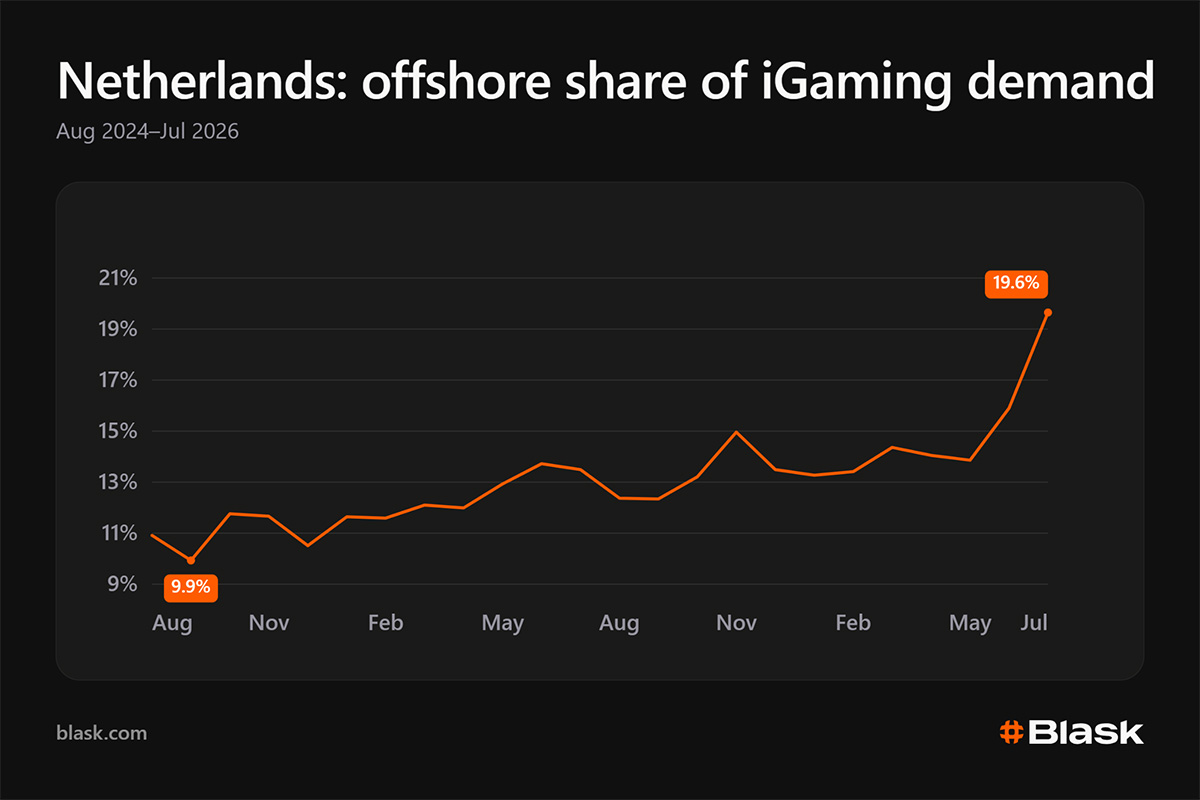
The Dutch online gambling market continues to expand, but recent market intelligence indicates that growth is not being distributed evenly across licensed operators. Blask data for the 12 months through July 2026 points to a stronger rise in user demand for offshore brands while the combined share held by leading licensed operators has declined.
The development comes as Dutch authorities continue to strengthen protections for younger people and take action against gambling services that do not hold a Dutch licence. In this changing environment, the competitive picture for iGaming operators is becoming more complex, with overall demand increasing while a larger proportion of that demand is being associated with offshore activity.
Licensed brands remain prominent among younger users
Research published by the Kansspelautoriteit, the Dutch gambling regulator, on 20 August 2026 examined gambling behaviour among minors and young adults aged 18 to 24. The regulator reported that 41% of new gambling accounts in this age group were opened by people who were 18 years old.








The research also found that account creation is frequently concentrated around the point at which young adults reach the legal age for gambling. The Ksa stated that many accounts belonging to 18-year-olds were created on or soon after their birthdays.
The findings are significant for the online market because brand familiarity appears to influence how younger adults approach gambling services. According to the research, young people are aware that offshore websites can be accessed but are more likely to identify licensed brands that they have encountered through advertising or through people in their social environment.
Among the brands specifically identified in the research were TOTO, Unibet, BetCity and bet365. These names also feature prominently in the demand figures cited by Blask for the wider Dutch market.
For operators, this creates an important distinction. Brand recognition among younger adults may remain closely associated with licensed services even as overall market demand increasingly reaches other parts of the online gambling ecosystem.
The leading market positions have changed
Blask's figures indicate that the four leading brands by user demand during the August 2025 to July 2026 period were TOTO, Unibet, BetCity and bet365. Together they represented 40.6% of the total Brand's Accumulated Power measure cited for the Dutch market.
The composition of the leading group differs from the previous 12-month period. Between August 2024 and July 2025, the comparable concentration was attributed to three leading brands, namely TOTO, Unibet and BetCity. At that stage, bet365 ranked eighth with a reported 5.5% share.
The subsequent movement of bet365 into the leading group represents one of the clearest changes in the market data. Blask reported that its increase in BAP was the largest positive year-on-year share movement among the current top 10 Dutch brands.
The data also identifies 711 and Fair Play as brands that increased their respective BAP shares during the period. 711 moved one position higher in the ranking while Fair Play advanced three places.
However, growth among several brands has not prevented the largest operators from losing part of their combined share. Blask reported that the three leading brands from the earlier comparison experienced a combined decline of 6.4 percentage points year on year.
The broader top 10 also saw its combined BAP fall by 6.8 percentage points to 69.2%. This suggests that demand is becoming more dispersed across a larger group of brands.
Offshore demand is growing faster
The most notable feature of the data is the pace at which offshore demand has increased.
Blask estimates that offshore operators represented 11.9% of the Dutch market's Blask Index during the August 2024 to July 2025 period. That proportion increased to 14.3% over the following 12 months.
At the same time, total user demand in the Dutch market increased by 23% year on year. Blask reported that the offshore segment grew by 48.2% during the period compared with 19.6% for onshore operators.
The difference becomes more visible in the latest monthly observations. Offshore operators accounted for 15.9% of the Dutch Blask Index in June 2026 before reaching 19.6% in July. Blask described the July level as the highest recorded since November 2021.
These figures do not mean that offshore brands collectively control the Dutch market. Instead, they indicate that a growing portion of measured demand is being generated outside the licensed onshore segment.
The distinction matters because the Dutch regulatory framework is designed around licensed operators that meet local requirements relating to player protection, monitoring and compliance.
SkyHills becomes a regulatory case study
SkyHills occupies a particular position in the market data because it was identified as the largest offshore brand in the Netherlands during the period covered by the analysis.
Blask reported that SkyHills represented 1% of the Dutch Blask Index between August 2025 and July 2026. The brand ranked 18th by user demand and was the only unlicensed operator within the top 25 in that dataset.
The situation subsequently changed following regulatory and legal action.
The Ksa's August 2026 youth research referred to SkyHills as an example of an unlicensed gambling site that had been promoted through TikTok and other social media channels. The reference formed part of wider research into how young people encounter gambling-related activity before and around reaching the legal age.
On 1 September 2026, Nederlandse Loterij announced that it had taken legal steps against the operators and directors associated with SkyHills and had demanded that activities in the Netherlands cease. The organisation stated that the platform was no longer accessible in the country following the demand.
That development provides important context for the market figures. SkyHills' reported share may illustrate the visibility of offshore demand but it should not be interpreted as evidence that one individual operator drove the wider increase.
Demand is becoming more fragmented
One of the clearest implications of the Blask data is that the offshore segment's expansion appears to be spread across multiple brands.
Even though SkyHills was identified as the largest offshore brand for the period, its reported 1% share remained relatively small compared with the combined demand associated with the major licensed operators.
This indicates a fragmented competitive environment in which numerous smaller brands can collectively account for a meaningful portion of user interest without any single offshore service dominating the market.
For licensed iGaming operators, this creates a more difficult competitive landscape. A market can grow rapidly while established brands still lose percentage share if new or previously smaller brands attract additional demand.
The rise of offshore activity therefore needs to be considered alongside the overall expansion of the Dutch market rather than viewed as a direct replacement of licensed gambling services.
Regulation remains central to market development
The Netherlands continues to place considerable emphasis on legal access, player protection and enforcement. Licensed operators operate within a framework overseen by the Ksa while authorities can take action against services that target Dutch consumers without the required authorisation.
The SkyHills case demonstrates that enforcement can extend beyond regulatory warnings and include legal action designed to restrict access to an offshore service in the Dutch market. Nederlandse Loterij stated that the SkyHills action formed part of a broader series of legal measures against illegal gambling sites.
At the same time, the Ksa's research into younger adults shows that market access cannot be assessed only through licensing statistics. Visibility, social exposure and the timing of account creation are also relevant to how gambling demand develops.
For iGaming operators, these factors increasingly connect commercial performance with compliance considerations. Maintaining visibility among consumers must take place within the applicable advertising and responsible gambling framework.
What the figures mean for licensed operators
The data presents a mixed picture for licensed operators. Total market demand is rising and major brands remain highly visible, especially among younger adults who are entering the legal gambling market.
Yet their combined share is decreasing as other brands capture a greater proportion of demand. The rise of offshore activity adds another layer to that shift.
For operators competing in the Netherlands, the challenge is therefore not simply to participate in a growing market. They must also retain visibility, respond to changes in consumer demand and operate within a regulatory environment where enforcement remains active.
The broader market may continue expanding without producing an equal increase in share for every established brand.
Conclusion
The Dutch online gambling market is entering a period in which growth and competitive pressure are developing at the same time. Blask data shows that overall user demand increased strongly during the latest 12-month period while offshore demand grew substantially faster than the licensed onshore segment.
At the same time, the leading licensed brands continue to hold significant levels of consumer attention. The Ksa's research into 18-to-24-year-olds indicates that familiar licensed names remain prominent among newly eligible users while regulatory action demonstrates that offshore visibility can face significant legal restrictions.
The resulting market picture is therefore more nuanced than a simple shift from licensed to unlicensed gambling. Demand is expanding, the competitive field is becoming more fragmented and enforcement is shaping which brands can continue operating in the Netherlands.
For the country's iGaming operators, the coming period is likely to be defined by the relationship between market growth, brand visibility and regulatory compliance. The latest figures underline that success in a growing market cannot be measured only by absolute demand. Changes in consumer attention and the evolving legal environment are equally important to understanding where the Dutch online gambling sector is heading.
FAQs
What is happening in the Dutch iGaming market?
The Dutch online gambling market is growing in overall user demand, but Blask data indicates that offshore demand is increasing faster than demand associated with licensed onshore operators.
Which licensed brands are prominent among younger Dutch players?
The Ksa research identifies TOTO, Unibet, BetCity and bet365 among the licensed brands that younger players recognise and mention.
How much did total user demand increase in the latest period?
Blask reported that overall user demand increased by 23% year on year during the latest 12-month period covered by its analysis.
How quickly did offshore demand grow?
Blask reported 48.2% year-on-year growth in the offshore Blask Index compared with 19.6% growth for onshore operators.
What was the offshore share of the Dutch Blask Index in July 2026?
The offshore segment accounted for 19.6% of the Dutch Blask Index in July 2026 according to the figures provided by Blask.
What was SkyHills' reported market position?
Blask reported that SkyHills represented 1% of the Dutch Blask Index for the August 2025 to July 2026 period and ranked 18th by user demand.
Is SkyHills still accessible in the Netherlands?
Nederlandse Loterij stated on 1 September 2026 that the SkyHills platform was no longer accessible in the Netherlands following a demand to stop its activities in the country.
What did the Ksa report about 18-year-olds?
The Ksa reported that 41% of new gambling accounts among people aged 18 to 24 were held by 18-year-olds, with many accounts opened on or shortly after the person's 18th birthday.
Why are licensed operators still important in the Dutch market?
Licensed operators remain prominent because they are visible to consumers and operate within the Netherlands' regulated gambling framework, which includes player-protection and compliance requirements.
What is Blask?
Blask is an iGaming market analytics platform that tracks market demand and brand performance using measures including the Blask Index and Brand's Accumulated Power.

Esther
I am a professional writer with 8 years of experience in this field and I can provide you with the best-written content you can find. Education B.A. - English, George Washington University, United States, Graduated 2011.
Related Posts

Alea Brings ‘Luck Decoded’ to SBC Summit Lisbon
September 16, 2026
BetComply strengthens compliance team with three experienced appointments
September 16, 2026
Euromat study finds Europe’s illegal online gambling market worth €12bn
September 16, 2026
Betting and Gaming Council warns of illegal betting risk at St Leger
September 16, 2026
Blask reports Vietnam iGaming demand fell 26.2% amid XoilacTV case update
September 16, 2026
Belarus iGaming demand jumps as Lukashenko targets Maxline advertising
September 16, 2026

Stake rebrands Stake Engine as Engine for wider iGaming operator access
September 15, 2026

BetConstruct AI to Exhibit Full Ecosystem at G2E Vegas 2026
September 14, 2026
Ace Games enters iGaming with 25+ titles and real-player testing model
September 14, 2026