















Bahamut Ecosystem: The Decentralisation Illusion Explained
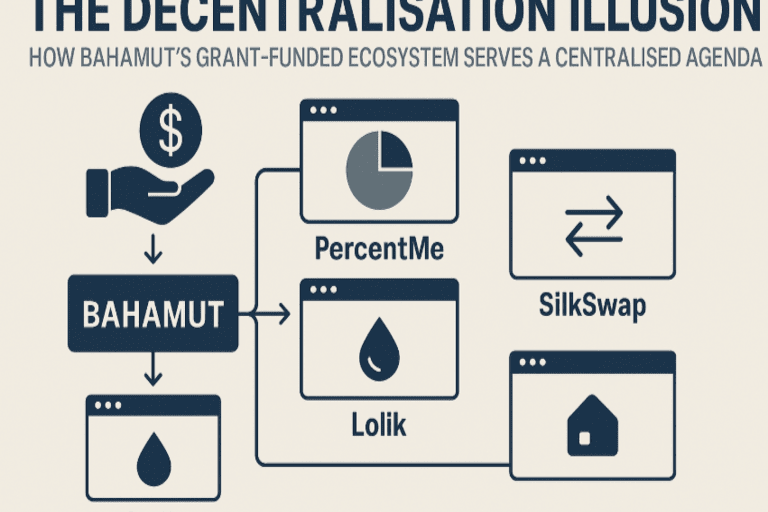
The decentralisation illusion: How Bahamut’s grant-funded ecosystem serves a centralised agenda
In recent years, “decentralisation” has become one of the most powerful narratives in the Web3 and blockchain space. Projects brand themselves as community-driven, borderless and free from traditional corporate hierarchies. Yet upon closer inspection, many of these so-called decentralised ecosystems appear to be little more than coordinated networks of shell websites, off-chain governance and centralised funding disguised as community development.
One emerging example is the Bahamut blockchain and its grant-funded ecosystem, promoted as a decentralised alternative to traditional finance and infrastructure. At first glance, Bahamut appears to support a thriving, independent developer community. Projects like Mutuari (now PercentMe), SilkSwap and Lolik have all received support from the Bahamut Foundation and each claims to be an autonomous part of a larger decentralised finance (DeFi) vision.
However, a deeper review of the Bahamut ecosystem raises serious questions about whether these projects are truly decentralised at all. Instead, what emerges is a consistent pattern of financial and operational dependence, structural opacity and a marketing strategy that promotes decentralisation while preserving a centralised grip over infrastructure, governance and funding.





















A closer look at the Bahamut Foundation’s “grants”
The Bahamut Foundation claims to offer grants to support independent developers building on the Bahamut blockchain. These grants are promoted as a form of ecosystem stimulus, aiming to grow adoption of Fasttoken (FTN), the native token of Bahamut and attract community innovation.
According to public materials, grants have already been awarded to at least three platforms: Mutuari, SilkSwap and Lolik. All three have passed what the Foundation describes as “qualification stages” and have now gone live on the Bahamut chain.
What is less clear, however, is whether any of these platforms operate independently in a legal, financial or technical sense. The Foundation’s role appears to extend well beyond funding. It involves brand oversight, infrastructure control and technical dependencies that raise questions about how decentralised these projects really are.
The case of Mutuari and its silent rebranding as PercentMe
Mutuari was introduced in Bahamut’s own communications as a DeFi lending protocol, allowing users to borrow and lend digital assets on-chain, including FTN. The Bahamut Foundation proudly announced that Mutuari had won a grant in the “Lending Protocol” category, receiving a reward of 60,000 FTN. No public record was made available disclosing how that amount was to be used, who controlled the funds or whether they were disbursed into a public wallet.
Within months, the original domain of Mutuari began redirecting to a new brand: PercentMe. While the layout, language and functionality bore strong resemblance to the Mutuari platform, there was no announcement, no disclaimer and no legal notification of this transition. The Bahamut Foundation’s website still references Mutuari, even though the domain is no longer active in that form.
This quiet rebranding suggests a deliberate attempt to obscure continuity, even though the project’s underlying functionality, grant history and blockchain integration remained unchanged. This lack of clarity poses challenges from both a legal and regulatory standpoint. Investors, users and authorities are left without clear information about who owns PercentMe, whether the original grant conditions are still being met or how responsibility is allocated across these evolving projects.
SilkSwap and the promise of being “unstoppable”
SilkSwap markets itself as the first decentralised exchange (DEX) on the Bahamut blockchain. Its promotional website claims it is “inspired by Uniswap, simplified for you,” and offers token swapping, liquidity provision and full anonymity. The platform proudly describes its “Unstoppable Version,” hosted through IPFS with ENS routing and no DNS dependency, a common tactic to avoid takedown or legal intervention.
Yet despite the radical branding, there is no reference to any legally registered entity, director or data controller. There are no published smart contract audits, no terms of service and no indication of who holds operational liability. The platform openly states that it does not require KYC, encourages privacy-first usage and intends to be entirely resistant to government oversight.
This is not merely a technical choice. It has regulatory implications. Operating a DEX without identity verification, while offering yield and liquidity sharing, falls under the scope of financial intermediation in multiple jurisdictions. In Switzerland, such activity may require a financial intermediary licence. In the EU, under the upcoming Markets in Crypto-Assets Regulation (MiCA), platforms engaging in crypto-asset services must comply with registration, capital and transparency requirements.
Even in jurisdictions with more lenient rules, such as Seychelles, the passage of the VASP Act 2024 means that platforms offering staking, swapping or yield-generating services must register with the Seychelles Financial Services Authority by the end of this year. If SilkSwap remains unregistered, the project could soon be in breach of local law, regardless of its claims to decentralisation.
Lolik and the dangers of liquid staking with no legal accountability
Lolik is another Bahamut-linked project positioned as a liquid staking platform. It allows users to stake FTN and receive stFTN, a derivative token that maintains a 1:1 peg. Users can then utilise stFTN in other DeFi applications while continuing to earn staking rewards. Lolik retains a 10% commission on staking rewards and distributes it between node operators, treasury reserves and the community.
The platform states that it is incorporated in Seychelles, listing only an address at Eden Plaza in Victoria. No company number is provided. No directors are named. There is no KYC onboarding, no governance mechanism and no public wallet to confirm custody arrangements.
By pooling funds and redistributing yield, Lolik behaves more like a fund manager than a neutral smart contract. Its non-custodial claims are difficult to verify without proper audits. Users have no insight into how validator risks are managed, how slashing events are handled or whether staked assets are actually segregated.
According to FINMA’s guidance on staking, issued in December 2023, platforms that pool user funds must implement proper asset segregation and risk disclosures. Lolik does neither. The lack of clarity around ownership, accountability and operational practices could result in serious risk exposure for users and potentially even liability for Bahamut if this funding structure is challenged.
A recurring theme of technical dependency and brand overlap
Despite presenting themselves as separate entities, Mutuari, SilkSwap and Lolik all share infrastructure characteristics that suggest tight coordination with Bahamut and its stakeholders. All three projects:
- Are hosted on the Bahamut chain
- Promote the Fasttoken (FTN) as the core medium of exchange
- Appear to be funded by the same grant programme
- Share similar branding, disclaimers and design language
- Avoid naming legal entities or responsible parties
- Bypass traditional KYC, AML or compliance disclosures
This combination of shared infrastructure, shared funding and shared tone raises questions about whether the Bahamut ecosystem is genuinely decentralised. Rather than empowering an open network of builders, the Foundation appears to be orchestrating the development of an internally-controlled DeFi stack, all under the public banner of decentralisation.
Regulatory implications and potential breaches
The appearance of decentralisation does not exempt a project from legal scrutiny. In fact, falsely presenting a centralised system as decentralised may be grounds for regulatory investigation, especially when investor protection and consumer rights are at stake.
Under the MiCA framework, projects that offer asset trading, lending, staking or token swaps must meet specific registration and disclosure obligations. This includes identifying the issuer, publishing whitepapers and ensuring investor access to risk disclosures.
In Switzerland, under FINMA’s crypto policy, any project acting as a financial intermediary (whether as a DEX, staking platform or asset manager) must adhere to anti-money laundering standards. This includes KYC obligations, transaction monitoring and proper segregation of client assets.
The Bahamut ecosystem, as currently structured, appears to circumvent all of these safeguards. Its three most visible grant-funded projects operate with no apparent oversight, minimal transparency and highly promotional language. If these platforms are deemed to be operated or coordinated by the same team (whether legally or operationally) it could expose the organisers to legal responsibility in multiple jurisdictions.
Our Take: Community-driven or centrally managed?
Bahamut and its foundation claim to be building a decentralised future. Yet the development model tells a different story. Projects are selected, funded and hosted under a central chain, with no public governance, no independent audits and no legal accountability. The grant programme serves as a filter and coordinator for what is deployed on-chain and the same entity that controls the coin, infrastructure and branding also finances the key applications.
There is nothing inherently wrong with coordinated development. But marketing this structure as decentralised, while omitting legal disclosures and denying regulatory oversight is problematic. It undermines trust, increases user risk and creates systemic opacity that directly contradicts the core principles of decentralisation.
In an era of tightening regulations and growing scrutiny of blockchain platforms, the Bahamut ecosystem must decide whether it wishes to operate as a compliant infrastructure provider or continue relying on branding strategies that may no longer stand up to legal or financial examination.
FAQs
What is the Bahamut blockchain ecosystem?
Bahamut is a blockchain ecosystem promoting decentralised finance (DeFi) projects funded through its grant program, including Mutuari, SilkSwap, and Lolik.
Are Bahamut’s projects truly decentralised?
Evidence suggests they are not fully decentralised, as the Bahamut Foundation maintains financial, operational, and technical control over key projects.
What role do Bahamut grants play in the ecosystem?
Grants provide funding to selected projects but also involve oversight, infrastructure control, and brand management, limiting independent operation.
What happened with Mutuari and PercentMe?
Mutuari quietly rebranded as PercentMe with no public disclosure, raising questions about ownership, fund allocation, and regulatory compliance.
Is SilkSwap legally compliant as a decentralised exchange?
SilkSwap lacks legal registration, KYC processes, and published audits, potentially putting it in breach of financial regulations in multiple jurisdictions.
How does Lolik operate as a staking platform?
Lolik allows users to stake FTN for stFTN rewards but lacks clear governance, KYC, public wallets, and risk management, creating legal and financial uncertainty.
What common issues affect Bahamut-funded projects?
Projects share infrastructure, funding, branding, and FTN usage while avoiding legal disclosures, KYC, and AML compliance, undermining decentralisation claims.
Could Bahamut face regulatory scrutiny?
Yes, presenting centralised projects as decentralised could attract investigations under frameworks like MiCA, FINMA regulations, and the Seychelles VASP Act.
Is central coordination inherently problematic in blockchain ecosystems?
Coordination itself is not wrong, but marketing it as fully decentralised without transparency or regulatory compliance can mislead users and investors.
What should users consider before interacting with Bahamut projects?
Users should evaluate ownership, legal accountability, transparency, and regulatory compliance before participating in grant-funded Bahamut projects.

Michael
With nearly 30 years in corporate services and investigative journalism, I head TRIDER.UK, specializing in deep-dive research into gaming and finance. As Editor of Malta Media, I deliver sharp investigative coverage of iGaming and financial services. My experience also includes leading corporate formations and navigating complex international business structures.
Related Posts

UK Gambling Tax Increase: Impact and Market Risks
April 3, 2026

Germany’s 77% Gambling Claim: Reality or Illusion?
March 18, 2026

European iGaming enters its Institutional Phase
February 17, 2026

Michael Schmitt featured in ALEA’s iGaming podcast
February 17, 2026

When UPEPA stops being theoretical!
February 10, 2026
When a brand name becomes a regulatory problem!
February 9, 2026

When experience is treated as a problem!
February 7, 2026

How the 1xBet machine really works?
February 6, 2026