















Fasttoken’s price shock was predictable!
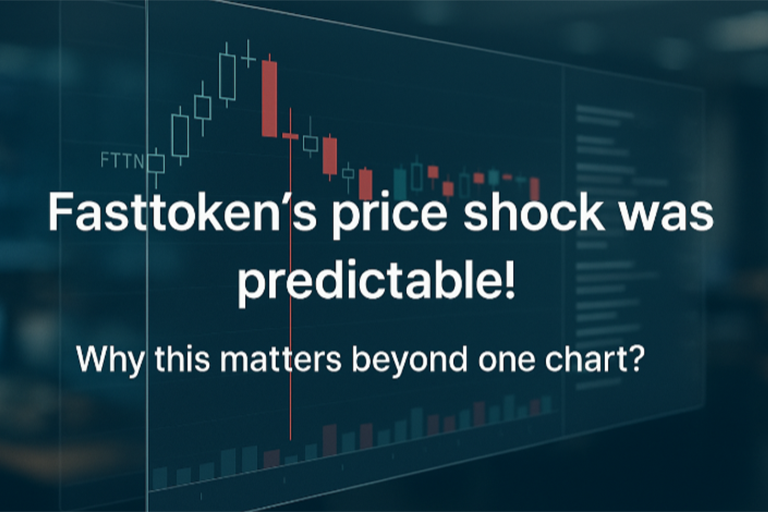
Fasttoken’s intraday collapse and rapid rebound are not an isolated market oddity. They fit a pattern we outlined in our earlier notes on Fastex and FTN. Concentrated insider holdings, thin public float, reliance on market making and fragmented liquidity create conditions where a minor operational fault or liquidity gap can produce a major price event. The latest wick confirms that structural risk. This article restates our research framework, documents what the price action implies and lists verifiable questions that Fastex can answer to restore confidence. We avoid allegations. We focus on observable mechanics and decision-useful risk indicators for holders, exchanges and counterparties.
The hook in plain numbers!
A vertical candle is a market message. The FTN chart you shared shows a sharp sell-through, a deep print far below recent trading bands, then a retrace to the prior range. Community commentary attributed the event to a “technical” or “market-making” issue. Even if that explanation is correct, it proves the core point. If a single technical or inventory problem can move the price this far in minutes, market structure is fragile. Robust tokens do not fall into an air pocket when one piece of machinery stutters.
What we assessed before the drop?
Our work on FTN and the Fastex ecosystem converged on five themes. Each theme is neutral in isolation. Together they increase fragility.






















- Free float that looks small next to insider and treasury supply We noted that public allocation appears modest relative to insider, team, or treasury-controlled balances. Where circulating supply is narrow, day-to-day price discovery depends on a small pool of voluntary sellers and buyers. That pool can dry up in stress.
- Liquidity that is orchestrated rather than organic Where market making underwrites most of the order book, spreads and depth are a function of inventory and algorithms. If inventory is tight, or a parameter shifts, spreads widen and bids vanish at once. Organic two-sided flow is slower to disappear.
- Multiple exchange listings but limited true depth Nominal liquidity can be fragmented. Several venues may show pairs, yet only a subset carries real size near the mid. Sudden off-exchange flows into a single venue can pierce that venue’s book and print extreme lows. Arbitrage repairs the gap after the fact, not before the wick.
- Treasury discretion that is high, governance that is thin Central treasuries are normal. The risk arises when disclosure about treasury rules, rebalancing policy and on-exchange inventory is sparse. Uncertainty about who decides, when and why, increases event risk even if decisions are made in good faith.
- Utility promises that outpace current on-chain demand Tokens that anchor an ecosystem can be valuable. The risk is timing. If promised utilities are still ramping, natural buy-side demand may not absorb large transfers from insiders, programmatic unlocks, or market-making buffers.
None of these points alleges misconduct. They describe a structure that needs careful guardrails. The wick shows those guardrails are not yet sufficient.
What the wick tells us about structure?
Price discovery happened in a vacuum
In healthy books, intense selling walks the ladder. In a fragile book, it falls through it. The long lower shadow indicates price discovery occurred where resting bids were sparse or absent. That is a structural signal, not a behavioural one.
Liquidity support appears parameter-driven
The public explanation points to a technical or market-making issue. That suggests depth depends heavily on a few bots with centralised control over inventory and risk limits. When those limits are hit, the bot steps back. The book becomes hollow until human intervention or a parameter reset.
Cross-venue protection was weak
If cross-exchange arbitrage was strong and inventory was plentiful, the low print would have been shallower. The depth gap implies that arbitrageurs either lacked inventory, faced transfer friction, or judged the risk too high to warehouse at the moment of stress.
Holders faced execution uncertainty
A retail holder trying to sell or buy into the event would have faced a wide execution band. That is the practical cost of fragile structure. Even calm holders internalise that cost and raise their risk premium. That feeds back into the price level.
The governance lens
Disclosure beats reassurance
A community note that says “do not panic” can stabilise sentiment for a day. It does not repair the mechanism. What repairs the mechanism is disclosure that lets market participants price the risk. That disclosure should cover supply, treasury policy, market-making arrangements, unlocks and kill-switch logic.
Centralisation is not a sin, silence is
Many ecosystems begin centralised. If FTN’s liquidity is centralised in one treasury or one set of market-making pipes, that is not inherently wrong. It is risky if the terms are unclear. Publish the terms and the parameters. Markets forgive structure when they can see it.
Conflicts exist. They can be managed
If the same ecosystem designs the token, funds the market making and benefits from higher prints, there is a structural conflict. The remedy is independent governance, third-party attestations, time-based rules for treasury actions and live reporting.
Tokenomics that deserve daylight
Circulating supply, float and real float
Circulating supply is a headline metric. Real float is circulating supply minus known locked balances, strategic holders and insiders unlikely to sell. Publish a conservative real-float estimate and keep it current.
Unlock schedules with live telemetry
If there are linear unlocks or cliffs, provide a machine-readable calendar. Add a live dashboard that shows how much unlocked supply remains off exchange, how much is committed to staking and how much has moved to venues in the last 30 days.
Treasury market-making policy
Set rules for on-exchange inventory bands, daily maximum net sells or buys and conditions that trigger withdrawals. If a kill-switch exists, define who can press it, under what conditions and how the market will be told. Make the policy auditable.
Staking and yield as supply sinks
If staking exists, report the share of supply that is staked, the effective unlock time to exit and the behaviour of stakers during volatility. Staking can stabilise supply if exit frictions are real. It can amplify risk if exit is instant.
Market microstructure that explains the wick
Order book depth and spread elasticity
In thin tokens, each marginal order moves price more than holders expect. A ten thousand USDT market order can slide the mid by many ticks if spread elasticity is high. We treat the wick as proof that FTN’s elasticity is high. That can be measurable. Exchanges can publish depth-at-ten-ticks, spread distributions and slippage curves.
Inventory location risk
If the ecosystem or market makers warehouse most inventory off exchange or on one venue, latency and transfer queues matter. When stress hits, moving collateral to where it is needed takes time. During that window, prices search for bids in the dark.
Stablecoin leg risk
FTN commonly trades against USDT or similar stablecoins. If the stablecoin leg faces its own transient frictions, quoted sizes shrink and risk limits tighten. That reduces absorbent depth exactly when it is most needed.
What exchanges should ask for!!!
Exchanges listing FTN are systemically exposed to wick risk that can trigger forced liquidations for leveraged users and reputational harm when charts show “flash crash” prints. Prudent exchanges will ask for:
- A signed market-making policy from the treasury or agent, with daily and weekly net-flow caps.
- A cold-warm-hot inventory map and an assurance that warm buffers on each venue cover X days of average volume.
- A notification protocol for parameter changes or system incidents, with an on-call contact matrix.
- A quarterly attestation of circulating supply and a reconciliation of any treasury transfers to exchanges.
These asks are routine in mature listings. If they are already in place, publishing a summary would help the market.
What holders can verify without privileged access
Holders do not need inside data to reduce uncertainty. The following checks are non-invasive and repeatable.
Trade-print analysis Export prints for the wick window across venues. Measure time-sequenced spreads, best-bid-offer depth and realised slippage for a standard order size. If post-event parameters changed, the profile will change. That is evidence of repair.
Exchange-by-exchange depth Compare depth at 1, 5 and 10 percent from mid on each venue during calm periods. A healthy token shows convergent profiles. Divergence suggests liquidity lives in only one place.
Whale transfer watch Track large transfers from known project or insider wallets to exchange deposit addresses in the 48 hours before and after the wick. Stable patterns reduce risk. New patterns without explanation raise it.
Staking exits If staking exists, monitor net exits around the wick. Persistent exits indicate confidence erosion. Stable staking suggests long-term holders are unfazed.
None of these steps requires accusations. They are normal market hygiene.
The communication that would change the story
Fastex can reverse the narrative by turning private knowledge into public information. A high-signal update could include:
- A precise incident report for the wick window with timestamps, systems impacted and why spreads widened.
- The current market-making policy, including inventory bands and daily flow caps, shared in plain language.
- A live dashboard for real float, unlocks, staking and exchange inventory buffers.
- A commitment to independent quarterly attestations by a named third party.
- A roadmap for decentralising liquidity provision over time.
A token can recover from a structural shock if it treats the shock as a transparency catalyst.
Why this matters beyond one chart?
Price integrity is not a matter of today’s candle. It is about the cost of capital. Ecosystems with credible market structure pay a lower risk premium on listings, partnerships and user acquisition. They also suffer less regulatory scrutiny because their governance documents answer the hard questions before a supervisor asks them. If FTN wants to support a payments or gaming-adjacent ecosystem at scale, it needs market plumbing that does not rely on “trust us.” Investors will discount opacity. Regulators will, too.
Addressing common counterpoints
“It was only a technical glitch.”
That is the point. A robust market absorbs a glitch without printing a cliff. If a single fault can create this much displacement, the market is brittle.
“Wicks happen on every chart.”
True, yet frequency and depth are the signal. Extreme wicks in large tokens are rare because depth is real and diverse. If FTN wants that reputation, it needs those conditions.
“Insiders did not sell.”
They may not have. The presence or absence of insider selling is not the only driver. Gaps can appear when market makers reduce quotes, arbitrageurs hesitate, or cross-venue buffers thin. Transparency can validate the non-selling claim and still accept the structure needs work.
Our standing hypotheses, tested by the event
- High reliance on coordinated liquidity The event supports the idea that coordinated liquidity, not organic end-user flow, drives the book. Remediation requires multi-market depth and clearer disclosure.
- Concentration amplifies execution risk If control over supply, inventory, or parameters sits with a small group, an error travels far. Governance that adds checks and visible rules would reduce amplitude.
- Utility adoption lags treasury influence If real-world demand had already matured, organic bids would have dampened the move. This is not a criticism of utility plans, it is a timing observation.
Each hypothesis remains falsifiable. Fastex can publish data that narrows or removes the gap.
Questions for Fastex that avoid speculation
- What percentage of total supply, measured today, is in the hands of insiders, team wallets, or entities under common control with the foundation or company?
- What is the real float, defined as circulating supply minus illiquid strategic and insider balances?
- What is the formal market-making policy, including inventory bands per venue, pause conditions and kill-switch governance?
- Did any parameters or risk limit change in the hour before the wick? If yes, who approved the change and how were exchanges notified?
- How many days of average volume do the warm inventory on each listed venue cover?
- What unlocks or vesting events occurred in the prior thirty days and how were those flows managed?
- What on-chain dashboards does the team recommend for independent monitoring of treasury and exchange-bound transfers?
- Will the project commit to third-party attestations for supply, treasury holdings and on-exchange inventory at a fixed cadence?
Clear answers would raise confidence more than calls to “stay calm.”
Practical guidance for stakeholders
For current holders Size positions with the assumption that intraday gaps can repeat. Use limit orders. Avoid forced leverage. Diversify venue exposure to reduce single-exchange execution risk.
For prospective buyers Wait for disclosures or for the market to rebuild depth. If disclosures arrive, read policy not promises. If depth rebuilds, check that it is organic. Sudden depth that appears at once and vanishes at once is not organic.
For exchanges During incident reviews, consider temporary protections such as dynamic circuit breakers, minimum quote obligations for designated market makers and post-trade surveillance that flags cross-venue anomalies. Publish slippage curves so users can estimate execution.
For auditors and partners Condition partnerships on governance documents, not slide decks. Ask for incident reports and parameter logs. If those do not exist, revisit the risk assessment.
The path to a resilient FTN
Resilience is a set of habits. Publish a conservative real-float number and keep it updated. Make unlock calendars machine-readable. Put market-making rules in writing, with named controls and accountable sign-offs. Spread warm inventory across venues. Encourage independent dashboards and do not fight critical analysis. When something breaks, ship a detailed post-mortem. These are not investor relations tactics. They are market safety rails.
If Fastex implements these steps and shows evidence, FTN’s risk premium can fall. The next shock would look like a dip, not a cliff.
FAQs
What caused Fasttoken’s sudden intraday collapse?
The collapse was driven by structural fragility: thin float, centralized liquidity, and parameter-driven market-making caused a deep wick.
How did Fasttoken recover so quickly after the drop?
Recovery occurred as liquidity parameters reset, human intervention or arbitrage corrected price gaps, and order books replenished.
What does a “wick” in FTN’s price chart indicate?
A wick signals a price move through areas of low liquidity, showing the market structure’s fragility, not necessarily insider action.
Why is FTN’s market considered fragile?
Concentrated insider holdings, orchestrated liquidity, and thin cross-exchange depth make FTN vulnerable to sharp price moves.
What steps can Fastex take to restore confidence in FTN?
Publishing real float, unlock schedules, market-making policies, live dashboards, and third-party attestations can rebuild trust.
Can holders protect themselves from similar events?
Yes, holders should use limit orders, diversify exchange exposure, size positions cautiously, and avoid forced leverage.
What role do exchanges play in preventing flash wicks?
Exchanges can enforce dynamic circuit breakers, minimum quotes, slippage reporting, and incident reviews to mitigate execution risk.
What is “real float” and why does it matter?
Real float is circulating supply minus locked, strategic, or insider-held tokens. It shows actual liquidity available for price discovery.
How does centralized liquidity increase risk?
When market-making or treasury control is concentrated, a single technical fault or parameter change can create major price swings.
What information should investors monitor after an FTN wick event?
Check exchange-by-exchange depth, trade prints, staking exits, whale transfers, and post-event spread and slippage patterns.
Disclaimer
This article expresses analytical opinions based on market structure principles and observable price behaviour. It does not allege wrongdoing. It is not investment advice. Readers should conduct their own checks and consider professional counsel where appropriate.
Appendix: a simple incident checklist you can run
- Record exact timestamps of the first break in spread, the lowest print and the first stabilised quote.
- Export prints and order book snapshots for all FTN pairs on all listed exchanges during the window.
- Compute realised slippage for a standard clip size at one-minute intervals before, during and after the wick.
- Map any large wallet transfers to exchange addresses in the 24 hours around the event.
- Compare post-event depth and spreads with the same weekday and hour one week earlier.
If these steps show tighter spreads, thicker books and stable inventory patterns after the incident, confidence can be rebuilt. If they do not, disclosure becomes more urgent.

Michael
With nearly 30 years in corporate services and investigative journalism, I head TRIDER.UK, specializing in deep-dive research into gaming and finance. As Editor of Malta Media, I deliver sharp investigative coverage of iGaming and financial services. My experience also includes leading corporate formations and navigating complex international business structures.
Related Posts



UK Gambling Tax Increase: Impact and Market Risks
April 3, 2026






Allwyn reports steady FY2025 growth with strategic expansion
March 19, 2026