

















Has Germany really reduced illegal gambling visibility?
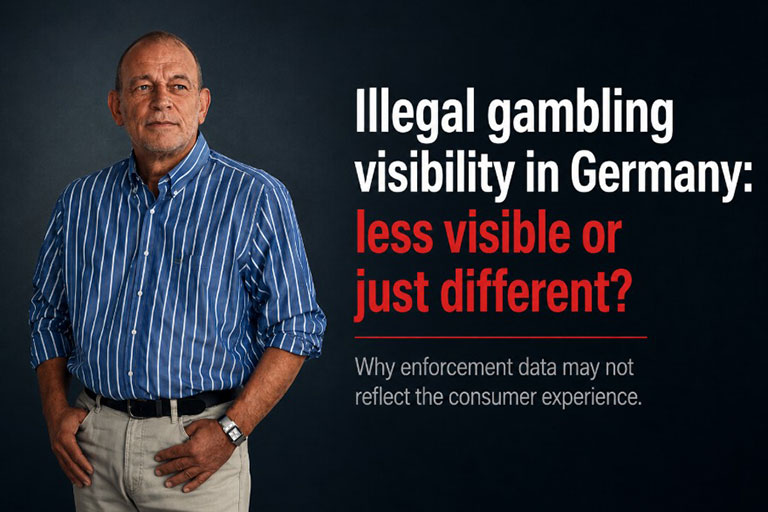
For several years, German gambling regulation has been built around a clear and understandable objective. Consumers should be directed towards licensed gambling operators and away from unlicensed alternatives. Few would disagree with that goal. A regulated market is intended to provide greater consumer protection, stronger oversight, responsible gambling safeguards and clearer accountability. The challenge has never been defining the objective. The challenge has been determining whether the measures introduced to achieve that objective are producing the intended outcomes.
One of the most frequently discussed indicators of progress has been visibility. Regulators, policymakers and industry participants regularly refer to the visibility of illegal gambling operators when assessing market developments. If illegal operators become less visible, the assumption is that fewer consumers will find them. If fewer consumers find them, channelisation into the regulated market should improve. On paper, the logic appears straightforward. In practice, however, the relationship between visibility and consumer behaviour is considerably more complicated.
The debate has become increasingly important because visibility is often presented as evidence that enforcement measures are working. Public statements frequently point to advertising restrictions, platform cooperation, website blocking measures and enforcement actions as indicators that the illegal market is becoming less accessible. Yet an obvious question remains. Has illegal gambling genuinely become harder for German consumers to find, or has visibility simply shifted into channels that are more difficult to regulate, monitor and measure?









This distinction matters because modern consumers rarely discover gambling products through a single source. Search engines, affiliate websites, comparison portals, social media platforms, video content, messaging groups and direct recommendations all play a role in how consumers navigate the online gambling market. Reducing visibility within one channel does not necessarily mean reducing visibility across the broader consumer journey. As a result, the public discussion surrounding illegal gambling visibility may be far more complex than headline figures or enforcement statistics initially suggest.
Understanding the regulatory objective
The primary purpose of gambling regulation is not to eliminate gambling activity altogether. Instead, regulators generally seek to ensure that gambling takes place within a controlled environment where operators comply with licensing requirements, consumer protection obligations and responsible gambling measures. The concept of channelisation sits at the centre of this approach. Consumers should be encouraged to choose licensed operators because those operators operate under rules designed to protect players and maintain market integrity.
Visibility has become an important part of this strategy because consumer choices are often influenced by what they see online. A consumer searching for an online casino, sports betting provider or gambling bonus is likely to engage with whichever information appears most prominently during that search process. If licensed operators dominate those search journeys, the regulatory objective becomes easier to achieve. If unlicensed operators remain highly visible, the effectiveness of the regulatory framework becomes more difficult to assess.
This explains why regulators have invested considerable effort into reducing the exposure of consumers to illegal gambling advertising and promotion. The objective is not merely symbolic. If consumers consistently encounter unlicensed operators before licensed alternatives, the regulatory framework risks being undermined regardless of how robust the underlying legal structure may appear. Visibility therefore becomes more than a marketing issue. It becomes a consumer protection issue, a regulatory issue and ultimately a public policy issue.
However, while the objective itself is relatively clear, the methods used to assess success deserve closer examination. Visibility can be measured in multiple ways. Search rankings, paid advertising impressions, website traffic, social media reach and affiliate referrals may all provide different answers. A reduction in one area may coexist with continued strength in another. Consequently, the broader question is not whether visibility has changed, but whether the methods used to measure visibility accurately reflect what consumers are actually experiencing.
What regulators say has changed
Over recent years, Germany has introduced a range of measures intended to limit the reach of illegal gambling operators. These measures have included website blocking initiatives, enforcement actions against advertising activities, regulatory interventions targeting intermediaries and increased cooperation with technology platforms. At the same time, major digital platforms have adjusted certain advertising policies, creating additional barriers for operators that do not meet licensing requirements.
From a regulatory perspective, these developments represent tangible achievements. They demonstrate activity, intervention and a willingness to engage with market participants and technology companies. Publicly available information indicates that regulators have sought to reduce the visibility of unlicensed operators by making it more difficult for those operators to access mainstream advertising channels. This approach reflects a broader international trend in which regulators increasingly seek cooperation from search engines, social media companies and payment providers.
If the discussion is limited solely to paid advertising, there is a reasonable argument that visibility has been reduced. Sponsored placements are generally easier to monitor than organic content. Platform operators can implement certification requirements, remove advertisers that fail to meet eligibility criteria and restrict access to certain markets. In that environment, enforcement outcomes can be measured relatively clearly because regulators and platforms can identify specific actions and specific results.
The difficulty arises when those outcomes are presented as evidence of broader market change. A reduction in paid advertising visibility does not necessarily mean a reduction in overall visibility. Consumers do not distinguish between paid and organic search results in the same way regulators or digital marketing professionals do. Most consumers simply engage with whatever information appears relevant, trustworthy or attractive. As a result, a reduction in one visibility channel may not have the same impact that headline enforcement figures appear to suggest.
This is where the debate becomes more complicated. Regulators may legitimately point to enforcement successes. Those successes may be genuine and measurable. Yet a reasonable observer may still ask whether those successes fully capture how consumers discover gambling products in practice. The answer is far from obvious and it is precisely this uncertainty that deserves closer examination.
What consumers actually see today
The online gambling market of 2026 looks very different from the market that existed even five years ago. Consumers increasingly encounter gambling-related content through a wide variety of channels that extend far beyond traditional advertising. Search engines remain important, but they represent only one part of a much larger digital ecosystem. Consumers may discover operators through review websites, affiliate rankings, social media discussions, YouTube content, influencer recommendations or messaging platforms. Each of these channels creates potential visibility that may not be fully reflected in traditional enforcement statistics.
Consider a typical consumer searching for information about online gambling. The consumer may begin with a general search query. Instead of immediately reaching an operator website, they are often directed towards comparison websites, review portals or affiliate content. These intermediary websites may present extensive information about gambling products, bonuses, payment methods and operator rankings. From the consumer's perspective, the distinction between informational content and promotional content is not always obvious.
This is particularly significant because many comparison and review websites are designed to capture exactly this type of search behaviour. Their purpose is to intercept consumers before they reach an operator and influence the decision-making process. Even where direct advertising visibility has declined, these intermediary channels may continue to shape consumer journeys in ways that are difficult to quantify. Consequently, a consumer may still encounter unlicensed operators despite reductions in traditional advertising exposure.
Another important consideration is that consumers who are actively seeking gambling products are often highly motivated. If a preferred operator disappears from one channel, consumers may simply use another. Search behaviour adapts. Discovery methods evolve. Visibility therefore becomes a moving target rather than a fixed metric. This does not mean enforcement measures are ineffective. It does mean that measuring their effectiveness requires a more sophisticated approach than simply counting advertisements or blocked websites.
The result is a situation in which regulatory progress and ongoing market visibility may coexist. Both observations can be true at the same time. Enforcement may have reduced visibility in certain channels while alternative routes continue to provide access to gambling products. Understanding this distinction is essential because it fundamentally shapes how the success of regulatory interventions should be evaluated.
The search engine question
Search engines sit at the centre of the visibility debate because they remain one of the primary ways consumers discover online services. When discussing illegal gambling visibility, many observers naturally focus on search results because they provide a highly visible and measurable representation of the online market. Yet search visibility is considerably more complicated than it first appears.
A common mistake within the public debate is treating search visibility as synonymous with advertising visibility. In reality, these are entirely different concepts. Advertising visibility relates to sponsored placements that can be purchased, controlled and removed through platform policies. Organic visibility is determined by a combination of content quality, authority signals, user engagement, search engine algorithms and countless other factors. The tools available to regulators in each area are fundamentally different.
This distinction has important implications for assessing enforcement outcomes. An operator that loses access to paid advertising may continue to benefit from organic visibility through affiliate websites, comparison portals or informational content. In some cases, intermediary websites may achieve stronger search visibility than operators themselves. Consumers searching for gambling-related information may therefore continue encountering pathways that ultimately direct them towards offshore products, even if those products are no longer heavily advertised.
The issue becomes even more complicated when considering search intent. Consumers do not always search directly for operator names. They often search for bonuses, payment methods, game categories, betting opportunities or operator comparisons. These searches frequently produce results dominated by intermediary websites rather than operators. Consequently, evaluating visibility purely through the lens of operator advertising may provide only a partial picture of the broader market landscape.
This raises an obvious question. If visibility has genuinely declined, where is the evidence across the entire search ecosystem rather than within individual channels? Equally, if visibility remains substantial despite enforcement efforts, what does that tell us about the effectiveness of current regulatory strategies? These are not questions that can be answered through assumptions alone. They require careful examination of how consumers actually interact with the market and how visibility is measured across the increasingly complex digital environment.
Why affiliate marketing remains at the centre of the visibility debate
Any serious discussion about illegal gambling visibility eventually leads to the affiliate sector. This is not because affiliates necessarily operate unlawfully, nor because affiliate marketing is unique to gambling. Rather, it is because affiliate websites frequently sit between consumers and operators, shaping the journey long before a player reaches a gambling platform. In many cases, consumers do not begin with a specific operator in mind. Instead, they search for information, comparisons, bonuses or recommendations. The websites that capture those searches often play a significant role in determining where consumers ultimately end up.
This creates a challenge when attempting to measure visibility. A regulator may successfully reduce the direct visibility of an unlicensed operator. That outcome may be genuine and measurable. However, if affiliate websites continue directing consumers towards offshore products through rankings, reviews or comparison tables, the practical effect may be more limited than headline enforcement statistics initially suggest. The operator becomes less visible, but the route leading towards that operator may remain largely unchanged.
The broader question is whether current visibility measurements adequately account for these intermediary channels. Public discussions often focus on operators because they are easier to identify and regulate. Yet from a consumer perspective, the affiliate website may be the first and most influential point of contact. If visibility assessments focus primarily on operators while giving less attention to referral pathways, a significant part of the consumer journey may be overlooked.
This does not necessarily imply a failure of regulation. It does, however, raise an obvious question. If affiliate websites remain a major source of gambling-related traffic, how should their influence be incorporated into assessments of enforcement success? The answer is not immediately apparent and the public record offers only limited insight into how such measurements are currently being conducted.
Comparison websites and the challenge of perceived neutrality
Comparison websites deserve particular attention because they often occupy a unique position within the gambling ecosystem. Unlike traditional advertising, comparison platforms frequently present themselves as independent information resources. Consumers may view rankings, ratings and reviews as objective guidance designed to help them make informed decisions. Whether that perception accurately reflects commercial realities will vary between websites, but the influence of these platforms on consumer behaviour is difficult to ignore.
From a regulatory perspective, comparison websites present a more complicated challenge than direct advertising. A banner advertisement is clearly promotional. A comparison table may appear informational while simultaneously influencing commercial outcomes. The distinction matters because consumers often place greater trust in content that appears independent. Consequently, comparison websites can become highly effective visibility channels even when direct promotional activity is reduced.
A reasonable observer may therefore ask whether the visibility debate has focused too heavily on advertising and not enough on discovery mechanisms. If consumers continue encountering offshore operators through review platforms and comparison websites, then visibility may remain substantial despite reductions in conventional advertising exposure. Equally, if those websites increasingly prioritise licensed operators, this may represent an important but underappreciated success story for regulation.
The difficulty is that publicly available evidence remains fragmented. Individual searches may produce different results. Rankings can change rapidly. Search engines continuously adjust their algorithms. As a result, drawing definitive conclusions about the overall impact of comparison websites remains challenging. Nevertheless, their role within the consumer journey appears significant enough to warrant closer examination when discussing illegal gambling visibility.
Why visibility metrics may not tell the whole story
One of the recurring themes within regulatory discussions is the search for measurable indicators of success. This is understandable. Regulators, policymakers and market participants all require metrics that allow progress to be assessed over time. Visibility naturally lends itself to this role because it appears tangible and quantifiable. Websites can be blocked. Advertisements can be removed. Search results can be monitored. Yet the simplicity of the metric may also conceal important limitations.
A reduction in visibility does not automatically translate into a reduction in consumer engagement. Consumers who actively seek gambling products may adapt their behaviour when certain pathways become unavailable. Search terms change. Discovery methods evolve. New referral channels emerge. Consequently, visibility measurements that focus exclusively on specific channels may struggle to capture the broader dynamics of consumer behaviour.
This issue becomes particularly important when visibility is used as a proxy for channelisation. The assumption often appears to be that lower visibility leads directly to fewer consumers using offshore operators. While that relationship may exist, the strength of the relationship remains difficult to determine without access to detailed behavioural data. A reduction in visibility may contribute to improved channelisation. It may also have a more limited impact if consumers continue finding alternative routes into the market.
For that reason, visibility should perhaps be viewed as one indicator among many rather than the definitive measure of enforcement effectiveness. The broader objective of regulation is not merely to reduce exposure. It is to influence behaviour, improve consumer protection and strengthen participation within the licensed market. Visibility contributes to those goals, but it does not necessarily provide a complete picture of whether they are being achieved.
Is channelisation improving or are consumers simply adapting?
The concept of channelisation sits at the heart of the German regulatory model. The objective is straightforward. Consumers should choose licensed operators because those operators operate within a regulated framework designed to provide safeguards and oversight. If channelisation improves, regulators can reasonably argue that the framework is functioning as intended. If significant numbers of consumers continue choosing offshore alternatives, the effectiveness of the framework becomes more difficult to assess.
The challenge is that channelisation and visibility are not identical concepts. A market may experience reduced visibility while channelisation remains largely unchanged. Equally, channelisation may improve even where visibility metrics appear relatively stable. This is because consumer behaviour is influenced by numerous factors beyond visibility alone. Product availability, payment methods, taxation, promotional restrictions and user experience may all influence where consumers choose to gamble.
As a result, it may be overly simplistic to view visibility as the primary driver of channelisation outcomes. Consumers do not always choose operators based solely on which brand appears first in a search result. Many actively compare alternatives, seek recommendations or return to operators they already know. Consequently, a decline in visibility may not necessarily produce the same level of behavioural change that enforcement models anticipate.
This does not diminish the importance of visibility. Rather, it suggests that visibility should be evaluated alongside broader market indicators. If policymakers wish to understand whether enforcement measures are working, examining visibility in isolation may provide only a partial answer. The more relevant question may be whether consumer behaviour is changing in a manner consistent with regulatory objectives.
Areas where greater transparency may help
One of the recurring difficulties within the visibility debate is the limited public information available regarding measurement methodologies. Regulators understandably publish information about enforcement actions and policy initiatives. However, considerably less information is available regarding how visibility itself is assessed, how different channels are weighted and how success is ultimately determined. This absence of detail makes it difficult for outside observers to independently evaluate claims regarding market developments.
Greater transparency could potentially strengthen confidence in the regulatory framework. If visibility measurements include search rankings, affiliate exposure, comparison websites, social media activity and other discovery channels, publishing additional methodological information could help stakeholders better understand the conclusions being reached. Such transparency would not necessarily eliminate disagreement, but it would create a clearer foundation for discussion.
A more detailed explanation of measurement techniques could also help distinguish between different forms of visibility. Advertising visibility, search visibility and referral visibility may each tell different stories about the market. Combining them into a single headline figure risks oversimplifying a complex issue. Separating them may provide a more accurate understanding of where progress is occurring and where challenges remain.
The objective should not be to produce favourable statistics. The objective should be to create a clear and credible picture of market realities. Transparency plays an important role in achieving that outcome and may ultimately prove just as important as enforcement itself when it comes to maintaining public confidence in the regulatory system.
Broader lessons for German gambling regulation
The discussion surrounding illegal gambling visibility highlights a broader challenge facing modern gambling regulation. Digital markets evolve rapidly and consumer behaviour evolves alongside them. Enforcement strategies that are effective today may become less effective tomorrow as technology, search behaviour and marketing techniques continue to change. As a result, regulators face the difficult task of measuring a constantly moving target.
This does not mean enforcement efforts lack value. On the contrary, measures aimed at reducing the visibility of illegal gambling may contribute significantly to consumer protection objectives. However, the debate demonstrates that measuring success requires more than counting enforcement actions or removed advertisements. It requires an understanding of how consumers actually interact with the market and how discovery pathways evolve over time.
The broader lesson may therefore be that visibility should be viewed as part of a wider regulatory assessment rather than a standalone indicator. Consumer protection, channelisation, market competitiveness and regulatory credibility are all interconnected. Understanding one element requires understanding the others. The more complex the market becomes, the more important this holistic perspective is likely to become.
Our final thoughts and conclusion
Germany has clearly devoted significant resources to reducing the visibility of illegal gambling operators. Website blocking measures, advertising restrictions, platform cooperation and enforcement actions all demonstrate an ongoing commitment to addressing the issue. There is little reason to doubt that these initiatives have had an impact in certain areas of the market. The more difficult question is whether that impact extends across the entire consumer journey.
The available public record suggests that visibility may have declined in some channels while remaining more resilient in others. Paid advertising appears to have become more challenging for unlicensed operators. Yet affiliate websites, comparison platforms and other discovery mechanisms continue to raise important questions about how consumers find gambling products in practice. The distinction is significant because visibility cannot be assessed solely through the channels that are easiest to regulate.
Ultimately, the debate may be less about whether visibility has changed and more about how visibility should be measured. A reduction in advertising exposure represents one indicator of progress. It does not necessarily provide a complete picture of market realities. Consumers interact with a complex digital ecosystem and understanding that ecosystem requires looking beyond individual enforcement statistics.
If Germany wishes to demonstrate that illegal gambling has genuinely become harder to find, continued transparency regarding measurement methodologies may prove essential. Without a clear understanding of how visibility is assessed, stakeholders are likely to continue reaching different conclusions based on different observations. That uncertainty does not invalidate regulatory achievements, but it does suggest that the conversation surrounding visibility is far from settled. As the market continues to evolve, the challenge for regulators will not simply be reducing visibility. It will be demonstrating, through transparent and credible evidence, that reduced visibility is translating into the consumer outcomes that the regulatory framework was designed to achieve.
FAQs
What is illegal gambling visibility?
Illegal gambling visibility refers to how easily consumers can find unlicensed gambling operators through search engines, advertising, affiliate websites, social media and other online channels.
Why is illegal gambling visibility important in Germany?
It is important because German regulators aim to direct consumers toward licensed operators that follow consumer protection and responsible gambling requirements.
What is channelisation in gambling regulation?
Channelisation is the process of encouraging players to use licensed gambling operators instead of unlicensed alternatives, helping improve consumer protection and regulatory oversight.
How has Germany attempted to reduce illegal gambling visibility?
Germany has implemented website blocking measures, advertising restrictions, enforcement actions and cooperation with digital platforms to reduce exposure to unlicensed operators.
Does reduced advertising automatically mean fewer players use illegal operators?
Not necessarily. Consumers may still find unlicensed operators through affiliate websites, comparison platforms, search results and other digital channels.
Why are affiliate websites important in the visibility debate?
Affiliate websites often influence consumer decisions by providing reviews, rankings and comparisons that can direct traffic toward gambling operators.
What role do search engines play in gambling visibility?
Search engines are a major discovery tool for consumers. Both paid advertisements and organic search results can influence which operators players encounter online.
Why are comparison websites attracting regulatory attention?
Comparison websites can appear neutral while still influencing consumer choices through rankings and recommendations, making them an important part of the visibility discussion.
Can visibility metrics accurately measure regulatory success?
Visibility metrics provide useful insights but may not capture the full consumer journey. They should be considered alongside channelisation, consumer behaviour and market participation data.
Why is transparency in measurement methods important?
Greater transparency helps stakeholders understand how regulators assess visibility and evaluate whether enforcement actions are achieving their intended objectives.

Michael Schmitt
Michael Schmitt is the founder of TRIDER.UK and Editor of Malta Media. He writes about iGaming, gambling regulation, corporate structures, financial services and market integrity, combining investigative journalism with nearly three decades of experience in corporate services and international business.
Related Posts
Gambling Commission reports growth across Great Britain’s gambling market
September 18, 2026
Blask reports Vietnam iGaming demand fell 26.2% amid XoilacTV case update
September 16, 2026
Belarus iGaming demand jumps as Lukashenko targets Maxline advertising
September 16, 2026
GGL court defeats expose weaknesses in German gambling enforcement
September 15, 2026

Stake blocks Irish access as GRAI steps up unlicensed betting enforcement
September 14, 2026

Evolution’s Asian trail did not disappear!
September 12, 2026

Brazil sports betting decision remains open as Lula weighs next steps
September 12, 2026

Germany intensifies enforcement against illegal online gambling operators
September 11, 2026

Follow the tax money: Bet3000 versus Lottoland
September 11, 2026