

















Germany regulates gambling while trading apps imitate it
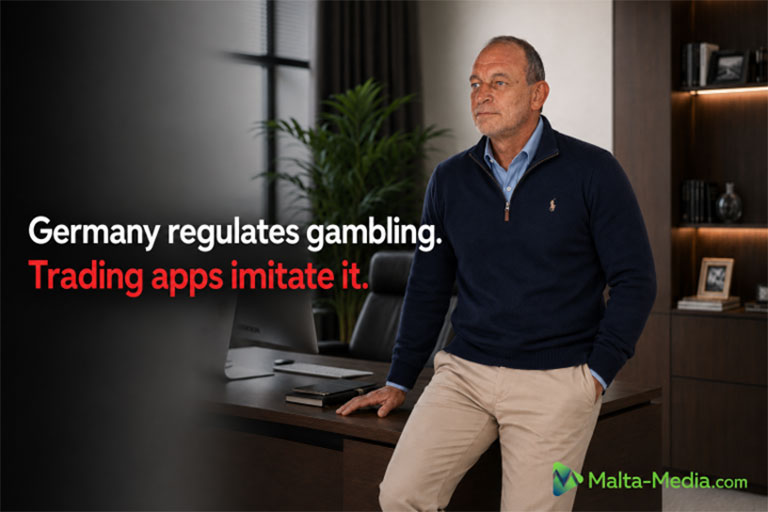
Germany has spent years constructing one of Europe’s most restrictive systems for licensed online gambling. Deposits are monitored across providers, self-exclusion is centralised, virtual slots are slowed down and product design is treated as a potential source of harm. Yet a smartphone user can move from a betting app to a trading app and encounter the same urgency, frictionless transactions and behavioural pressure under an entirely different regulatory philosophy.
That uncomfortable overlap moved into the open on 21 July 2026. The Landesstelle Glücksspielsucht in Bayern’s report on its 16th gambling congress says the event began with presentations on neobrokers and online trading, followed by gambling advertising in professional football. A congress for gambling addiction considered trading apps relevant enough to place them at the start of the programme.
The timing matters. Germany’s temporary exemption from the EU prohibition on payment for order flow expired on 30 June 2026, forcing a significant change to a business model that helped neobrokers offer extremely cheap trading. The financial regulator is addressing conflicts in how orders are routed. The broader behavioural question remains far less settled: what happens when an investment app is designed to make frequent speculation feel as immediate and repeatable as gambling?









This article does not claim that investing is gambling. Buying a diversified fund for twenty years is economically and behaviourally different from placing a sports bet or spinning a virtual slot. The problem begins when regulators rely on the legal label of a product while overlooking the way it is presented, promoted and repeatedly used.
Bavaria put the regulatory contradiction on the programme
The congress was not a finance industry event looking for a provocative comparison. It brought together addiction counselling, treatment services, self-help organisations, ministries, researchers and gambling providers. According to the organiser, 76 people attended in Munich and 94 joined online.
The official programme described the first presentation as examining risk and addictive behaviour in online trading and trading apps. Munich’s Health Advisory Council newsletter likewise identified online-trading risk and addiction as an increasingly relevant subject. That language should make financial and gambling regulators uncomfortable for the same reason.
Germany regulates sectors through different legal boxes. Gambling supervision asks whether a product can produce addiction, loss of control and financial harm. Financial supervision asks whether an instrument is suitable or appropriate, whether risks and costs are disclosed and whether markets operate fairly. Both approaches have legitimate purposes, but the consumer sees only one phone and one bank balance.
The boundary becomes harder to defend when the interface, not the underlying asset, drives behaviour. Constant price movement, push notifications, effortless deposits, attention-grabbing lists and rapid repeat transactions can turn a legitimate investment service into an engagement machine. The regulatory name changes. The behavioural loop may not.
The PFOF ban changed the economics, not the psychology
The EU has now acted against one important structural conflict. Regulation (EU) 2024/791 prohibits investment firms from receiving third-party payments for routing or executing client orders on a particular venue. Member states that previously allowed the practice could use a transition only until 30 June 2026.
Payment for order flow mattered because it allowed brokers to receive revenue from the destination handling a customer’s trade. The practice supported low or zero headline order fees, but it also created the possibility that order routing could be influenced by the payment received rather than only the client’s execution outcome. The EU decided that disclosure was not enough and prohibited the model.
That is meaningful investor protection. It also demonstrates that lawmakers understand how a platform’s revenue model can affect customer treatment. The same logic should be applied to engagement: if a firm benefits when customers transact more often, regulators should examine whether interface design encourages activity that is profitable for the platform but harmful to the user.
The ban does not impose a cooling-off period, loss limit or universal restriction on repeated trading. Nor should long-term investing be subjected automatically to gambling controls. It does mean the end of PFOF is not the end of the problem when frequent trading remains commercially valuable through spreads, product fees, subscriptions, interest or other revenue channels.
Retail order flow was far more valuable than it looked
The economics behind cheap trading were not marginal. A Deutsche Bundesbank research paper on German retail order flow found that specialist retail market makers were extremely profitable on a risk-adjusted basis. The researchers estimated that they would be willing to surrender around 60 per cent of trading revenue for access to retail order flow.
The paper does not prove that individual neobrokers harmed customers or deliberately encouraged excessive trading. It shows why retail transactions were valuable to the businesses processing them. A supposedly free order was not free of commercial significance.
The same study notes regulatory concern about gamification and conflicts of interest in retail brokerage. It also presents important qualifications: retail participation can support market liquidity, some investors perform well and low-cost access can benefit consumers. A serious comparison must retain those benefits rather than treating every easy-to-use app as predatory.
But accessibility and exploitation are not opposites. A platform can lower barriers to sensible investing while also creating incentives to check, trade and react more frequently than is financially rational. Regulators should measure both outcomes instead of assuming that a regulated financial instrument neutralises the psychology of its delivery.
Consumer protection still relies heavily on warnings
The German consumer advice centre’s March 2026 neobroker guidance explains that neobrokers are not truly free, may offer access to only a limited selection of trading venues and can expose customers to worse spreads outside regular market hours. It also warns that frequent trading increases risk and reduces long-term returns.
Those warnings are useful, but they place responsibility on consumers to resist an environment designed for speed and convenience. Gambling regulation takes a more interventionist view. Germany does not merely tell a vulnerable player to understand the risks of parallel play or rapid slot sessions; it imposes central controls intended to interrupt the behaviour.
Financial regulation is not entirely passive. Appropriateness tests apply to certain non-advised complex products, suitability rules apply to advice and portfolio management and BaFin has used product-intervention powers. Its restrictions on CFDs include leverage limits and other retail protections, while interventions have also addressed futures and turbo certificates.
The difference is that financial safeguards are often product-specific. A gambling-style behavioural pattern can develop across ordinary shares, crypto exposure, derivatives or repeated switching between them. If the risk sits partly in frequency and interface design, regulating only the instrument leaves the delivery mechanism insufficiently examined.
European regulators already recognise the design risk
The comparison is not based only on addiction-sector concern. The European Securities and Markets Authority has warned that gamification techniques in trading apps and personal recommendations on social media may cause retail investors to trade without understanding the risks. It supported the PFOF ban and called for action on aggressive marketing and online engagement practices.
ESMA’s later discussion paper on digital investor protection defined digital engagement practices broadly. They include behavioural techniques, differential marketing, gamification and design features that intentionally or unintentionally keep retail investors engaged. The paper stated that these practices may benefit firms from customers’ cognitive biases rather than improve long-term investor outcomes.
One cited finding was particularly uncomfortable: around three quarters of surveyed investors aged 25 to 34 said apps increased how frequently they traded. That figure does not establish addiction and cannot be applied automatically to Germany. It does show that interface design changes behaviour, particularly among younger users.
Germany therefore does not need to invent the issue. European supervisors have identified it, consumer organisations have described the risks and a Bavarian gambling-addiction congress has now placed it on the main programme. The missing step is a coherent regulatory response that follows behaviour across sector boundaries.
Gambling carries controls that trading apps do not
Germany’s legal online gambling operators work under controls that go far beyond disclosure. The GGL’s explanation of the 2021 State Treaty describes central limit and activity files, player exclusion and detailed restrictions for online products. The legal market is built around the assumption that access and behaviour may need to be interrupted even when an adult understands the product.
A retail trading customer can suffer substantial losses without entering OASIS, encountering a cross-provider deposit limit or waiting through a universal transaction pause. That is not automatically a regulatory failure. Securities can create ownership, income and long-term capital growth, while gambling stakes are generally consumed by the event.
The contrast still exposes an inconsistency. Germany accepts that behavioural safeguards are necessary when chance-based products are involved, but it largely returns to disclosure, product governance and targeted intervention when speculative financial products are delivered through high-engagement apps. The consumer’s vulnerability does not change because the regulator changes.
A loss of control deserves attention whether the screen shows a football match, a slot reel, a leveraged certificate or a volatile token. The appropriate intervention may differ, but the trigger for examination should be the observed behaviour and harm, not only the legal category generating it.
The answer is not to regulate investing like a slot machine
A crude solution would damage consumers. Mandatory gambling limits across every savings plan, share purchase or diversified fund would confuse investment with speculation and discourage long-term participation in capital markets. Germany already has a problem with limited equity ownership compared with some other developed economies.
The better approach is targeted and evidence-led. Regulators should distinguish recurring long-term investment from rapid speculative activity, simple assets from leveraged or path-dependent products and neutral usability from design choices intended to increase transaction frequency.
Platforms should be required to test whether notifications, default settings, rankings, rewards and social prompts increase harmful trading. Customers showing extreme transaction frequency, escalating losses or repeated deposits could receive friction that becomes stronger as the pattern continues. That might include clearer cumulative-loss information, temporary pauses or an optional cross-platform self-control tool.
These measures require research and proportionality. They should not be presented as settled solutions, and regulators must avoid collecting more behavioural data than necessary. The immediate demand is simpler: BaFin, the GGL, addiction researchers and consumer bodies should stop treating the boundary as somebody else’s jurisdiction.
The gambling regulator should also be careful what it asks for
The comparison cuts both ways. Gambling regulators cannot point to trading-app risks merely to justify every restriction imposed on licensed operators. If similar behavioural mechanisms are tolerated elsewhere, that may reveal inconsistency, but it does not prove that gambling controls are ineffective or unnecessary.
The legal gambling market has legitimate complaints about proportionality, channelisation and unequal competition with illegal websites. Those arguments become stronger when authorities impose burdens without publishing measurable outcomes. They become weaker if the industry treats another sector’s regulatory gaps as a reason to remove player protection.
The correct question is which controls reduce harm at an acceptable cost in each context. Germany should compare evidence on frequency, losses, vulnerability, product complexity and consumer response. It should then explain why similar behavioural risks produce different interventions.
That would be more honest than maintaining two separate stories. In one, friction is essential because consumers can lose control. In the other, friction is an obstacle to financial participation even when the platform’s revenue benefits from repeated activity.
Our final thoughts and conclusion
Bavaria’s gambling congress did more than add an unusual presentation to its programme. It exposed a regulatory border that has become increasingly artificial on a smartphone. Neobrokers and online trading appeared at an addiction-focused event because experts working with gambling harm recognise overlapping behavioural questions.
The evidence does not establish that trading is gambling, that neobrokers cause addiction or that gambling rules should govern ordinary investing. It establishes that European regulators are concerned about gamification, consumer bodies warn against frequent app-based trading and German retail order flow has been commercially valuable. The EU’s PFOF ban addressed one conflict but not the full engagement model.
Germany’s next step should be a joint behavioural-risk framework across gambling and retail finance. It should measure how design changes transaction frequency and losses, identify which customers are vulnerable and test proportionate friction without obstructing sensible long-term investment.
The current division is convenient for institutions, not consumers. Germany regulates the gambling licence, the financial instrument and the trading venue. The person moving between all three is still the same person, using the same phone and losing money from the same account.
Principal sources
The principal sources are the Landesstelle Glücksspielsucht in Bayern’s congress report, the official congress programme, Munich’s Health Advisory Council newsletter, Regulation (EU) 2024/791, ESMA’s digital investor-protection material, BaFin’s product interventions, the Deutsche Bundesbank research paper and the Verbraucherzentrale’s 2026 neobroker guidance.
All principal online sources are embedded as clickable hyperlinks in the article text. No claim has been based on anonymous allegations, private submissions or an assumption that every trading platform uses the same engagement practices.
Evidence notes for editorial review for future articles
Established facts
The 16th Bavarian Gambling Congress took place on 21 July 2026 and opened with presentations on neobrokers and online trading, followed by gambling advertising in professional football. The official programme framed the trading presentation around risk and addictive behaviour.
The EU prohibition on payment for order flow allowed relevant national exemptions only until 30 June 2026. ESMA has identified gamification and other digital engagement practices as possible risks to investor outcomes, while BaFin has imposed product-specific restrictions on CFDs and other high-risk instruments.
Disputed or qualified claims
The available sources do not establish that neobroker use constitutes gambling or that a particular German platform causes addiction. Trading apps differ, and buying securities can support productive long-term investment.
The Bundesbank paper examined the value and market structure of retail order flow, not clinical addiction. Its findings on profitability support analysis of commercial incentives but do not prove misconduct by a broker or market maker.
Reasonable inferences
The congress programme indicates that gambling-harm professionals consider behavioural risk in trading apps sufficiently relevant for formal examination. The expiry of the PFOF exemption changes one revenue source but does not remove every incentive connected to customer activity.
Separate gambling and financial regimes may produce inconsistent responses to similar patterns of rapid, repetitive and loss-driven behaviour. A cross-sector framework could improve evidence without imposing identical controls on fundamentally different products.
Unanswered questions
Germany has not publicly established a common method for measuring harmful engagement across gambling, trading and crypto apps. Public data on transaction frequency, escalating losses, app notifications and vulnerable customer groups remain incomplete.
It is unclear which design interventions would reduce harmful trading without discouraging long-term investment, how cross-platform tools could operate proportionately and which authority would coordinate the work. These questions require research rather than automatic transplantation of gambling controls.
FAQs
What is the main issue discussed in the article?
The article examines how Germany regulates online gambling much more strictly than trading apps despite similar behavioural risks.
Why are trading apps compared with online gambling?
Both can encourage frequent, fast-paced user activity through digital design features such as notifications and frictionless transactions.
Does the article claim that investing is gambling?
No. It clearly distinguishes long-term investing from gambling while highlighting concerns about speculative trading behaviour.
What is payment for order flow (PFOF)?
PFOF is a practice where brokers receive payments for routing client orders to specific trading venues. The EU prohibited it after a transition period ended on 30 June 2026.
Why did the EU ban payment for order flow?
The ban aims to reduce conflicts of interest and improve investor protection by preventing financial incentives from influencing order routing.
What concerns does ESMA have about trading apps?
ESMA has warned that gamification, digital engagement techniques and aggressive marketing may encourage unnecessary trading by retail investors.
How does Germany regulate online gambling differently from trading apps?
Licensed online gambling operators must comply with central deposit limits, player exclusion systems and other behavioural safeguards that generally do not apply to trading platforms.
What role did Bavaria's gambling congress play in this debate?
The congress highlighted online trading and neobrokers as topics relevant to gambling addiction research, reflecting growing concern about behavioural risks.
Does the article recommend regulating investing like gambling?
No. It argues for targeted, evidence-based measures that distinguish long-term investing from speculative, high-frequency trading.
What is the article's main conclusion?
The article suggests Germany should develop a behavioural risk framework that considers consumer behaviour across both financial services and online gambling rather than regulating each sector in isolation.

Michael Schmitt
Michael Schmitt is the founder of TRIDER.UK and Editor of Malta Media. He writes about iGaming, gambling regulation, corporate structures, financial services and market integrity, combining investigative journalism with nearly three decades of experience in corporate services and international business.
Related Posts
Germany’s gambling blocking system struggles with obvious targets
September 19, 2026
Gambling Commission reports growth across Great Britain’s gambling market
September 18, 2026

Flows launches TakeDown as first free-to-play crash game via FlowsWave
September 17, 2026
BetComply strengthens compliance team with three experienced appointments
September 16, 2026
Euromat study finds Europe’s illegal online gambling market worth €12bn
September 16, 2026
Betting and Gaming Council warns of illegal betting risk at St Leger
September 16, 2026
Dutch iGaming operators face shifting demand as offshore interest grows
September 16, 2026
Blask reports Vietnam iGaming demand fell 26.2% amid XoilacTV case update
September 16, 2026
Belarus iGaming demand jumps as Lukashenko targets Maxline advertising
September 16, 2026