

















Germany’s gambling blocking system struggles with obvious targets
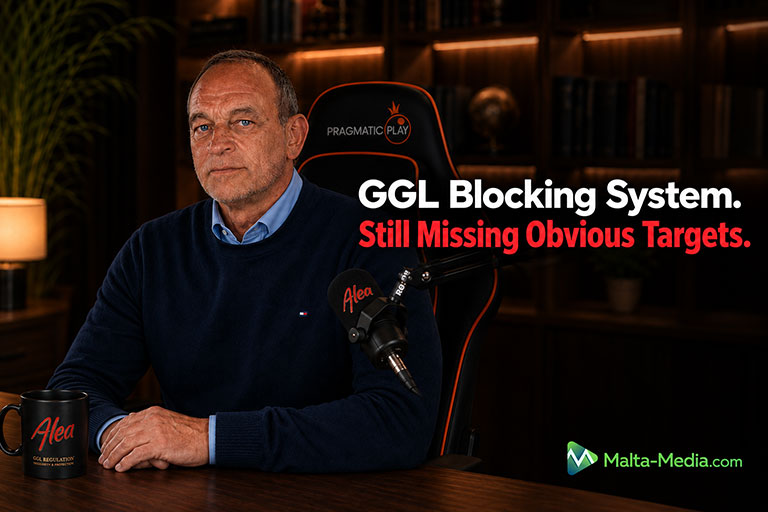
Why Germany’s gambling blocking system keeps missing the obvious targets
Germany reported 1,843 illegal gambling websites made inaccessible in 2025. That sounds decisive until prominent operators keep returning through new domains, payment routes and search listings. The problem is not a lack of activity. It is a system that still measures individual interventions more clearly than permanent market outcomes.
Germany’s anti-illegal-gambling machinery looks powerful in a table. The GGL says it checked 2,662 websites during 2025, while 1,843 became inaccessible through prohibition measures or network blocking and 178 could no longer use common payment services. Those numbers are real and dismissing them would be unfair. A large number of completed actions can still coexist with a very visible weakness: the operator a player recognises may remain findable, fundable or ready to return through another route.
The GGL’s own reporting makes that tension difficult to ignore. When a technical intermediary changes, the authority explains that the process has to begin again against the new provider. That is an honest description of the work, but it is also the reason the strongest headlines can overstate the result. Germany often blocks an address, a payment relationship or one service provider while the underlying commercial operation survives.









Germany has a blocking chain, not an off-switch
The political version of blocking is wonderfully simple. An offer is illegal, the authority identifies it and access disappears. The real system consists of several separate procedures aimed at different parties: a prohibition order against the operator, technical action involving a host or intermediary, payment restrictions against financial companies and cooperation with search or advertising platforms.
Each measure can work on its own without ending the consumer journey. A website may become unavailable while a mirror domain appears. A payment processor may withdraw while another company takes over. A search result may disappear and return later, while affiliates and social-media accounts continue sending customers towards the same brand.
The easier cases will normally react to the first serious contact from the regulator. Operators with German assets, EU exposure or mainstream commercial partners have something immediate to lose. The obvious hard targets are different because they can contest jurisdiction, replace infrastructure and make every new step another administrative procedure.
The court removed the most obvious shortcut
The clearest legal setback arrived in March 2025. The Federal Administrative Court confirmed that ordinary internet access providers could not be used as broad blocking instruments under the existing wording of the Glücksspielstaatsvertrag. A company which merely transmits third-party data is not automatically responsible for the gambling content it carries.
That judgment did not protect illegal gambling and it did not make the underlying offers lawful. It exposed a provision whose political promise was much wider than its legal reach. The GGL later said it had already stopped taking further steps against access providers after the earlier court decisions and would concentrate on other intermediaries instead.
This matters because IP blocking had been presented as the hard technical edge of the system. Offshore operators might ignore a letter from Halle, but German internet providers could not. Once that shortcut disappeared, Germany was left with slower and more fragmented routes through hosts, payment services, search platforms and international cooperation.
Payment blocking causes pain, then the route moves
Payment blocking remains one of the GGL’s strongest tools because every gambling business has to move money. During 2025, the authority says 38 payment providers stopped participating in transactions connected with five illegal operators, affecting 178 websites. It also says established payment options increasingly disappear from illegal sites and are replaced by less familiar and more awkward alternatives.
That is a meaningful result. An operator becomes less attractive when deposits are difficult, withdrawals look uncertain and customers are pushed towards obscure services. The problem begins when the first disruption is counted as the final outcome even though the commercial route is later rebuilt.
Five operators accounting for 178 websites also show why domain totals need context. One commercial operation can sit behind multiple brands, mirrors and replacement addresses. The useful questions are how long payment access remained unavailable, how much German turnover disappeared and whether players moved into the licensed market or simply found the next available route.
The GGL’s own report describes a moving target
The 2025 activity report contains one of the clearest descriptions of the problem. When the relevant hosting or intermediary provider changes, the GGL starts the process again against the new company. That may be unavoidable under administrative law, but it means the illegal business can force the state to keep chasing disposable parts of its infrastructure.
The same report describes cooperation with a major search engine. A high-reach illegal lottery operator was removed from the search index, later found a way to appear again and was removed once more after another GGL notification. That is good platform cooperation, but it also captures the entire weakness in a few lines: remove, reappear and repeat.
The answer cannot be reckless enforcement based on an unverified screenshot. The authority still has to establish the facts and use powers that survive judicial review. It does, however, need intelligence that follows the operator across domains, hosts, processors and promotional channels instead of allowing every technical change to make the case look new.
Lottoland is the obvious long-term test
Lottoland remains useful because the timeline is too long to explain away as a new or hidden target. The GGL publicly acted against international Lottoland offers in 2022, warned specifically about illegal El Gordo participation in 2023 and still maintains current guidance, updated on 13 August 2026, identifying the international offer on lottoland.com as unlicensed in Germany.
That should not be confused with Lottoland Deutschland GmbH, which is a separate licensed German company using different authorised domains. The international offer and the licensed German operation have to be treated according to their own legal positions. The issue here is narrower: after years of action against a highly recognisable international brand, the regulator still needs to explain to German consumers that the offer remains illegal.
This does not prove that every previous measure failed. A payment route may have disappeared, a search listing may have been removed and German access may have become more difficult at different points. The GGL should now show which of those effects lasted and what a German consumer can no longer do because of the enforcement already undertaken.
Licensed operators remain wonderfully easy to reach
There is a structural reason why Germany can look tougher against companies already inside the system. Licensed operators have named directors, compliance teams, known technology and a permission they cannot afford to lose. When the regulator asks for documents or imposes a deadline, those businesses answer because the alternative can be commercially devastating.
An offshore operator can force a very different process. It can move a host, change a processor, use another domain or make the authority work through a foreign jurisdiction. No conspiracy or deliberate favouritism is required for the imbalance to develop. Administrative power naturally bites hardest where the regulated company is easiest to identify and control.
The answer is not weaker supervision of licensed operators. Germany needs strong oversight of the legal market. It also needs an illegal-market strategy effective enough that refusing German regulation does not become the more commercially resilient option.
Germany needs to measure the operator, not the file
The GGL should report more outcomes at operator level rather than presenting websites as though every domain were a separate victory. A useful enforcement record would connect mirror sites, recurring payment companies, hosts, affiliates and brand changes over time. It would show whether the commercial operation became smaller, less visible and less capable of taking German money.
The headline figure of 1,843 inaccessible websites is important, but it would mean far more if the public knew how many distinct operations sat behind those domains and how many remained unavailable after 30, 90 and 365 days. Search visibility, payment recovery and replacement-domain traffic are difficult to measure, yet they are much closer to the experience of players and licensed competitors.
This is also the information policymakers need. If the legal basis is too narrow, the Länder should amend it. If foreign intermediaries cannot be reached, that gap should be documented clearly. If payment blocking produces only temporary disruption, the speed and scale of replacement should become part of the success measure.
Our Final Thoughts and Conclusion
Germany’s problem is not that the GGL does nothing. The authority is active, it has removed large numbers of websites and it has persuaded operators, hosts and payment companies to change their behaviour. The problem is that administrative activity is not the same thing as permanent control of the most recognisable illegal businesses.
The Federal Administrative Court narrowed the access-blocking route. Payment services can be replaced, hosts can change and search listings can return after removal. The GGL’s own report describes all three parts of that chase, while the continuing Lottoland guidance shows why the long-term result matters more than the first successful intervention.
Germany does not need another impressive blocking headline. It needs evidence that, after years of enforcement, the obvious targets are genuinely harder to find, harder to fund and less profitable. Until the system can demonstrate that outcome, it will continue winning individual steps while the operators it was built to remove survive between them.
FAQs
How does Germany block illegal gambling websites?
Germany uses several enforcement measures, including prohibition orders, action against hosting and technical intermediaries, payment restrictions and cooperation with search and advertising platforms.
How many illegal gambling websites became inaccessible in Germany in 2025?
The GGL reported that 1,843 websites became inaccessible during 2025 through prohibition measures or network-blocking action.
How many gambling websites did the GGL check in 2025?
The GGL checked 2,662 websites during 2025 as part of its supervision and enforcement activity against illegal gambling.
Why can illegal gambling operators return after a website is blocked?
Operators can move to replacement domains, change hosting providers, switch payment processors or use other promotional channels, allowing the underlying business to continue after an individual intervention.
What happened to Germany’s internet access blocking powers in 2025?
In March 2025, the Federal Administrative Court ruled that internet access providers can only be subject to gambling blocking orders under the relevant provision when the statutory responsibility requirements are met.
How does payment blocking affect illegal gambling operators?
Payment blocking can make deposits and withdrawals more difficult by removing established payment options, although operators may respond by moving to alternative payment providers.
Why are domain-blocking statistics not enough to measure gambling enforcement?
A single gambling operation can use multiple domains, mirror sites and replacement addresses, meaning the number of blocked websites does not necessarily represent the number of distinct operators removed from the market.
What is the difference between Lottoland.com and Lottoland Deutschland GmbH?
The GGL distinguishes the international Lottoland.com offer from Lottoland Deutschland GmbH. Its current whitelist identifies Lottoland Deutschland GmbH and its authorised German domains as licensed gambling services.
Why are licensed gambling operators easier for German regulators to supervise?
Licensed operators generally have identifiable management, compliance structures, known technology and German regulatory permissions that can be affected if they fail to comply with supervisory requirements.
How could Germany better measure illegal gambling enforcement?
Enforcement reporting could focus more on operators rather than individual domains by tracking recurring websites, payment providers, hosts, affiliates and brand changes and measuring how long disruptions remain effective.

Michael Schmitt
Michael Schmitt is the founder of TRIDER.UK and Editor of Malta Media. He writes about iGaming, gambling regulation, corporate structures, financial services and market integrity, combining investigative journalism with nearly three decades of experience in corporate services and international business.
Related Posts
Gambling Commission reports growth across Great Britain’s gambling market
September 18, 2026
Bet3000 disappeared online. Who made money from it?
September 17, 2026

BetComply strengthens compliance team with three experienced appointments
September 16, 2026

Euromat study finds Europe’s illegal online gambling market worth €12bn
September 16, 2026
Betting and Gaming Council warns of illegal betting risk at St Leger
September 16, 2026
Dutch iGaming operators face shifting demand as offshore interest grows
September 16, 2026
Blask reports Vietnam iGaming demand fell 26.2% amid XoilacTV case update
September 16, 2026
Belarus iGaming demand jumps as Lukashenko targets Maxline advertising
September 16, 2026
GGL court defeats expose weaknesses in German gambling enforcement
September 15, 2026