

















Curaçao consultancy affair raises questions over €3.4m CGA contract
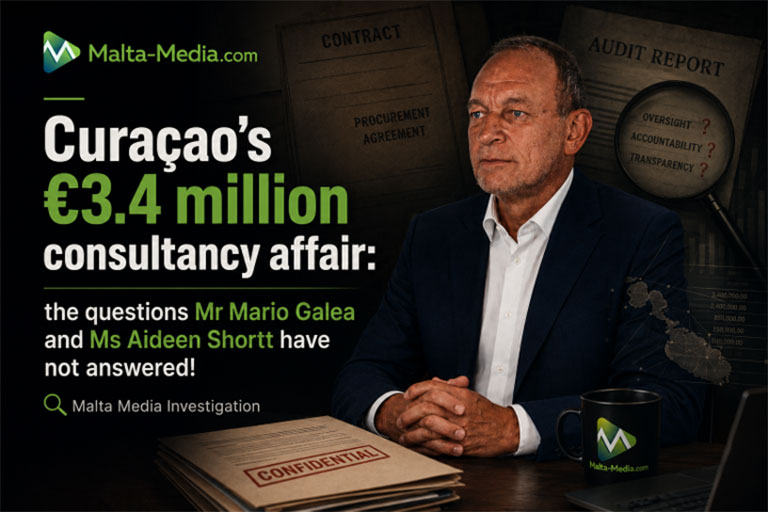
Curaçao’s €3.4 million consultancy affair: the questions Mr Mario Galea and Ms Aideen Shortt have not answered!
Mr Charles Cooper handed Random Consulting Limited an enormous gift when he claimed that the Malta-based consultancy was receiving 8.3 million Caribbean guilders, approximately €4 million, every year from the Curaçao Gaming Authority. The figure was wrong, Mr Mario Galea was entitled to correct it and every publication which repeated it as an established annual payment should correct it too. Mr Galea and Random Consulting have since disclosed that the company received €3,426,406 between 2022 and 2025.
Correcting the minister’s arithmetic, however, does not explain the contract. It does not explain how Random Consulting was selected, whether there was a tender, how its fees were calculated, which public body authorised the engagement in 2022 or why almost three quarters of the entire disclosed amount was paid in 2025. It also does not explain why the CGA’s own new supervisory board objected to the regulator’s 2026 budget strongly enough to involve the finance minister and trigger an independent administrative investigation.
Ms Aideen Shortt, publicly presented as the CGA’s marketing and PR adviser, responded to the controversy by promoting Random Consulting’s right of reply and accusing sections of the media of allowing “a lie” to be “laundered” until it acquired the appearance of truth. She called the reporting an “irresponsible charade” but did not tell readers that she had previously worked as a Partner Consultant inside Random Consulting or that she has been publicly described as Mr Galea’s life partner. Those connections do not prove that anything improper happened, but they make her failure to disclose them rather more interesting than her indignation.








The current administrative investigation also returns Curaçao to questions first raised almost two years ago by financial forensic investigator Drs. Luigi Faneyte. His roughly 400-page criminal complaint named Mr Galea, Ms Shortt and others connected with the gambling reform and alleged serious criminal conduct. Those allegations remain unproven, parts of his evidence were strongly disputed and Malta Media itself rejected one particularly controversial attempt to identify Mr Galea’s voice on a recording. What happened to the wider complaint after Curaçao’s Public Prosecutor confirmed receiving it has never been publicly explained.
Now, some of the governance questions contained in that enormous dossier have resurfaced from an entirely different source. They are no longer coming only from Drs. Faneyte, an opposition politician or journalists who have spent years questioning Curaçao’s regulatory makeover. They are coming from inside the regulator’s own supervisory structure.
A wrong number became a very useful shield
Antilliaans Dagblad established that the 8.3 million-guilder amount appeared in the CGA’s 2026 budget and covered wider investments and expenditure connected with the continued implementation of the National Ordinance on Games of Chance, known as the LOK. It could not properly be described as an annual payment of the entire amount to Random Consulting.
Mr Cooper’s handling of the information was careless. A finance minister should not take a disputed budget figure, attach it publicly to a named company and person and ask explosive questions before confirming what the figure actually represents. His mistake supplied Mr Galea with a legitimate correction and allowed Random Consulting to shift the public argument away from its contract and towards the reliability of the reporting.
Random Consulting’s own detailed statement gives the actual payment schedule. The company says it received €15,406 in 2022, nothing in 2023, €884,250 in 2024 and €2,526,750 in 2025, bringing the total to €3,426,406. Almost 74 per cent of everything Random Consulting says it received over the four-year period was therefore paid during 2025.
Random Consulting says this uneven payment pattern resulted partly from the Curaçao government asking the company to defer payments during the early implementation stage. According to the company, Mr Cooper himself attended a meeting at which that arrangement was discussed. That may be entirely correct, but it makes the underlying documents more important because the payment dates alone no longer show when the work was performed, when invoices were issued, when liabilities were recognised or which milestones caused more than €2.5 million to become payable in a single year.
Mr Galea has placed a payment total on the table. He has not placed the contract, invoices, work reports, payment approvals, agreed hourly rates, project milestones or contract variations beside it. A payment schedule is useful, but it is not the same as transparent public procurement.
Random Consulting also points out that 617 licences generate more than €29 million in annual revenue under the new regime. That may expose another weakness in Mr Cooper’s original attempt to describe the consultancy payments as 35 per cent of gambling revenue, but it does nothing to establish whether Random Consulting’s fees were reasonable. A private contractor’s bill is justified by the work commissioned, resources deployed, results delivered and price available in the market, not by demonstrating that the public authority collecting licence fees has considerably more money coming in.
Mr Galea disclosed the payments, not the deal
Random Consulting’s statement shows that its role was considerably broader than supplying a piece of software. The company says it designed, developed and continues to maintain the online licensing portal which forms the backbone of Curaçao’s licensing and licence-management system. It also provides a dedicated multidisciplinary team involved in application processing, workflow management, applicant support and administration of the licensing system.
Its stated responsibilities include hosting, maintenance and technical support for the original NOOGH platform and the newer CGA Portal. Random Consulting also describes providing operational and regulatory support for the licensing process and developing a real-time monitoring system intended to identify licensed operators and websites falsely claiming to hold Curaçao licences. These may be valuable services, but they place the company unusually close to functions ordinarily associated with the regulator itself.
In 2024, Mr Galea responded to Drs. Faneyte’s allegations by saying that Random Consulting supplied the portal but did not manage it, did not decide which licences were issued and did not collect money from operators. Random Consulting’s latest statement now describes a team contributing to application processing, workflow management, applicant support, system administration and regulatory operations. The two positions are not necessarily irreconcilable, but they leave a very large grey area between providing technical support and participating in the administration of a sovereign licensing system.
The independent investigation must establish where that line was drawn in practice. It needs to identify which tasks were performed by CGA employees, which were performed by Random Consulting personnel and who had the final authority at every stage of application assessment. It should also establish whether private contractors reviewed due-diligence material, beneficial ownership records, source-of-funds information or other sensitive documents and what access controls, confidentiality rules and audit trails applied.
These questions acquire greater weight when read alongside the Caribbean Financial Action Task Force’s assessment of Curaçao. The assessment, based on an onsite visit in June 2024, found that the supervisory approach for online casinos had yet to be implemented and identified online gambling as one of Curaçao’s highest money-laundering-risk sectors. The report represents conditions at the time of the assessment and does not establish that the position remained unchanged in 2026, but it makes the division between private operational support and formal public supervision impossible to treat as a technical footnote.
Random Consulting received €884,250 during 2024, the year covered by that onsite assessment. The relevant question is not whether the CFATF findings somehow prove that Random Consulting failed, because the company may have been building systems that were not yet expected to be operational. The investigation should instead establish what the 2024 payment bought, which deliverables had been accepted by then and how the regulator assessed the effectiveness of the operational and regulatory support it was purchasing.
Who owns Curaçao’s regulatory backbone?
Random Consulting says the software it developed will transfer to the CGA at the end of the agreement, giving the authority permanent ownership without continuing software licensing costs. That sounds reassuring until one considers what it also implies: ownership apparently has not yet transferred, or at least the public has not been shown documentation establishing the CGA’s present rights.
If the portal is the backbone of Curaçao’s online gambling regulator, the island should know who presently owns the source code, infrastructure, databases and associated intellectual property. It should know whether the CGA has continuous access to current source code, whether an independent escrow arrangement exists and whether the authority could keep operating if Random Consulting ceased work unexpectedly. It should also know what contractual exit plan exists and whether another supplier could take over without disrupting licence administration.
Mr Cooper and local politicians have raised questions about where the licensing data are stored, with Curaçao, Malta and London all mentioned in the public discussion. Paradise FM reported that the inquiry is expected to examine the services delivered, the absence or existence of an open tender and the location of privacy-sensitive licence-holder information. The outlet’s original report repeated Mr Cooper’s inaccurate annual figure, but those underlying questions remain valid and have not been answered by Random Consulting’s correction.
There is currently no public evidence proving that data have been stored improperly outside Curaçao. There is equally no published contract, data-processing agreement, hosting architecture or independent security review showing where the data sit, which legal entities process them and which individuals can access them. For a portal holding corporate documents, shareholder records, ultimate beneficial ownership information and personal data used in integrity assessments, “confidential” is not an adequate public explanation.
Random Consulting’s involvement also began in 2022, more than two years before the LOK came into force on 24 December 2024. That does not mean there was no competent public body capable of entering the contract, as the old Gaming Control Board already exercised gambling-related functions. It does mean the investigation must establish which organisation signed the original agreement, who signed on its behalf, what statutory or delegated authority supported the engagement and whether the scope expanded as the reform developed.
The alarm came from inside the CGA
The most important fact in the current controversy is not Mr Cooper’s error. According to Antilliaans Dagblad, the CGA’s relatively new board of commissioners, performing the regulator’s supervisory role, disagreed with the 2026 budget and communicated the disputed 8.3 million-guilder amount to the finance minister. Mr Cooper subsequently said the board did not want to approve the amount.
This new board arrived after the CGA’s entire previous supervisory board resigned in September 2025, a development Malta Media covered when the authority insisted that the resignations had not affected its stability. The reasons for that collective departure were never properly explained in public. Curaçao therefore moved from one board disappearing during a critical stage of the reform to a newly appointed board questioning millions in proposed expenditure within its first year.
Mr Cooper and Justice Minister Mr Shalten Hato then signed a formal request for an administrative governance investigation. Antilliaans Dagblad reported that the government wanted advance sight of the Terms of Reference and that procurement would form part of the inquiry. This is not, on the evidence currently available, a criminal investigation in which Mr Galea or Random Consulting has been designated a suspect, and Malta Media does not describe it as one.
That legal distinction does not make Random Consulting peripheral to the process. Curaçao.nu reported that the supervisory board could choose from ten international firms to investigate the agreement, amounts paid, work delivered, identity of the contracting authority and legal basis on which the contract was concluded. Prime Minister Mr Gilmar Pisas said he did not possess the agreement himself and that publication was a matter for the autonomous CGA.
Autonomy is intended to protect a regulator from improper political interference. It is not supposed to prevent a government, parliament or public from seeing how millions were committed to an external contractor performing work at the centre of a national licensing regime. The fact that Curaçao’s prime minister apparently does not have the agreement only strengthens the case for its controlled publication, subject to narrowly justified redactions for genuine security or commercially sensitive material.
No timetable for selecting the investigator has been published. There is also no known deadline for completing the work and no firm commitment that the final report will be released in full. After two years of unanswered allegations and another year of upheaval within the supervisory structure, an open-ended inquiry followed by a confidential report would merely add another layer of secrecy to the contract it is supposed to examine.
Ms Shortt’s outrage came without disclosure
Ms Shortt is not an unrelated industry commentator who discovered the story on LinkedIn and became suddenly concerned about accuracy in journalism. She has repeatedly been publicly described as the CGA’s marketing and PR adviser and, in previous years, as an adviser to Curaçao’s finance minister involved closely in communicating the gambling reform. In June 2026, industry reporting was still identifying her as the CGA’s marketing and PR adviser when she promoted the authority’s new cryptocurrency guidance.
Her connection to Random Consulting is equally well documented. In 2015, Ms Shortt joined the company as a Partner Consultant, with Mr Galea saying she would oversee European gaming markets and strengthen the company’s marketing and operational expertise. There is no public evidence before Malta Media showing that Ms Shortt retained ownership or a formal role after leaving, but describing her as unconnected to Random Consulting would plainly be inaccurate.
Curaçao reporting in 2024 also described Ms Shortt as Mr Galea’s life partner, based on the account contained in Drs. Faneyte’s complaint and subsequent reporting. Malta Media has not independently verified the current status of that private relationship and does not present it as its own finding. Neither a personal relationship nor a previous job proves that Ms Shortt influenced a contract or payment.
The relevance lies in disclosure. A person publicly operating as the communications voice of a regulator should disclose a previous senior role with a contractor when launching a personal attack on reporting about that contractor. If she is also in a private relationship with the contractor’s principal, that relationship becomes relevant to readers assessing whether her intervention is independent regulatory communication, private loyalty or a mixture of both.
Ms Shortt’s LinkedIn post disclosed none of that. It directed readers towards the defence advanced by Mr Galea and Random Consulting, accused media organisations of laundering a lie and shamed those supposedly participating in the charade. Her outrage was remarkably selective: she demanded precision and transparency from journalists while providing no transparency about her own proximity to the people and company she was defending.
The public is repeatedly invited to treat Ms Shortt as an authoritative voice for the CGA when she announces legislation, explains licensing policy or attacks reports concerning the authority. When she publicly defends Mr Galea and Random Consulting, it is suddenly unclear whether she is speaking as a CGA adviser, a former Random Consulting colleague, a reported private partner or merely an individual expressing a personal view. That ambiguity may be convenient for Ms Shortt, but it is unacceptable for a public regulator whose credibility depends upon clear lines of responsibility.
The conflict questions should be answered with documents
The independent inquiry should establish who engaged Ms Shortt or her company, which public body paid for her services and what her terms of reference covered. It should examine whether her former role with Random Consulting and any relevant personal relationship with Mr Galea were formally declared to the Gaming Control Board, the CGA, the Ministry of Finance or the relevant supervisory boards.
The investigators should also determine whether Ms Shortt attended discussions involving Random Consulting’s appointment, contract scope, invoices, payment deferrals, renewals or performance. Her involvement in preparing communications concerning the company, responding to criticism or placing rights of reply should also be established, along with whether she had access to confidential contractual or payment information through her public advisory role.
If Ms Shortt played no part in any decision or communication affecting Random Consulting, that finding would protect her from unsupported suggestions of improper influence. If declarations were made and recusals were properly documented, publication of those records would demonstrate that Curaçao recognised and managed the potential conflict. If no declarations were considered necessary despite the previous commercial connection and reported private relationship, the investigation should explain why.
A potential conflict of interest does not require evidence of bribery, corruption or a secretly manipulated contract. It exists where personal or commercial relationships could reasonably be perceived as influencing professional judgement. Competent public bodies deal with that possibility through disclosure, recusal and independent supervision rather than expecting the public to accept that everyone involved is above questioning.
Ms Shortt’s aggressive intervention also sits within a longer record which Malta Media has already examined. In July 2025, our investigation into Ms Shortt, the CGA and the façade of reform reviewed her recorded comments in a German ARD/SWR documentary, where she was introduced as a senior CGA adviser and finance ministry consultant. The recording included her describing aspects of Curaçao’s framework as deliberately weak, saying the regulator did not want to damage operators’ businesses and suggesting that countries such as Germany, France and Spain were not prohibited markets under Curaçao’s approach.
That article called for an independent review of the CGA’s leadership and advisory structures, including consultant contracts, conflict disclosures and licence decisions. Curaçao did not provide that transparency then. Thirteen months later, the regulator’s own new supervisory board has raised concerns about its budget and the government is finally commissioning an investigation into the contracts and procurement surrounding the reform.
The 400 pages Curaçao never publicly disposed of
On 25 November 2024, Drs. Faneyte filed his first complaint concerning Curaçao’s gambling reform. Nu.CW reported that the Public Prosecutor confirmed receipt and said each complaint would be assessed on its own merits. Contemporary Curaçao reporting described the submission as hundreds of pages, while later local coverage put its length at approximately 400 pages.
Drs. Faneyte accused then-finance minister Mr Javier Silvania, Mr Galea, Ms Shortt and Mr Mario Fiorini of serious offences connected with the licensing system. His allegations included official misconduct, corruption, fraud, embezzlement and money laundering. They were accusations submitted for investigation, not conclusions reached by a prosecutor and certainly not findings made by a court.
The complaint focused partly on provisional licences being processed through a portal associated with Mr Galea and on the role of the Maltese advisers presented by Mr Silvania during a February 2024 parliamentary briefing. Antilliaans Dagblad reported at the time that Mr Galea, Ms Shortt and Mr Fiorini had been introduced as investors involved in modernising the gambling system. Drs. Faneyte argued that a promised plan explaining their role never appeared.
A second complaint filed in December widened the allegations and named Random Consulting, Mr Cedric Pietersz, the Gaming Control Board and several other individuals and organisations. Curaçao.nu reported claims involving payment arrangements, cryptocurrency links, invoicing and the use of a Czech electronic-money institution. Those claims remain allegations and should not be repeated as established fact without the underlying records and a response from those named.
The Gaming Control Board rejected the criminal allegations and published a detailed defence of its authority, licensing process and handling of operator payments. Malta Media reported that the regulator disputed Drs. Faneyte’s account and maintained that licence fees were invoiced by the board and paid into an official government account rather than being collected through Mr Galea’s portal.
One element of the second complaint involved a recorded telephone conversation which Drs. Faneyte’s material associated with Mr Galea. The regulator said neither voice belonged to one of its advisers, while Ms Shortt called the identification completely false. In our later review of Ms Shortt and the Curaçao controversy, Malta Media stated plainly that we did not believe the available recording established that Mr Galea was the person speaking.
That correction remains important. Investigative journalism becomes worthless if a publication clings to a dramatic piece of evidence after it no longer believes the evidence is reliable. The same standard applies to Mr Cooper’s inaccurate annual payment figure, which should not be kept alive merely because the underlying contract remains suspicious enough to investigate.
One error does not dissolve every other question
Ms Shortt has now used substantially the same argumentative method twice. In December 2024, she said that the disputed identification of Mr Galea on the recording meant the entirety of Drs. Faneyte’s second complaint was built on a false premise. In August 2026, she used Mr Cooper’s wrong annual figure to accuse local and trade media of laundering a lie.
Both errors deserved correction. Neither correction determines how Random Consulting was procured, what contractual authority existed in 2022, how €3.426 million was priced, why the CGA’s new board objected to the 2026 budget or whether relationships involving the public advisers and private contractor were properly declared. Finding one weak beam in an investigation does not cause every separate document and question in the building to disappear.
Mr Galea and Ms Shortt also attacked Drs. Faneyte in 2024 as a possible “mouthpiece” for commercial interests allegedly damaged by the new licensing regime. Mr Galea said efforts were being made to identify who was behind him, while Ms Shortt described the affair as a trial by media. Drs. Faneyte’s political position and possible motives were legitimate matters to examine, particularly with an election approaching, but attacking the person asking questions never established whether the consultant contracts, procurement and conflicts were sound.
The current investigation does not vindicate Drs. Faneyte’s criminal allegations. It does something more limited but still significant: it confirms that concerns surrounding expenditure, procurement, contractual authority and the regulator’s dependence on external consultants were serious enough to trouble a newly appointed CGA supervisory board. Those questions have now survived the disputed telephone call, the 2025 election and Mr Cooper’s inaccurate figure.
What happened to Drs. Faneyte’s complaints remains unclear. Malta Media has found no public confirmation that Mr Galea, Ms Shortt or Random Consulting became formal criminal suspects as a result of the filings. We have also found no clear announcement saying the complaints were dismissed in full, formally closed or found to be without merit.
For a case involving hundreds of pages, several international businesses, senior public officials and allegations against the very structure used to create Curaçao’s new gambling regime, that silence is extraordinary. The Public Prosecutor does not have to conduct its work through newspaper statements, but the public is entitled to know whether a major complaint affecting confidence in a national regulator remains active, was rejected or disappeared into an administrative drawer.
Malta Media has been asking about the same structure for years
Malta Media’s interest in the CGA did not begin with Mr Cooper’s Facebook posts. We have repeatedly questioned whether Curaçao’s proclaimed reform replaced the old regulatory culture or simply gave it a better website, a more expensive portal and a fresh set of international conference presentations.
Our analysis of Curaçao’s new gambling rules questioned whether higher fees and new administrative layers were being mistaken for meaningful supervision. We later described the prolonged licensing transition as a spectacular regulatory mess and examined how promised reforms repeatedly gave way to extensions, incomplete applications and uncertainty over the status of operators.
In September 2025, our investigation into the CGA’s failure to act examined an authority which was often quicker to correct journalists than to explain enforcement decisions publicly. In February 2026, we returned to the issue after finding contradictions between the CGA’s enforcement register and certificate portal, raising further questions about the regulator’s enforcement credibility.
The turmoil inside the CGA continued through board resignations, shifting political responsibility, conflicting claims about investigations and uncertainty surrounding licensing deadlines. None of those previous articles proves that Random Consulting was overpaid or that Ms Shortt influenced its engagement. Together, they show why another demand that everyone trust the reform and stop asking awkward questions is no longer remotely convincing.
The CGA’s initial reaction to Mr Cooper concentrated on the reputational damage being done to the regulator, Curaçao and the online gambling market. That concern is understandable, but the regulator’s reputation will not be restored by protecting the contract from view. It will be restored only if the contract, procurement and work withstand independent examination.
What the investigators must place on the public record
The inquiry should begin with the original agreement and every amendment, extension and side letter that followed it. It must identify the contracting entity, the officials who signed, the authority on which they relied and the process through which Random Consulting was chosen. Where no open tender took place, the report should identify the precise legal exemption and demonstrate why a direct engagement represented Curaçao’s best available option.
The financial review must reconcile the €3,426,406 disclosed by Random Consulting with CGA records, invoices, accruals and bank payments. The claim that payments were deferred at the government’s request should be tested against meeting records, correspondence and the original payment schedule. The investigators should establish why no payment was made in 2023, why €884,250 was paid in 2024 and why €2,526,750 followed in 2025.
The work itself requires more than a broad description such as “modernisation” or “regulatory support”. The report should identify the number and location of Random Consulting personnel assigned to the project, their roles, rates, hours or contracted deliverables and any subcontractors used. It should match accepted milestones and performance reports to each material payment and explain how the CGA assessed quality and value.
The inquiry must map the boundary between private assistance and public regulatory power. It should identify who reviewed licence applications, performed due diligence, accessed personal and beneficial ownership data, recommended approvals, investigated compliance issues and advised on enforcement. Any use of Random Consulting staff in those processes must be matched to a clear legal mandate, CGA supervision and documented controls.
Ownership and resilience of the technology also require a complete examination. The public should know where the platforms and databases are hosted, who presently owns the software, who holds the source code, what access CGA personnel possess and how the regulator would continue operating if the agreement ended. Any cross-border processing of sensitive applicant data should be documented together with the governing contracts, security assessments and legal safeguards.
The conflict review must cover every official, adviser and contractor involved in selecting, managing or publicly defending Random Consulting. It should identify declarations made by Ms Shortt and Mr Galea, any recusals applied and whether Ms Shortt participated in communications or decisions concerning Random Consulting while acting for the ministry or regulator. The inquiry should also establish whether she helped prepare or coordinate the company’s public response and, if so, in which professional capacity.
Finally, the Terms of Reference and final report should be published. Legitimate technical security details and narrowly defined commercial secrets can be redacted, but the central findings on procurement, authority, payments, deliverables, data, ownership and conflicts must be available to Curaçao’s parliament and public. An investigation which checks the arithmetic while keeping the contract and relationships hidden would be an expensive way of confirming what Random Consulting has already chosen to disclose.
The correction does not close the file
Mr Cooper owes Curaçao an explanation for how he converted a wider CGA budget figure into a claim that one Malta-based company was receiving 8.3 million guilders every year. His carelessness damaged the credibility of an investigation which may prove genuinely important and allowed those facing legitimate questions to portray themselves as victims of fabricated reporting.
Mr Galea is entitled to insist that Random Consulting received €3.426 million rather than €4 million annually. He should now support publication of the agreement, procurement basis, deliverables, invoices and data arrangements needed to establish that his company was properly selected and fairly paid. Demanding an investigation into who disclosed information about a confidential public-sector agreement while resisting publication of the agreement itself is not a convincing substitute for transparency.
Ms Shortt is entitled to defend someone she knows personally and professionally. She is not entitled to present herself as a neutral guardian of accuracy while failing to disclose her former Random Consulting role, her public position around the CGA and the reported personal relationship which gives her intervention an obvious private dimension. That may be loyalty, but it is not transparent regulatory communication.
Drs. Faneyte’s allegations remain allegations and the current administrative investigation does not prove that his criminal claims were right. It does show that the procurement, payment, authority and conflict questions at the centre of the reform were not made irrelevant by one disputed recording, just as they have not been removed by one finance minister getting his figures wrong.
For two years, the people surrounding Curaçao’s gambling reform have treated these questions as malicious noise produced by political enemies and irresponsible journalists. The regulator’s own new supervisory board has now demonstrated that the questions belonged inside the institution all along.
FAQs
What is the Curaçao consultancy controversy about?
The controversy concerns more than €3.4 million paid to Malta-based Random Consulting between 2022 and 2025 for work connected with Curaçao’s gambling regulatory reform. Questions remain about procurement, contractual authority, deliverables, payments and oversight.
How much did Random Consulting receive in Curaçao?
According to Random Consulting, it received a total of €3,426,406 between 2022 and 2025. This comprised €15,406 in 2022, nothing in 2023, €884,250 in 2024 and €2,526,750 in 2025.
Why was the original €4 million annual payment claim incorrect?
The disputed 8.3 million Caribbean guilders appeared in the CGA’s 2026 budget but represented wider expenditure connected with implementing the National Ordinance on Games of Chance. It was not an annual payment of that entire amount to Random Consulting.
What services does Random Consulting provide to the Curaçao Gaming Authority?
Random Consulting says it designed, developed and maintains the online licensing portal while also providing application processing, workflow management, applicant support and licensing-system administration.
Why is the Random Consulting contract being investigated?
The CGA’s new supervisory board raised concerns over the regulator’s 2026 budget. The resulting administrative investigation is expected to examine issues including the agreement, payments, procurement, work delivered, contracting authority and legal basis for the contract.
Was there an open tender for Random Consulting's work?
The article states that it has not been publicly established whether an open tender was conducted. Determining how Random Consulting was selected and, if necessary, what legal exemption permitted a direct engagement is one of the central questions for investigators.
What role does Aideen Shortt play in the Curaçao controversy?
Aideen Shortt has been publicly described as a marketing and PR adviser to the CGA and previously worked as a Partner Consultant at Random Consulting. The article argues that investigators should examine whether relevant connections were declared and whether she participated in matters involving the company.
Are Mario Galea or Random Consulting criminal suspects?
The article says there is no public confirmation that Mario Galea, Aideen Shortt or Random Consulting became formal criminal suspects following earlier complaints. The current inquiry is described as an administrative governance investigation, not a criminal investigation in which Galea or Random Consulting has been designated a suspect.
What concerns exist about Curaçao's gambling licensing technology?
Questions include ownership of the software and source code, hosting arrangements, access to licensing data, business continuity and whether sensitive applicant information is processed across borders. The article calls for these arrangements to be documented as part of the investigation.
What should the Curaçao investigation establish?
The article argues that investigators should examine procurement, contractual authority, payments, deliverables, data handling, technology ownership, conflicts of interest and the division between private consultancy services and public regulatory functions. It also calls for publication of the Terms of Reference and final report, subject to justified redactions.

Michael Schmitt
Michael Schmitt is the founder of TRIDER.UK and Editor of Malta Media. He writes about iGaming, gambling regulation, corporate structures, financial services and market integrity, combining investigative journalism with nearly three decades of experience in corporate services and international business.
Related Posts


Jdigital raises concerns as Spain advances wider gambling reform measures
September 29, 2026

Octoplay secures Pennsylvania authorization for North American expansion
September 28, 2026

Finland receives 75 applications for gambling licenses ahead of 2027 launch
September 25, 2026
Irish Bookmakers Association warns as Ireland considers gambling tax rise
September 21, 2026
Germany’s gambling blocking system struggles with obvious targets
September 19, 2026
Bet3000 disappeared online. Who made money from it?
September 17, 2026