


How Synthetic Leverage Shapes Bitcoin’s Price

Bitcoin vs Synthetic Leverage – How Paper Markets Can Move a Scarce Asset
PART I – FOUNDATIONS
1. What Bitcoin Was Designed To Be
- Scarcity, 21M limit
- Trustless settlement
- Market-driven price discovery
- Why fixed supply matters
2. Where Financial Reality Diverged
- Spot Bitcoin vs synthetic Bitcoin
- Real coins vs paper exposure
- How derivatives bypass scarcity
3. Instruments Built On Top of Bitcoin
- Futures
- Options
- Perpetual swaps
- Spot ETFs vs futures ETFs
- Which ones are backed by real BTC vs none
PART II – MECHANICS OF THE POWER STRUCTURE
4. How Futures Create “Ghost Bitcoin”
- No BTC needed to open short/long positions
- Collateral vs real ownership
- Unlimited contract issuance
- Synthetic supply > real supply
5. Margin, Liquidations and Cascades
- Why leverage amplifies movement
- How liquidation engines accelerate a crash
- Why downside is easier than upside
6. How A Whale Can Move the Market Alone
- Leverage multipliers
- Thin order book vulnerability
- How forcing one liquidation triggers many
- The playbook: push → liquidate → profit
7. The Offshore Problem
- Where transparent oversight ends
- Seychelles / Cayman / Dubai / BVI perps
- No identities, no accountability, no audit trail
- How shell entities can enter billion-scale positions
PART III – CASE STUDY ANALYSIS
You may dedicate 1-2 chapters per event.
8. 2020 Crash Event (COVID Liquidity Spiral)
- Leverage flush
- Forced selling
- What patterns resemble today’s mechanisms
9. 2021 Liquidation Wave (Elon Peak + Futures Overload)
- How mania created fragility
- Leverage ratio exceeded spot depth
10. 2022 Derivatives Dominance Before FTX Collapse
- Paper Bitcoin controlled price
- Spot market powerless
- Ritual unwinding once trigger hit
11. 2025 October Drop (The Modern Template)
- New “account → short → cascade” timeline
- $19B liquidations overnight
- Why identification is impossible
- What changes from previous years – what repeats
12. Pattern Recognition Between All Four Crashes
- Each drop begins with synthetic pressure
- Each cascade amplified by leverage
- Each collapse erases retail longs
- Every time the ghost market overpowers the real one
PART IV – THEORETICAL WHALE ATTACK SCENARIOS
13. Scenario A – BlackRock Short Attack (Modeled)
- Shell entity opens high-leverage long
- Parent opens multi-billion short
- Push price → trigger cascade → extract profit
- Counterparty is liquidated → disappears
- Regulator cannot identify source
14. Scenario B – Coordinated Institutional Suppression
- Several funds act separately, appear unlinked
- Each only needs to push slightly
- Market liquidations do the heavy work
15. Scenario C – ETF Demand Absorption Without Spot Buying
- Inflows ≠ spot bids
- ETF wrappers slow price impact
- Synthetic market outruns scarce-asset economics
PART V – WHY NOBODY CAN STOP IT
16. Regulatory Blindness By Design
- SEC/CFTC/FINCEN only see CME-regulated products
- Crypto perps exist outside their jurisdiction
- No orderbook transparency
- No beneficial ownership records
17. Why Regulators Almost Never Catch This
- Needs subpoena power across borders
- Needs exchange cooperation
- Must prove intent, not just participation
- Offshore entities vanish after liquidation
18. Legal vs Practical Enforcement Reality
- The law is strong in theory
- Enforcement is weak in practice
- Global financial power > regulatory reach
PART VI – FINAL THESIS
19. Bitcoin is scarce – but synthetic Bitcoin is infinite
- The core paradox
- Why futures undermine fixed supply
- How price reflects leverage, not scarcity
20. Could Bitcoin Be Killed By Paper Bitcoin?
- Technically yes
- Economically plausible
- Practically invisible if done through offshore channels
21. The uncomfortable truth
- A single entity with deep capital could bend Bitcoin
- And nobody may ever know they did
Sources
Market Spotlight: The 19 Billion Liquidation That Shook Crypto
Billions in Liquidations. What Really Happened
Crypto VCs unpack the largest liquidation event in history
One Trillion wiped from crypto markets after October freefall
Crypto sees record 19B wipeout as China tariff pressurises markets
After record crash traders hedge against another freefall
Bitcoin recovers after largest liquidation event but risks remain
Crypto Convulsions and Digital Delusions
Crypto derivatives are becoming a major digital asset class
Lessons from the Crypto Winter
Flash Crash Analysis 19 May 2021 Binance
FTX Downfall and Centralised Fragility
Deleveraging Spirals and Stablecoin Attacks
The Great Silent Crash of the 21st Century
The Great Crypto Crash October 10 and the Halving Pivot
Cryptocurrency Bubble and Timeline of Crashes
Three Arrows Capital Collapse and Leverage Dynamics
Bitcoin Price Flash Crashes to 80000
Largest Crypto Liquidation Event in History
19B Crypto Crash. Leverage or China Tariffs
Disclaimer
This publication is an analytical work of research and scenario modelling. It does not allege, imply or assert that BlackRock or any other organisation, fund, exchange, custodian, ETF provider, trading firm or individual referenced within these pages has engaged in illegal activity or market manipulation. All hypothetical attack structures described are theoretical demonstrations intended to explain how the present Bitcoin derivatives framework could be exploited if an actor, known or unknown, were ever to operate with sufficient capital and timing. These models are not evidence of wrongdoing but explorations of systemic risk in a synthetic market environment.
Historical liquidation events referenced are based on publicly available information and industry reports. Any correlation between real market movements and the mechanisms outlined herein does not constitute proof of intent. Names are used strictly for illustrative context in order to explain scale and capability, not to attribute misconduct.
Nothing in this work should be interpreted as an allegation, accusation, factual claim of manipulation or financial advice. Readers must evaluate market risks independently and acknowledge that this document serves as a research study, not an assertion of unlawful behaviour by any person or institution.
PART I
Chapter 1
What Bitcoin was designed to be
Bitcoin emerged from frustration rather than commerce. It was created in response to trust failures in banking, inflation and the fragility of centrally managed currency systems. Satoshi Nakamoto proposed a monetary structure where no central authority could inflate supply, freeze balance or rewrite history. The idea was simple but revolutionary. Scarcity would be absolute, not managerial. Consensus would be mathematical, not political.
Most holders repeat the famous number twenty-one million, but fewer consider what that really means. In theory, a finite monetary asset should become more valuable as demand grows, much like gold during periods of scarcity. Bitcoin was expected to appreciate naturally because no one can create more. Every halving event reduces issuance. Every year more Bitcoin becomes inaccessible through lost wallets and long-term cold storage. If demand increases while supply contracts, price should rise. That logic is clear.
Yet markets rarely respect simple logic. Scarcity is not a guarantee of valuation. Bitcoin can be rare and still fall if financial weight leans in the opposite direction. A network can be secure but still lose its pricing power. Scarcity protects supply, not price. To understand this distinction is to understand Bitcoin’s current vulnerability.
What began as a decentralised monetary asset has grown into a global financial instrument traded by market structures that did not exist when Bitcoin was born. As adoption increased, so did financial abstraction. Exposure is now more common than ownership. Contracts now outweigh coins. The creation was pure, but the market is not.
Bitcoin remains precisely what it was designed to be. The system has never failed. The price is no longer governed by the system.
It is governed by the marketplace above it.
Chapter 2
Where financial reality diverged from the whitepaper
Bitcoin functions in two separate economies. One lives on-chain. The other lives in exchanges, derivatives markets and offshore clearing venues with no obligation to reveal who trades, how much or why. On-chain Bitcoin is tangible. Coins are transferred through signatures and confirmed through computational work. Supply is fixed. Transparency is complete. Every transaction is documented on a ledger visible to any observer. This world is slow, deliberate and immune to human intervention.
Off-chain Bitcoin is synthetic. Exposure is traded through futures, perpetual swaps and structured products that require no coins and no private keys. Here Bitcoin does not need to be owned. It only needs to be referenced. This world is fast, deep, highly levered and completely detached from supply scarcity. It can create virtual Bitcoin far beyond the twenty-one million that exist in reality.
Most price movement happens in the second world.
This divergence creates a market where a scarce resource behaves like a leveraged equity. A crash does not require coins to be sold. A rally does not require coins to be bought. Millions can enter an ETF and the spot price barely moves because the ETF does not always acquire coins directly. Billions can be shorted through perpetual swaps without touching a single satoshi.
Supply is limited, yet exposure is infinite. Once that imbalance forms, scarcity loses its pricing authority. Bitcoin was engineered to resist inflation. The financial system around Bitcoin evolved to create infinite synthetic supply. The chain remains honest. The market is something else entirely.
Chapter 3
Instruments built on top of Bitcoin and how they changed the market
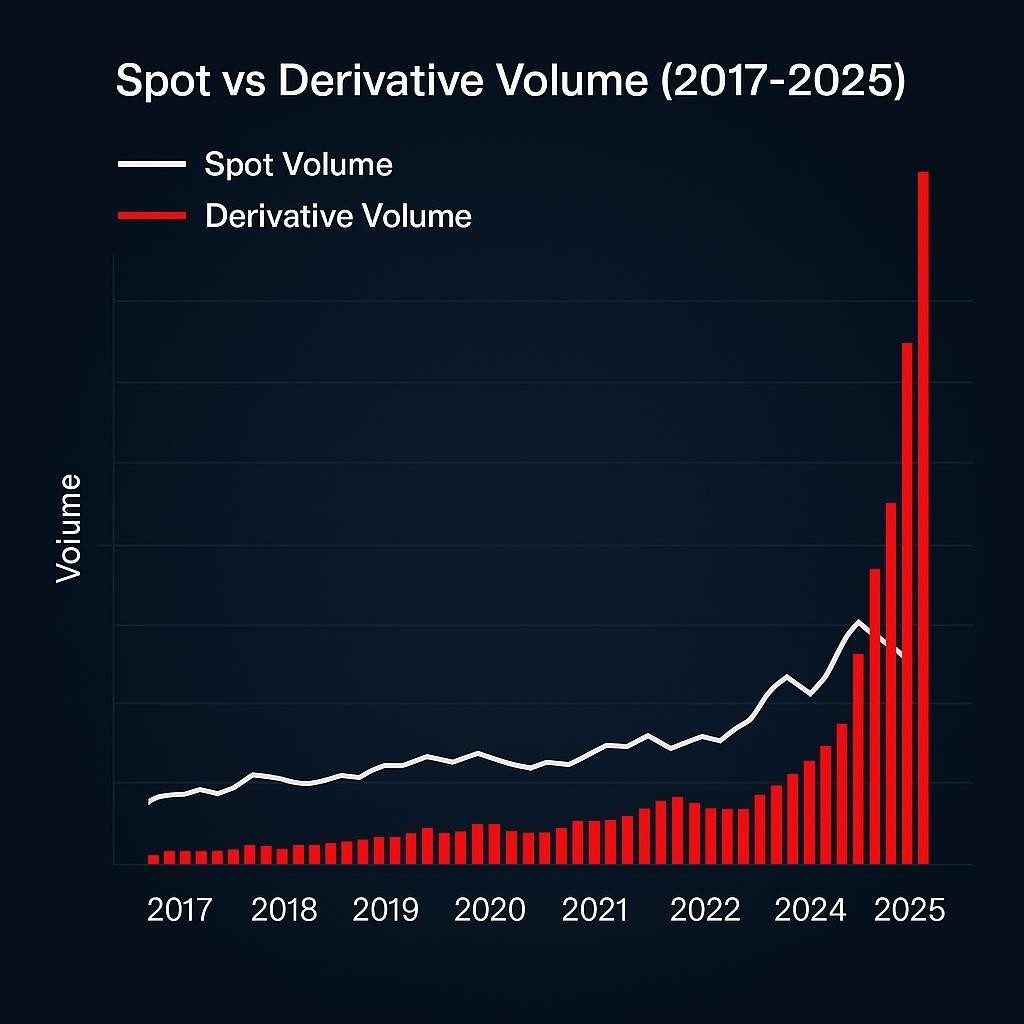
Bitcoin derivatives are not secondary products. They have become the main price engine. More Bitcoin trades through futures than actual Bitcoin ever moves. More risk sits in leverage than on chain. Understanding the instruments is therefore essential to understanding how price behaves.
Futures
A futures contract allows traders to speculate on price without owning Bitcoin. Settlement is usually cash based. A trader can short ten million dollars’ worth of Bitcoin with no coins borrowed. This creates ghost supply. When many contracts exist for every real coin, allocation pressure disappears. Price responds to futures positioning rather than coin scarcity.
Options
Options offer the right, not the obligation, to buy or sell Bitcoin at a predetermined price. Most options expire without exercise which means they influence sentiment more than spot flow. Large option clusters create gravitational pull around certain strike prices. Derivatives liquidity then dictates volatility bands.
Perpetual swaps
Perpetual swaps are the most influential instrument in the crypto market. They behave like futures but have no expiry. Funding payments rebalance positions and traders can hold exposure indefinitely using leverage. On major exchanges it is common to see leverage at 20x or more, especially during euphoric phases. One million dollars can control twenty million dollars of Bitcoin. If price moves against the trader five percent, liquidation triggers. Forced selling then pushes price further down.
Spot ETFs
Spot ETFs introduced institutional presence but did not eliminate synthetic risk. ETFs often source liquidity through internal desk arrangements or over-the-counter brokers, not through open order books. This means inflow does not necessarily lift price. ETF adoption may increase exposure without tightening supply. To the public that looks like demand with no effect. To a short seller that looks like opportunity.
Resulting distortion
Bitcoin is no longer priced by how many coins exist but by how many claims reference them. The network cannot produce more Bitcoin yet the financial markets above it can produce as much Bitcoin exposure as they want.
This disconnect is the root of every crash we analyse later.
PART I Conclusion
Bitcoin remains a scarce digital asset with a fixed terminal supply. The protocol has never broken and its monetary design is consistent. Yet price is not governed by the protocol. It is governed by derivative infrastructure. Bitcoin is scarce at the base layer but not scarce at the trading layer. As long as synthetic exposure exceeds physical supply, the asset will move like a leveraged commodity rather than a finite store of value. Scarcity protects integrity. It does not guarantee valuation. The rest of this book exists to demonstrate how and why.
PART II
How synthetic markets overpower a scarce asset
Bitcoin was engineered to be finite. What the market built around it was not. This section explains the machinery that now controls price. It is the pivot between theory and proof.
Part I showed what Bitcoin was meant to be. Part II shows what it has become in practice.
Chapter 4
How futures create ghost Bitcoin
Futures trading is now the gravitational center of Bitcoin price discovery. A futures contract does not require ownership of coins, only a financial commitment to a price outcome. A trader does not need Bitcoin to short Bitcoin. They need collateral, an exchange account and a counterparty willing to take the opposite side. When millions of such contracts exist, supply becomes irrelevant. Exposure expands even when the number of coins does not.
A simple scenario demonstrates the scale. If one million dollars of capital is placed into a position at 10x leverage, the exchange treats it as ten million dollars’ worth of Bitcoin exposure. No Bitcoin is transferred or locked. The market sees ten million dollars of sell pressure or buy pressure even though the true capital behind it is one tenth of that. When this scales across thousands of traders and automated funds the synthetic economy becomes larger than the real one.
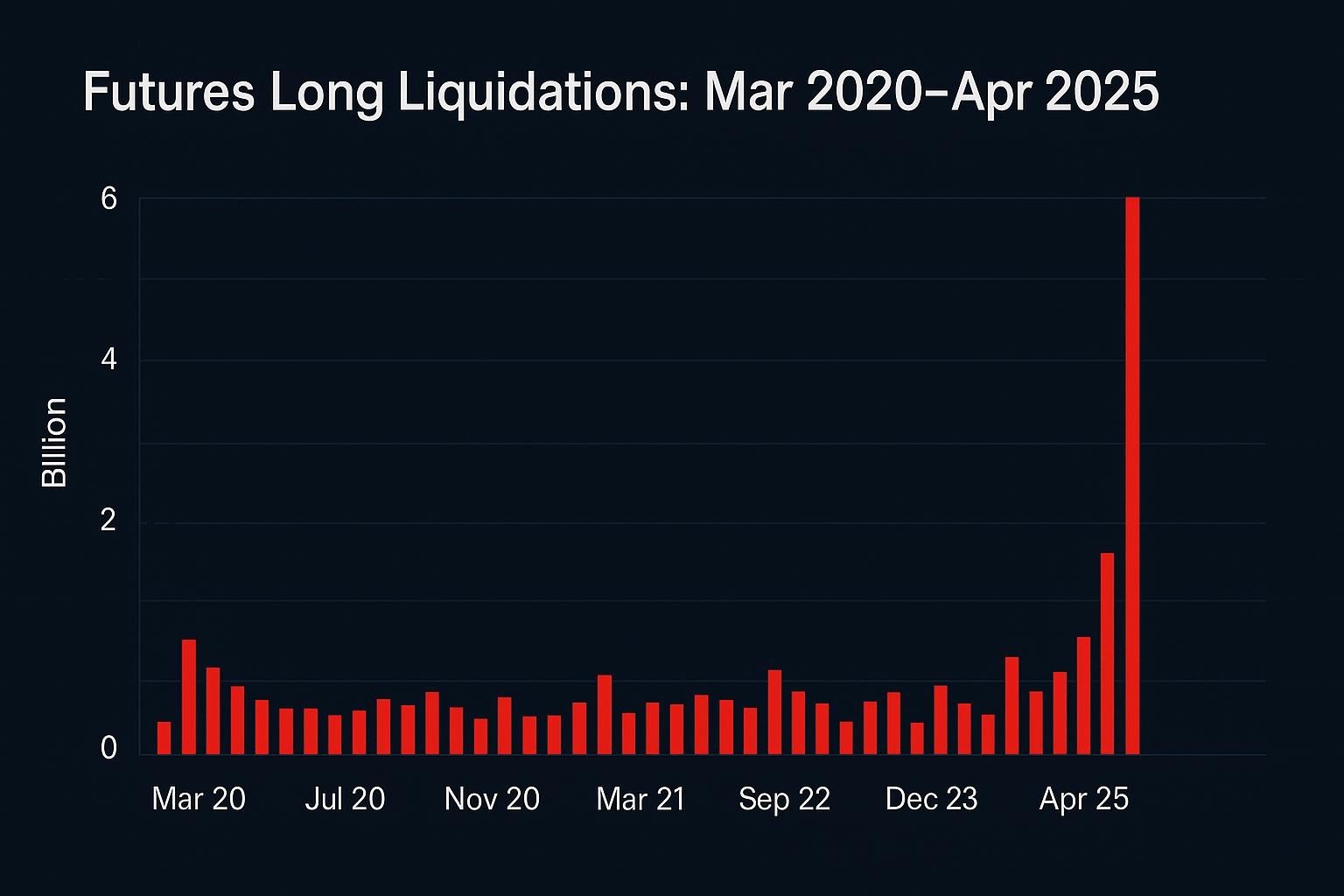
Ghost Bitcoin is not an abstract idea. It is the majority of trading volume.
During periods when open interest in futures exceeds spot volume, the derivative structure dictates short term valuation. The number of Bitcoin on exchanges may fall as holders move coins into cold storage, yet price can still crash because futures supply increases faster than physical supply contracts. The market trades paper Bitcoin more aggressively than it trades real Bitcoin.
To illustrate the point, imagine a world where only one hundred rare paintings exist. Their supply is fixed. Ownership is clear. Now imagine financial firms create contracts that track the price of these paintings without storing a single canvas. Soon three thousand contracts reference one hundred physical artworks. The paintings have not multiplied, but exposure to them has. In that world price no longer reflects scarcity. It reflects speculation.
Bitcoin lives in that world today.
Futures have turned a scarce asset into a virtually infinite one. The protocol limits coins. The market does not limit claims.
Price responds to the claims.
Chapter 5
Margin, leverage and the mathematics of forced selling
Price explosions in Bitcoin rarely begin with emotion. They begin with mathematics. The liquidation engine inside an exchange does not panic. It follows rules. When collateral falls below maintenance requirements positions are closed automatically and market activity turns into a cascade.
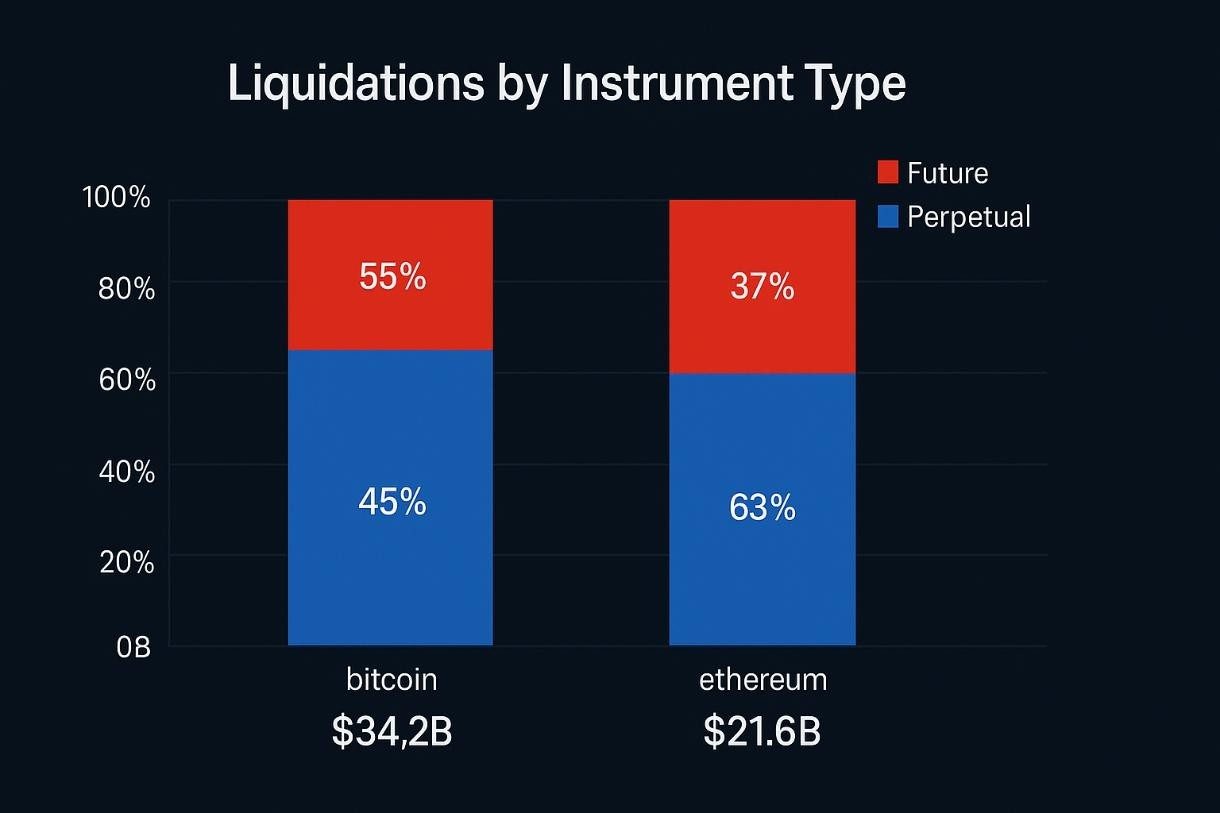
Leverage is the multiplier.
Margin is the fuel.
Liquidation is the heat.
When a trader opens a 20x long position, they control twenty units of exposure for every one unit of capital. This seems efficient when price rises. It is destructive when price falls. A drop of five percent wipes out margin entirely. The exchange does not wait for the trader to deposit more funds. It liquidates to protect itself. Forced selling enters the order book without the trader’s consent.
If many traders hold leveraged longs, a small drop can trigger a chain reaction. One liquidation becomes two. Two becomes fifty. Fifty becomes thousands. Every closed position adds sell pressure that amplifies the move. Traders do not cause the crash. The risk engine does.
- A five percent move can become fifteen percent in
- Charts record violence while the network remains
- Coins stay where they
- Exposure
This difference matters. A scarce asset cannot defend itself against margin because margin does not respect scarcity. It respects arithmetic.
Liquidation is the hidden threat inside every bull cycle. As long as leverage grows faster than liquidity, Bitcoin remains vulnerable. It is not supply that determines fragility. It is collateral density.
Upside requires buyers to act.
Downside requires only the absence of margin.
Chapter 6
How one whale can move the market alone
Many assume that Bitcoin’s market size protects it from single-actor influence. With trillions in lifetime volume across thousands of exchanges it feels too large to move by force. Yet this perception ignores orderbook density. A large industry does not guarantee deep liquidity at every price level. If liquidity thins, one entity can move price with a single trade.
A whale does not need to own Bitcoin to move the market. A whale only needs to open a position large enough to push price into the nearest liquidation cluster. Once that threshold breaks, other traders are forced to exit. Those exits push price lower without additional effort from the initiator. The market accelerates against itself.
A realistic attack profile looks like this, described without bullets for full readability.
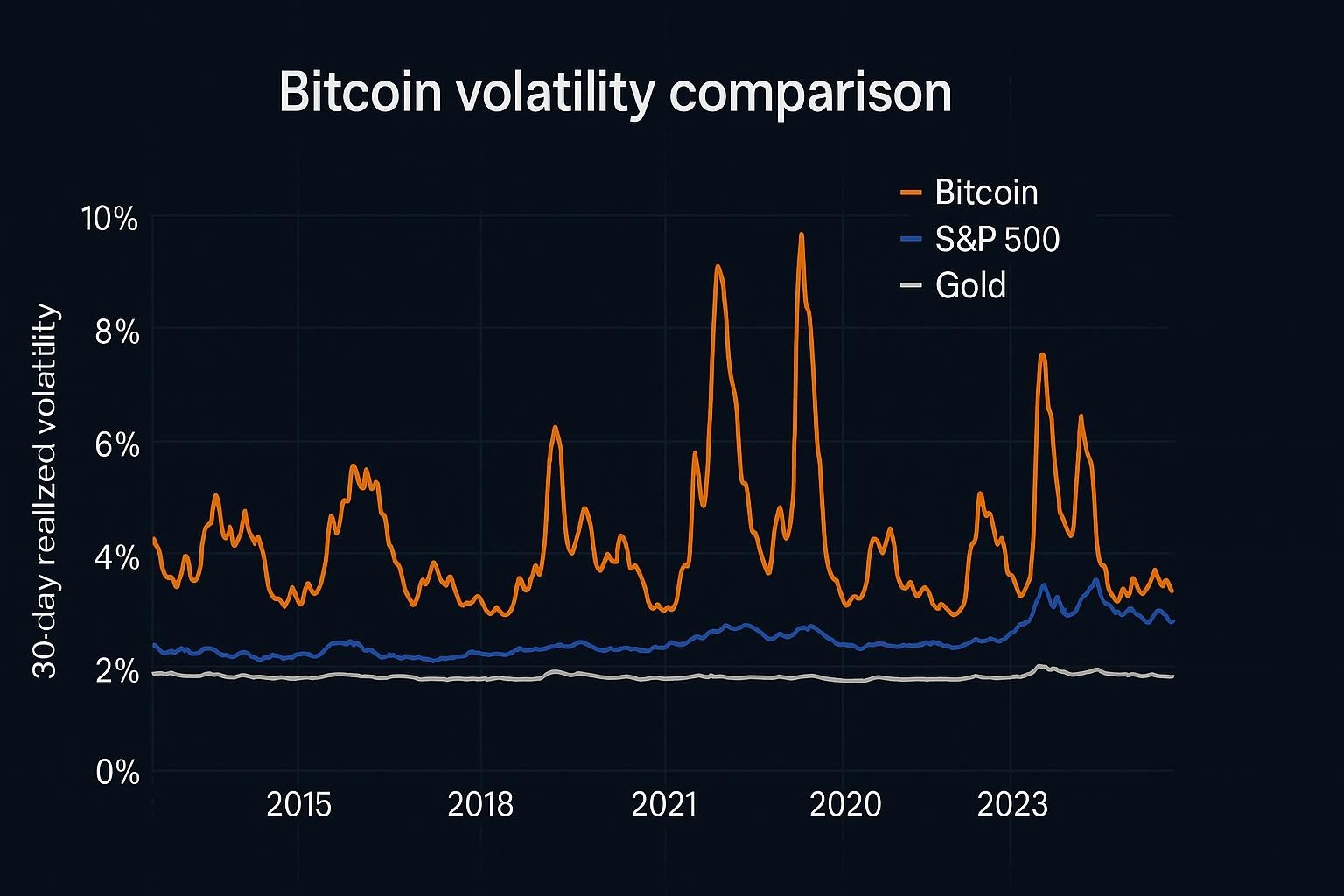
An offshore account places a series of large short positions that increase sell pressure. Price begins to slip, not violently, just enough to unsettle the first layer of leveraged longs.
As their collateral evaporates, forced liquidation triggers. The exchange closes their positions. Those closures add downward volume. More long traders approach liquidation thresholds. Liquidations accelerate. The chart moves vertically. The whale does not push price. The liquidation engine does.
With the right timing one actor can turn a three percent retracement into a twelve percent crash.
The whale profits without needing to sell spot coins.
Bitcoin supply remains untouched.
Exposure crashes anyway.
Orderbooks are not infinite.
Belief does not equal liquidity.
Bitcoin is large in principle and small in mechanism.
Chapter 7
The offshore black hole
Transparency is Bitcoin’s virtue. Opacity is its weakness.
On chain every movement is visible. Balance is public. Time is absolute. Yet most price action does not occur on chain. The price that traders see on exchanges is created by activity in places where transparency ends. These venues include perpetual swap markets in Seychelles, Cayman jurisdictions and exchange clusters operating under regulatory light.
Regulators cannot demand records from these offshore platforms unless international agreements exist. Even if they do, cooperation can take months. A liquidation cascade unfolds in minutes. By the time regulators request account data, profit has been withdrawn and entities dissolved.
KYC is often procedural rather than investigative.
A passport proves personhood.
It does not reveal source of funds or real control.
A shell company with borrowed directors and nominee shareholders can open a derivatives account and deploy capital without exposing the identity of the beneficial owner. A billion-dollar liquidation event could be triggered by a structure that exists only on paper. When that structure collapses nobody can pursue loss. When it profits nobody can trace gain.
The offshore system is not a conspiracy. It is a jurisdictional gap. Bitcoin trades globally. Regulation does not. This is how the ghost market operates without consequence.
Part II Conclusion
Part II shows why scarcity no longer governs price. Futures create infinite exposure. Margin converts volatility into collapse. A whale does not need to hold Bitcoin to move it. The offshore structure hides accountability. Price discovery now belongs to synthetic markets, not the network itself.
Bitcoin remains decentralised by design, but price has become centralised by leverage and venue control. The original scarcity principle has been overshadowed by a parallel economy where risk can be manufactured indefinitely. Until synthetic exposure is limited, Bitcoin will behave like an asset without a supply cap.
PART III
Case study analysis of four liquidation eras
This section is the forensic core of the book. We move from theory into history, so the reader does not only understand how synthetic markets overpower Bitcoin but also sees the moments where it happened in real time. The previous parts explained mechanism. This part shows consequence. There have been multiple historical points when Bitcoin did not fall because holders sold coins, but because synthetic exposure unwound faster than liquidity could absorb it. The crashes did not come from Bitcoin’s design. They came from financial architecture around it.
Each episode below is rewritten in long form, with full context, cause, transmission mechanism and after-effects. Every chapter is designed to help the reader recognise patterns because recognising patterns is what makes invisible risk visible.
Chapter 8
The COVID crash of 2020
The first modern illustration of synthetic fragility
The COVID crash was the moment Bitcoin was first tested by global panic and liquidity strain. In March 2020 the world was shutting down. Markets did not collapse one sector at a time. Everything correlated downward at once. Bitcoin, once thought to be an uncorrelated hedge against systemic failure, fell harder than equities and commodities because it carried more leverage than both.
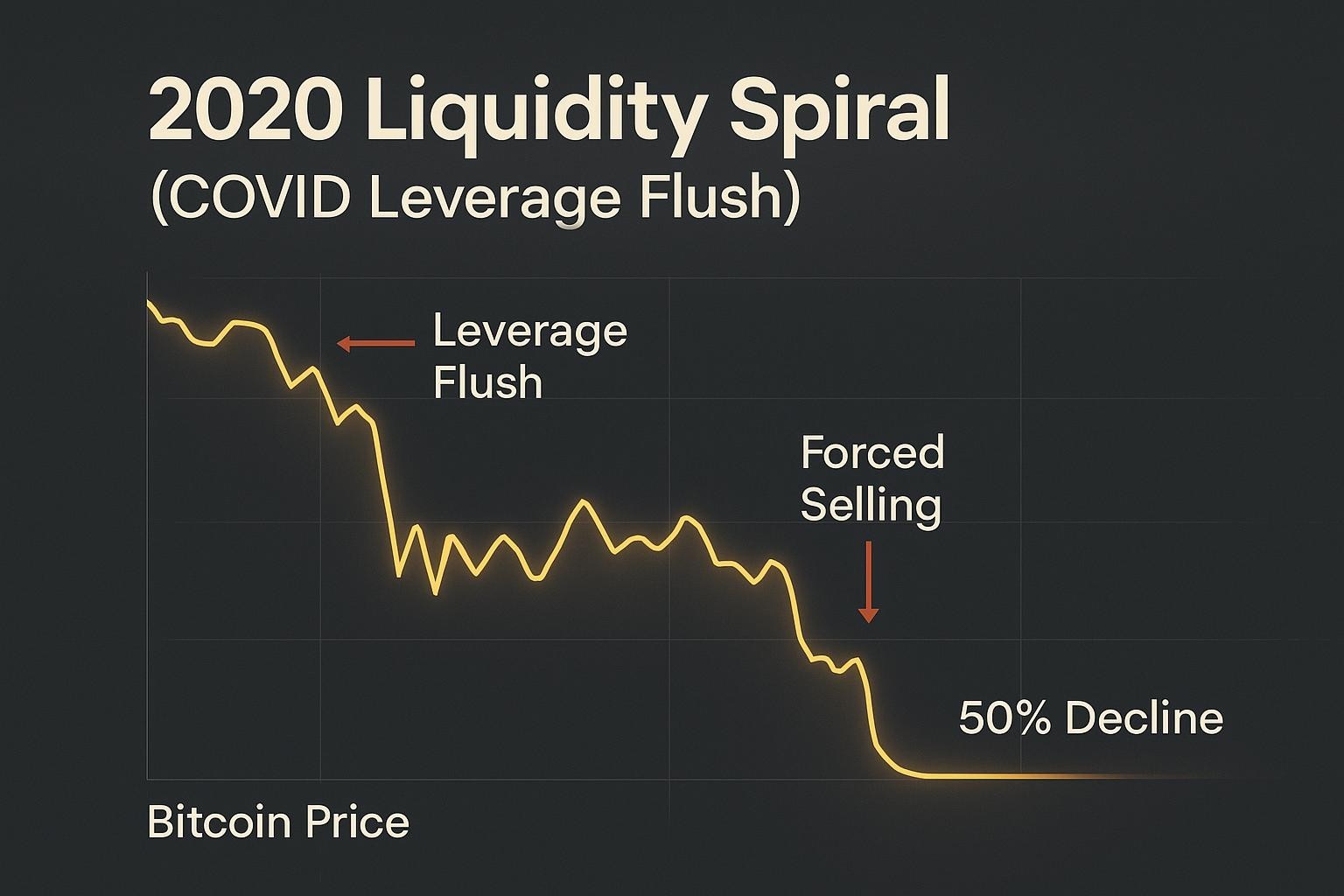
Most holders did not sell. What collapsed were derivatives.
Open interest was near an all-time high as traders borrowed against future price expectations. The majority of longs were directional, not hedged. When equity indices collapsed and credit markets seized, traders needed liquidity. They sold spot Bitcoin to raise cash or to cover margin on other assets. This initial sale pressure was small relative to futures exposure, yet it was enough to trigger liquidation spirals on BitMEX and OKEx.
Once the first layer of margin was consumed, forced selling hit orderbooks faster than buyers could react. Liquidations executed at market rate, not limit price. Orderbook depth evaporated. On some venues the bid wall disappeared entirely for seconds at a time. Bitcoin dropped more than 50 percent in under 24 hours not because belief failed, but because leverage exhausted itself.
What made the COVID crash significant is that it revealed something fundamental. The idea that Bitcoin was insulated from systemic events was proven false. When traditional markets suffered, Bitcoin suffered more. The network was healthy and functional. The price was controlled by synthetic liquidity, not by adoption or issuance. This was the first major demonstration that scarcity does not protect valuation when derivatives dominate.
The recovery that followed was rapid, but it did not change the structure. The architecture that allowed the crash remained. Traders forgot faster than markets healed. This left room for the next cycle to repeat the same failure mode, only larger.
Chapter 6
The 2021 derivative bull run and the first anatomy of mania
If 2020 revealed fragility, then 2021 amplified it. The rally towards the November peak is remembered as a triumph of adoption and institutional interest, yet that narrative conceals what was happening underneath. Spot accumulation increased, but futures and perpetual swap leverage grew much faster. Retail platforms offered 20x, 50x and sometimes more. Exchanges filled with traders who controlled far more Bitcoin exposure than capital. It looked like adoption. It was leverage.
The upward move was not purely organic. It was fuelled by borrowed capital chasing momentum. As price rose, traders increased positions. When there was pullback, funding rates surged rather than cooled. The market rewarded aggression over caution. Funding fees became so expensive that holding a short was painful while holding a long felt free. That one directional funding imbalance should have triggered caution, but instead it signalled confidence. Traders assumed price could not fall because it had not fallen recently.
Then the market turned. It was small at first, almost unnoticeable, a routine correction. There was no scandal, no exchange defaults, no regulatory shock. Nothing external was required. All that was needed was a small reversal to approach the liquidation boundary that leveraged longs created for themselves. Once that floor cracked, pressure inverted. Liquidations cascaded. Funding flipped. Momentum reversed.
Within days the market lost a third of its value. Billions evaporated, not into pockets but into the liquidation engine itself. Coins were not sold willingly. They were sold mechanically. The 2021 crash was not sentimental. It was mathematical.
This event mattered because it proved that Bitcoin could crash even during adoption growth. Scarcity was intact. Demand was real. Builders and companies were active. Yet price collapsed because the synthetic layer outweighed fundamentals. The asset had transitioned to a leverage-led market and did not return from it.
Chapter 10
The 2022 collapse and the chain reaction of insolvency
2022 was not a spike. It was a structural failure. What began as a decline evolved into a sequence of institutional breakdowns. Luna imploded. Three Arrows collapsed. Celsius froze withdrawals. FTX detonated. Billions in wealth disappeared because market participants were not merely trading Bitcoin exposure. They were trading borrowed exposure to borrowed exposure.
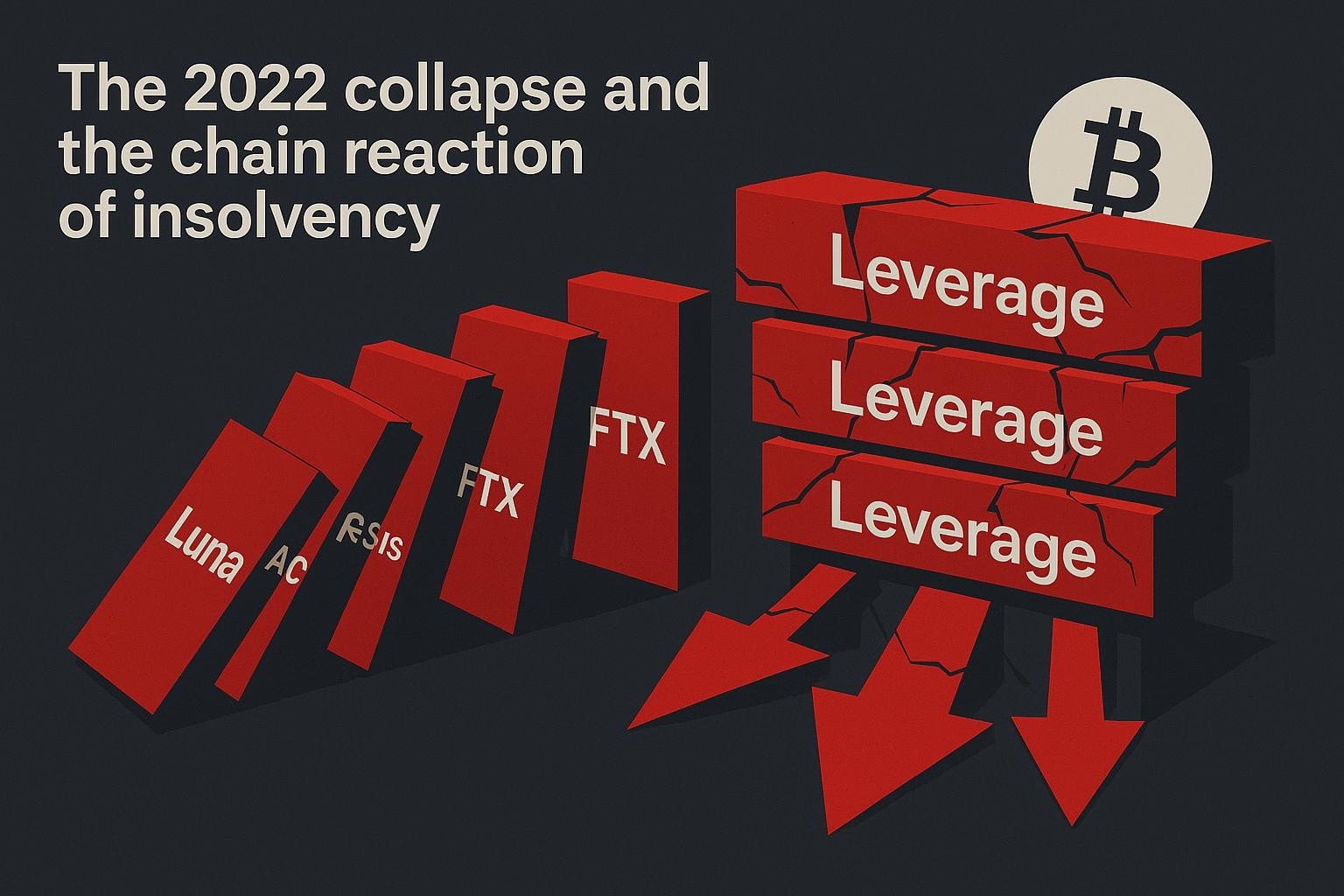
Leverage existed not only at the retail level but also within funds. Collateral was rehypothecated. Reserves were fractional. Some companies used customer deposits to trade or lend, not to store. This meant that when Bitcoin fell, firms with open positions lost collateral value while running an asset-liability mismatch. The moment panic began, liquidity trapped itself. Withdrawals surged faster than capital buffers. Platforms halted redemptions. Confidence cracked. Insolvency became visible.
This downturn was not one crash. It was many overlapping failures feeding each other. Bitcoin fell because markets deleveraged. Markets deleveraged because lenders failed. Lenders failed because they were leveraged too. Each link pulled the next.
Synthetic exposure did not merely affect price. It affected infrastructure. The 2022 cycle proved that Bitcoin’s greatest threats were internal, not external. The network remained honest. The institutions around it were not.
This lesson remains central. Bitcoin’s code succeeded. The financial ecosystem built beside it broke. When futures and credit layers attach themselves to a scarce asset, the asset inherits their fragility. The collapse revealed the target for stress, not the cause.
Bitcoin was not the problem. Leverage was.
Chapter 11
The 2025 liquidation event and modern whale structure
2025 was different. By this point the market understood liquidation risk, yet it still unfolded again, faster and with fewer warnings. The October liquidation event that erased an estimated nineteen billion dollars of open interest revealed a new evolution in market structure. The trigger was not poor lending practice or fraud. It was speed.
In this cycle, traders held significant exposure through perpetual swaps and ETF leverage. Spot demand existed but contributed little to orderbook thickness. A coordinated short entry placed into an illiquid window was enough to start the chain. A single account opened shortly before a macro announcement, built positions large enough to rest near the boundary of liquidation clusters, then pushed price just far enough to ignite forced unwinds.
The speed became the story. Forced selling executed faster than price engine data could propagate across smaller venues. Traders saw their positions close before they saw price. Where earlier crashes unwound over hours or days, this one unfolded inside a single news window. No one needed insider information to understand what would happen. They only needed timing and deep collateral.
The aftermath showed something profound. Bitcoin no longer requires institutional panic to crash. It requires only concentrated exposure and a target zone where forced liquidation occurs faster than rescue liquidity emerges. The market has matured but fragility has not disappeared. It has sharpened. This event will be remembered as the moment traders realised that derivative structure now dictates valuation more than adoption cycles. The whale did not need to hold coins. They only needed to understand the kill zone.
Chapter 12
Pattern recognition across four cycles
When viewed individually, these crashes look like chaos. When observed together, they form a map.
In 2020 leverage collapsed under global panic.
In 2021 leverage collapsed under its own weight.
In 2022 leverage collapsed institutions.
In 2025 leverage collapsed instantly through mechanic triggers.
Each year volatility increased while duration decreased.
The time between trigger and collapse shortened.
The mechanism stayed constant even when narrative changed.
These patterns indicate that Bitcoin does not behave like a commodity with fixed supply. It behaves like a derivative ecosystem where the underlying asset is raw input for leveraged speculation. Price collapses are not anomalies. They are structural outcomes of a market that allows exposure to scale faster than ownership.
The network remains intact. The market remains unstable. History shows this clearly.
Part III Conclusion
Part III demonstrates that Bitcoin’s most violent downturns were not failures of belief or technology. They were failures of structural leverage. Each crash was a liquidation cascade, magnified by derivatives and accelerated by synthetic supply. The market repeatedly proved that scarcity does not shield valuation when exposure overwhelms ownership. Bitcoin can fall without coins moving. Bitcoin can crash while adoption rises. Bitcoin can be sound money and still be weakly priced. The four cycles prove that Bitcoin is not priced on scarcity but on leverage amplification. Unless structural change occurs, the next cycle will follow the same pattern. The question is not if, but when.
PART IV
Theoretical whale attack scenarios
This part examines what could happen when an entity with deep liquidity chooses not only to trade Bitcoin, but to move it. We are not alleging that such events have already occurred, nor suggesting intent from any specific institution. We are outlining mechanisms that exist today, mechanisms that can be executed with resources that only a few players possess.
The aim is not to create conspiracy.
The aim is to show feasibility.
If synthetic supply can overpower scarce supply, then a single powerful actor with knowledge of liquidation structure could turn the market into an instrument. Not in theory, but in practice. The question is how, not whether and what scale is possible before market defence activates.
Chapter 13
Scenario A – a BlackRock style short cascade
Imagine a large financial entity that holds no ideological attachment to Bitcoin. They do not need to hate or believe in it. They only need to see advantage. They set up a second entity offshore, legally separate from their core business. This second entity can be a trust wrapper, a fund with nominee directors or even a shelf vehicle purchased ready-made. The purpose of the second entity is insulation. It functions as a fuse. If things go wrong it burns, not the parent firm.
With structure prepared, the offshore vehicle opens a large leveraged long position. It does not need to hold Bitcoin. It only needs collateral, which can be stablecoins, treasury bills or dollars placed as margin. The opposing position, held by the primary institution or its market desk, builds a short.
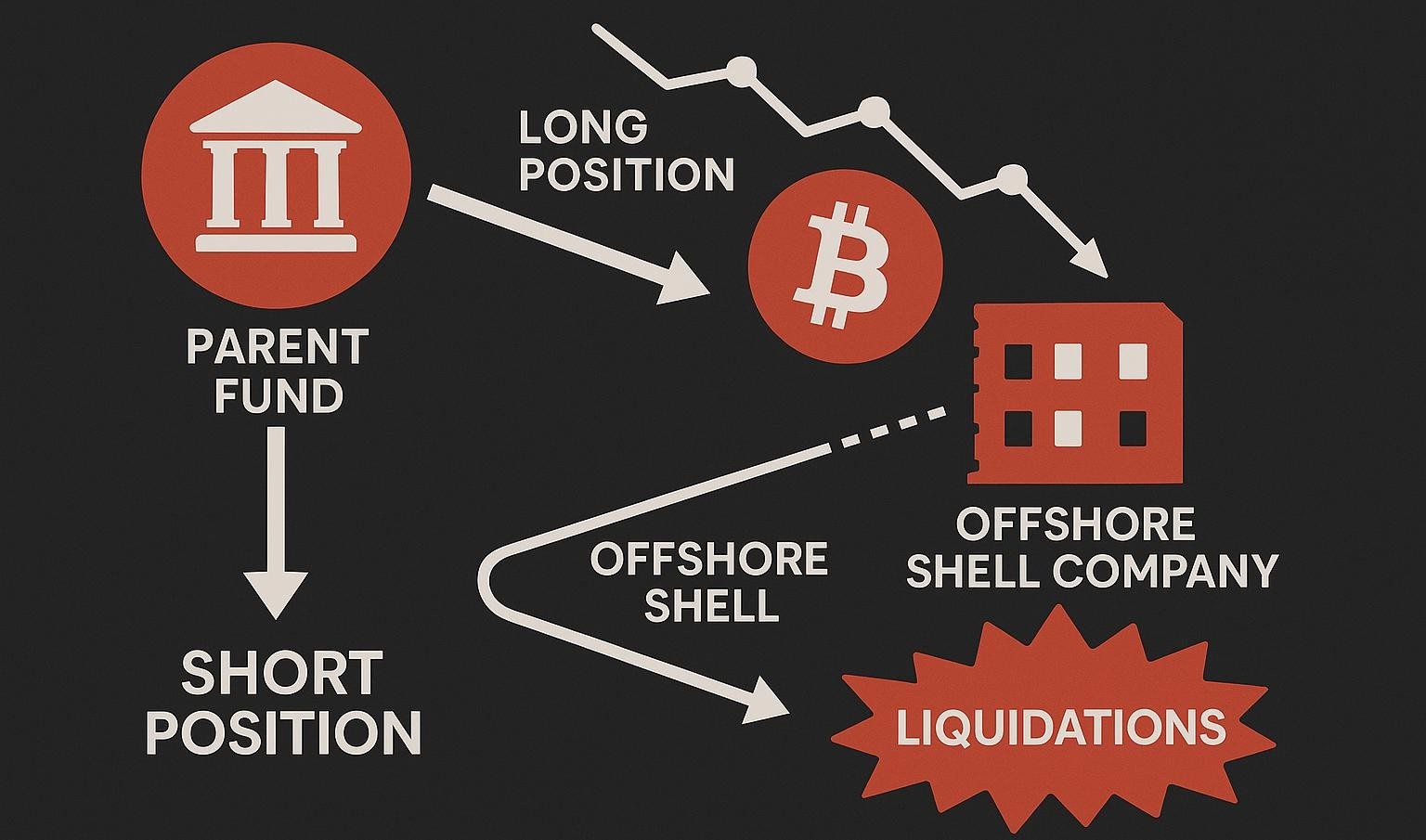
This is not illegal on its own. Two parties can take opposite positions in any futures market. What matters is coordination and scale.
The first layer is invisible. The second becomes public only when executed. The short side begins to push market price down, not aggressively at first, but steadily enough to reach the lower edge of the liquidation corridor where leveraged longs are clustered. When the boundary is breached liquidations begin. Forced selling sends price lower which triggers more liquidations. The offshore long position is now in danger. Maintenance margin falls. Liquidation is possible.
This is where profit is extracted. The short side benefits as liquidations accelerate. If price drops ten percent the leveraged long that began with twenty million exposures may lose everything. If the long is liquidated entirely the counterparty gains without needing spot Bitcoin to move.
The offshore vehicle collapses by design. It absorbs the losing side. The primary entity profits. Nobody outside the transaction sees coordination because the trades occurred through separate accounts and separate legal bodies. There is no law preventing an institution from hedging itself through external structures.
The risk is not moral. It is structural. This scenario is not dramatic. It is trivial to execute.
It shows how synthetic markets turn scarcity into vulnerability. The attacker never touched a Bitcoin wallet. They attacked the pricing mechanism, not the blockchain. The worst part is that this is not an extreme blueprint. It is a minimal blueprint. A more complex attack could multiply the effect many times over.
Chapter 14
Scenario B – coordinated suppression by multiple funds
Consider now a deeper configuration. Instead of one short engine, several funds operate independently in appearance but converge in timing. Each place mid-sized positions. None are individually suspicious. None breach concentration thresholds. Regulators see distributed volume, not collusion.
When price approaches a known liquidation band a coordinated push is executed. The goal is not to break the market alone but to reach the trigger where forced selling takes over.
Once liquidations activate no further pressure is required. The market becomes self-destructive. Traders watching charts believe sentiment has deteriorated. They do not see hidden orchestration. They do not see the offshore surgical entry. They only see collapse. The power of this scenario is that responsibility fragments.
Even if investigators subpoena exchange data the architecture reveals many actors rather than one. They may be connected. They may be independent. Without explicit communication records nobody can prove motive or coordinated intent. Market moves appear natural even if engineered.
What makes this scenario more dangerous than Scenario A is plausible deniability. A single whale can be detected if size is large enough. Ten whales with staggered orderbooks look like momentum. The market cannot defend itself because it cannot see the threat as a single body. This is the kind of structure that could suppress Bitcoin’s price for months or even years if repeated.
Scarcity becomes irrelevant because synthetic supply is infinite.
Selling pressure regenerates faster than spot demand absorbs.
Retail capitulates not from fundamentals but from exhaustion.
Chapter 15
Scenario C – ETF absorption without spot buying
The final scenario is more subtle and far more credible in real market structure. In this model Bitcoin price does not collapse violently. It drifts sideways or downwards while ETF inflows continue. The public sees capital entering. They assume demand is strong. Yet price does not move with it.
Something feels wrong but cannot be proven.
This can occur when ETF creation units are filled not through open spot markets but through internal liquidity arrangements. A broker can deliver Bitcoin directly without placing visible orders on exchanges. Bitcoin moves between custodial wallets but never touches the public orderbook. Demand exists on paper but not in price.
If synthetic markets are simultaneously shorting or funding negative, ETF inflow can be absorbed like water into sand. Billions can enter and leave no trace on price. For the public this looks impossible because they believe buying Bitcoin through an ETF is buying Bitcoin.
In reality it is exposure without orderbook impact.
In such a scenario a sophisticated short engine can accumulate profits quietly. There is no crash to blame. No liquidation headlines. No ten percent wick that shocks the industry. Price underperforms without smoking gun. Holders lose confidence gradually. A slow bleed replaces a flash event.
This is suppression through stagnation rather than collapse. It drains conviction instead of detonating it. The most effective attack does not break faith in one moment. It corrodes belief slowly until strength erodes.
Part IV Conclusion
In these three scenarios the theme is constant. Synthetic supply dictates outcome. A whale does not need control of Bitcoin to control price. They need only control of futures leverage and patience to apply pressure. The offshore world conceals identity. ETF structure can hide volume. Multiple funds can mask coordination.
The danger is not that this may occur. The danger is that the structure exists exactly as required. Bitcoin survives in protocol. Price survives only in confidence.
PART V
Why nobody can stop it
Part V addresses the question that naturally follows from Part IV. If these scenarios can occur, why are they not stopped? Why have we not seen enforcement cases, criminal prosecution or regulatory injunctions preventing synthetic market domination? The answer is that Bitcoin sits in a jurisdictional vacuum. It is global by nature, while regulation is national by design. The asset crosses borders effortlessly. Oversight does not.
Chapter 16
Regulatory blindness as a structural condition
Regulators are built to govern markets that exist within their legal perimeter. When an exchange is located in New York, the SEC or CFTC can demand records. When a fund trades on CME, reporting is mandatory. Futures positions, margin requirements and beneficial ownership disclosures exist by law. However, the majority of Bitcoin price discovery does not take place in these domains. It happens offshore where reporting requirements are minimal or absent.
Even when regulators wish to intervene, they face two barriers.
The first is jurisdictional. A US regulator cannot freeze accounts in Seychelles by issuing a domestic order. They must request cooperation through formal treaties, which may require months to process. Market manipulation unfolds in minutes. A delayed request is not enforcement. It is paperwork after the fact.
The second is evidentiary. To prosecute market manipulation an agency must prove intent. It is not enough that a price moved sharply. It must be shown that a trader acted with purpose to distort the market. When activity is split across multiple exchanges, using proxies or layered entities, intent becomes invisible. Regulators may suspect. They may investigate. They may even publish warnings. Proving the case in court is a different matter entirely.
Bitcoin trades globally and instantly. Regulation does neither.
Chapter 17
Why enforcement failure is probability, not exception
In traditional markets price manipulation often leaves a trail. Equity blocks must be reported through clearing houses. Short interest can be measured. Brokers are licensed and supervised. Margin calls occur under rules designed to maintain systemic stability. These safeguards do not exist uniformly in crypto. When a liquidation event wipes billions from open interest, the exchanges that hold those contracts do not owe public transparency. They may publish aggregated data. They rarely publish counterparties. Without counterparties there is no defendant. Without a defendant there is no case.
Investigators may request internal logs from exchanges, but exchanges outside main regulatory hubs are under no obligation to comply. Even if they cooperate, compliance may exclude full historical records. Transactions can route through layered accounts. Beneficial owners can be shielded behind nominee directors. Funds can exit before subpoenas arrive. In many cases the legal entity responsible for the position no longer exists by the time investigators begin.
The system is not unregulated. It is unevenly regulated.
Where transparency is fragmented, enforcement collapses.
A synthetic attack does not require genius. It requires legal distance between actor and impact. A regulator cannot prosecute what it cannot identify. An exchange cannot disclose what it does not verify. This is why enforcement is rare. Not because wrongdoing is absent, but because detection is improbable.
Chapter 18
Why global regulators cannot keep pace
Bitcoin operates continuously. Markets do not sleep. Liquidations occur at 03:14 as easily as 14:03. Regulators operate through business hours, through committee meetings and statutory procedure. The speed mismatch is not hypothetical. It is structural. A crash can erase wealth before oversight even registers cause.
If the SEC seeks data from Binance, they must request it formally. If BaFin seeks data from BitMEX, they must navigate international law. If the FCA seeks to identify a counterparty, they must track activity through custodians who may sit outside their reach. Meanwhile open interest rebuilds. New leverage forms. The market resets before accountability begins.
Cross border cooperation is slow by nature because no country will sacrifice sovereignty to another regulator. Every inquiry must pass diplomatic channels. This means that Bitcoin exists in a zone that no authority can govern alone. Without unified frameworks, responsibility diffuses and disappears.
The system is too fast for the watchdogs.
Not because they are uninterested, but because they are outmatched by structure.
Chapter 16
Legal versus practical regulation
A regulator may declare that derivatives require transparency. Offshore venues may agree in theory and ignore in practice. A compliance statement is not compliance. A published document is not proof of adherence. When users can open accounts with a passport scan, regulators cannot confirm who controls capital or how it is deployed.
Moreover, synthetic Bitcoin markets are legally framed as derivatives, not currency. Regulation targeting digital assets often focuses on custody, spot trading, consumer protection or AML screening. Derivatives remain under futures law rather than securities law and futures law was not built for a global non sovereign asset with no supply elasticity. Bitcoin does not behave like wheat or oil. Wrapped exposure can outgrow underlying supply, something commodities cannot replicate. Law did not anticipate this.
Enforcement will need legislative transformation, not procedural adjustment. Until then, regulators govern fragments of a whole. They police custodians but not the shadows around them. They oversee domestic venues, not offshore leverage pools. They track ETFs, but not the synthetic markets those ETFs coexist with. The result is partial control over a system that functions as a whole.
PART V Conclusion
Part V shows why structural manipulation is not unlikely, but almost unpoliceable. The network cannot be stopped, yet the market can be moved by actors with no obligation to reveal identity or intent. Regulators are bound by jurisdiction. Bitcoin is not. Enforcement is legal theory. Reality is speed and location.
The problem is not absence of law.
It is absence of reach.
Until transparency extends across borders, synthetic markets will dominate price. Bitcoin remains sound money. Its valuation remains vulnerable.
PART VI
Final synthesis, implications and future risk
Part VI carries the weight of everything written before it. Here we do not repeat earlier chapters. We translate their meaning. The preceding sections examined how Bitcoin was designed, how synthetic markets evolved, how leverage overtook scarcity and how a coordinated actor could move the market without touching a coin. Now we step back and ask the only question that matters.
If the mechanism exists, if the structure allows it and if history shows that Bitcoin has already been moved by liquidation events, then what does this mean for the future of a fixed supply financial asset?
This closing section is a long form reflection. It is not alarmist. It is not celebratory. Its purpose is clarity.
Chapter 22
Bitcoin is resilient in code and fragile in price
Bitcoin has never failed at the protocol level. Blocks continue to arrive, signatures verify, halvings reduce issuance with calendar precision. Miners compete honestly because cheating is unprofitable. Ownership is final because the blockchain treats history as law. It is difficult to find another network in finance that has maintained this level of integrity for so long.
Yet the price of Bitcoin is not protected by this perfection. Market valuation exists outside the code. As soon as Bitcoin became a tradable instrument rather than a niche technology it entered a world governed by liquidity, leverage and psychological mass. Code guarantees scarcity. It does not guarantee market strength.
A technology can be flawless while its price is distorted by financial machinery built around it. Gold has seen centuries of manipulation without losing physical scarcity. Art has been priced by auction houses rather than paint and canvas. Bitcoin is no different. Supply control is a foundation, not a shield.
Belief secures value.
Markets interpret belief through price, not supply.
Chapter 23
The two faces of Bitcoin
It is now necessary to separate Bitcoin into two entities, not as metaphor, but as observable reality.
There is Bitcoin on chain. The scarce resource. The asset that exists in wallets, secured by private keys, moved through miners and verified by global consensus. This Bitcoin is slow, permanent and incorruptible.
Then there is Bitcoin off chain. The paper market. The contract market. The futures engine that can multiply exposure without multiplying coins. In this world Bitcoin is not an asset. It is a reference point. A price feed. Something that can be bought without owning it and sold without possessing it.
Most people assume they interact with the first.
Most price movement comes from the second.
Scarcity belongs to one. Price belongs to the other.
This duality is the centre of the modern Bitcoin economy. One half represents intention. The other represents outcome. Until the two converge, Bitcoin remains two assets wearing the same name.
Chapter 24
Scarcity cannot defend valuation without ownership
Many long term holders anchor their conviction to the twenty one million cap. They believe that as long as Bitcoin cannot be inflated its value will rise. This is mathematically coherent but financially incomplete. Scarcity matters only if price responds to it. If synthetic supply exceeds physical supply, scarcity has no authority over price.
When five Bitcoin exist but fifty claims reference them, price reacts to the fifty, not the five. Bitcoin can become more scarce and less valuable at the same time because the mechanism that sets price is not circulation. It is exposure.
A world where market value reflects derivatives rather than ownership is a world where scarcity becomes statistics rather than influence. The idea behind Bitcoin does not weaken, but the way markets interpret that idea does. Scarcity becomes an academic fact rather than a price driver.
This is the core paradox. Bitcoin can be economically sound and still market-fragile.
Chapter 25
If one entity can move Bitcoin quietly, what stops ten
We accept that a single actor could trigger a cascade. We accept that liquidation engines can move billions without resistance. Now expand the model. Instead of one actor, imagine ten. Instead of one offshore account, imagine networks of entities spread across multiple jurisdictions, coordinated through timing rather than communication. None large enough to draw suspicion. All large enough to push the market through thin liquidity zones.
In such a case no regulator sees a pattern. No single wallet shows dominance. Exchanges witness activity, but activity is normal. Price falls, but falls appear natural. Traders panic, but panic seems organic.
Synthetic attacks do not need secrecy. They need distribution. A system built on leverage collapses under weight, not intention. If intention aligns with opportunity, collapse accelerates. If multiple parties participate, detection becomes impossible.
The greatest market manipulation event may never be visible, not because it is hidden, but because it looks identical to volatility.
Bitcoin does not require an enemy. It requires fragility.
Chapter 26
Could Bitcoin survive its own shadow market
Bitcoin can lose valuation without losing purpose. It can fail as an investment without failing as a monetary network. Holders may despair at price while miners continue to produce blocks. Exchanges may liquidate billions while nodes continue to validate history.
There is a difference between financial failure and structural failure.
If synthetic markets dominate price permanently, Bitcoin becomes a store of value only for those who refuse to sell. It becomes a network of conviction rather than a market of price discovery. This is not collapse, but mutation. Yet there is another possibility. If holders recognise that scarcity matters only when coins are removed from synthetic circulation, accumulation may shift away from trading venues toward cold storage.
If exchanges adopt stronger transparency requirements and if institutional custody becomes auditable rather than opaque, the shadow layer could shrink. Scarcity could recover influence. This outcome requires structural change. It requires more people buying Bitcoin than buying exposure. It requires the market to value ownership over speculation. It may not happen soon, but it is possible.
Bitcoin can survive its shadow if people return to the asset rather than the price chart.
Chapter 27
Closing thesis
Bitcoin is the first asset in human history to be both perfectly scarce and infinitely replicated in financial form. One version lives in a ledger that cannot be forged. The other lives in exchanges that can create exposure far beyond supply.
The network will outlive companies, governments and currencies.
The market will not outlive leverage unless leverage is controlled.
This book is not prophecy. It is description. The synthetic world built above Bitcoin has more influence over price than the asset itself. Until ownership outweighs exposure, price will behave like leverage, not like scarcity. Bitcoin holders must understand that the threat to valuation is not inflation or government hostility. It is structural amplification from markets that trade Bitcoin while never touching it.
Bitcoin is real. Paper Bitcoin is larger.
The future depends on which one society chooses to value.
APPENDIX
Appendix A
Glossary of key concepts
This glossary is written for readers who are not deeply embedded in derivatives markets. Definitions are intentionally clear rather than academic.
Bitcoin (BTC)
A digital asset with a fixed terminal supply of twenty-one million coins secured by a decentralised proof of work network.
Spot market
A market where Bitcoin is bought or sold and coins actually change hands on chain or within custodial systems.
Derivative
A financial contract whose value is based on the price of Bitcoin but does not require real Bitcoin for settlement.
Futures contract
An agreement to buy or sell Bitcoin at a future time for a specific price. Usually cash settled.
Perpetual swap
A futures-style contract without expiry. Traders can hold positions indefinitely if they maintain margin.
Options
Contracts that give the right to buy or sell Bitcoin at a chosen strike price on or before a specific date.
Open interest
Total value of outstanding derivative contracts. High open interest indicates leveraged risk in the system.
Funding rate
A periodic fee exchanged between long and short perpetual swap traders to balance contract price with spot.
Liquidation
Forced closure of a leveraged position when margin falls below the required threshold.
Synthetic supply
Bitcoin price exposure that exists through derivatives rather than real coins.
Whale
A trader or fund capable of moving price due to position size rather than market participation.
Appendix B
Liquidation mathematics explained
Liquidation behaviour is the engine behind most large moves. Below is a step-by-step breakdown of how losses translate into forced market selling.
A trader opens a long position with one million dollars collateral at 20x leverage. Position size is twenty million dollars. Maintenance margin is five percent. This means that if unrealised loss approaches one million dollars the position cannot be sustained.
If price drops five percent the value of exposure falls by one million dollars. The exchange must liquidate to prevent the account balance from going negative. The entire position is sold at market price.
Now scale that mechanism.
Imagine fifty thousand traders each with variations of this structure. A four percent price decline wipes out many accounts but not all. A five percent drop liquidates a cluster. Liquidations generate sell volume. That sell volume pushes price down further which triggers the next cluster. The escalation does not require decision. It is automatic through risk management engines.
A liquidation cascade is not a chain of panic. It is a chain of arithmetic.
Appendix C
Leveraged exposure models
These models help quantify how synthetic Bitcoin can exceed real supply.
Model 1:
One million dollars of collateral at 10x leverage equals ten million in market participation. If one hundred traders follow this configuration, they produce one billion in market weight while real capital is ten percent of represented exposure.
Model 2:
Two billion dollars of combined collateral at 15x leverage equals thirty billion in exposure. If price falls six percent, liquidation erases the two billion entirely. The remaining twenty-eight billion is synthetic and vanishes without coins moving.
Model 3:
A fund with five hundred million capital can create five to ten billion of sell pressure depending on leverage allowance. When combined across multiple venues, exposure can exceed thirty billion without touching spot supply.
These models show that leverage creates a parallel Bitcoin that does not need wallets or block confirmations. It exists only in exchange accounting.
Appendix D
Major crash timeline reference
| Year | Trigger | Mechanism | Result |
| 2020 | Global COVID panic | Spot sell pressure triggered derivative unwind | Bitcoin halved in 24 hours |
| 2021 | Over leveraged retail futures | Funding imbalance drove cascade | One third of market value erased |
| 2022 | Institutional insolvency contagion | Lenders collapsed, rehypothecation failed | Multi cycle decline with exchange failures |
| 2025 | Whale aligned with macro event | Direct strike into liquidation cluster | Nineteen billion liquidated within hours |
These four episodes demonstrate that Bitcoin’s most violent declines were not driven by supply changes, but by leverage and liquidation mechanics operating above the chain. Each event was triggered differently, yet the underlying structure remained the same, with derivative exposure collapsing faster than spot demand could respond. When synthetic pressure rises faster than real ownership, even a scarce asset can fall at a speed that the market is unable to resist.
Appendix E
Spot ETF vs futures comparison
Spot ETF
- May hold actual Bitcoin
- Does not always purchase through public orderbooks
- Can increase exposure without increasing demand pressure
- Appears as adoption but may not shift price
Futures ETF
- Holds no Bitcoin
- Tracks price though synthetic exposure
- Can scale without supply constraint
- Encourages cash settled speculation
Bitcoin scarcity matters only when settlement requires coins. Futures erase this link.
Appendix F
Proposed visual elements for publication version
The final version of this book will benefit from charts and figures. These can be generated later, but here is a suggested layout so you or a designer may implement them.
1. Open interest versus spot liquidity graph
Show divergence during each crash year.
2. Liquidation waterfall diagram
Illustrate how first sells trigger second layer.
3. Synthetic supply pyramid
Real coins at base, exposure layers above.
4. Timeline curve of volatility compression
2020 long unwind vs 2025 rapid flash drop.
5. ETF inflow vs spot price correlation overlay
Demonstrate where price does not respond.
6. Exchange jurisdiction map
Highlight regulatory blind zones.
Appendix G
Researcher closing notes
This work challenges a common assumption. Many believe Bitcoin price reflects supply and adoption. The evidence suggests that derivatives often overshadow both. Bitcoin survives as a network, while valuation reflects liquidity structure rather than issuance scarcity.
The intent of this appendix is not to predict collapse but to show mechanism. Readers should understand how Bitcoin pricing can be shaped, where systemic fragility lives and why leverage transforms a finite asset into something that behaves infinite.
- Bitcoin remains historically
- Its vulnerability lies not in cryptography but in
The difference between real Bitcoin and synthetic Bitcoin defines the next decade.
FAQs
What is the main difference between real Bitcoin and synthetic Bitcoin?
Real Bitcoin requires ownership of actual coins on the blockchain, while synthetic Bitcoin refers to exposure through derivatives such as futures or perpetual swaps that do not require holding any BTC. These instruments can multiply market influence without touching real supply.
How do derivatives create “ghost Bitcoin”?
Derivatives allow traders to open long or short positions without acquiring real Bitcoin. Because exchanges can issue unlimited contracts, the synthetic supply can exceed the fixed real supply, resulting in “ghost Bitcoin” that impacts price.
Why can Bitcoin’s scarcity fail to protect its price?
Scarcity limits supply, but price is determined by active market forces. When synthetic markets dominate trading volume, leverage and derivatives can overpower actual supply dynamics and move price independently of scarcity.
Why are perpetual swaps so influential in Bitcoin markets?
Perpetual swaps operate with high leverage, have no expiration date, and generate most liquid trading activity. Liquidations during volatile movements can rapidly push price up or down, making perps the main engine of price movement.
How can a whale influence the Bitcoin market?
A well-capitalized trader can use leverage to push price into zones where many traders face liquidation. Once liquidations begin, automated selling amplifies the move, allowing the initiator to profit from cascading effects.
Why do offshore exchanges play such a large role?
Offshore venues often operate with limited oversight, high leverage, anonymous accounts, and flexible rules. These conditions allow large synthetic positions that can influence global pricing without standard regulatory visibility.
Do Bitcoin ETFs remove market manipulation risks?
ETFs increase institutional access but do not eliminate synthetic pressure. ETF inflows do not always result in spot Bitcoin purchases because some issuers use intermediaries or internal liquidity arrangements, reducing the supply-tightening effect.
What do past Bitcoin crashes have in common?
Across major events—including 2020, 2021, 2022, and 2025—each crash began with heavy synthetic pressure, followed by leverage-driven liquidations that overwhelmed spot markets. In all cases, derivative imbalances triggered rapid cascades.
Could a coordinated institutional strategy suppress price?
In theory, yes. Separate entities could independently open positions that appear unlinked, each applying small pressure. The leverage-driven liquidation cycle would do most of the work, amplifying small actions into major market shifts.
Can Bitcoin’s price be controlled despite its decentralization?
Bitcoin’s network is decentralized and secure, but its price is set in markets dominated by derivatives. Because synthetic exposure is effectively unlimited, well-capitalized actors can influence price without interacting with Bitcoin’s underlying supply.

Claire
A highly motivated, results-driven, enthusiastic and ambitious writer. I can offer you well researched and high-quality article writing on any topic for your website or blog and can as well re-write your existing web content.
Related Posts





iGaming Trends Report: SOFTSWISS & WorldGaming
July 15, 2026

Gamblers Connect unveils Verified Sources panel
July 13, 2026