There are many things I would expect from a consumer social media platform. I would expect noise, weak moderation, strange decisions, automated support and a general feeling that nobody is really responsible when something goes wrong. That may not be good, but it is also not surprising. People use platforms such as Snapchat, TikTok, Instagram, Facebook or X for different reasons, and many of those reasons are casual, personal or entertainment-driven. If something goes wrong there, it may be frustrating, but in most cases it does not immediately damage a professional reputation or disrupt a business relationship.
LinkedIn is supposed to be different. That is the entire point of LinkedIn. It is not presented to the market as another app for private entertainment, short videos, holiday photos, filters or casual updates. LinkedIn presents itself as the professional network where careers are built, companies communicate, publishers distribute content, recruiters find talent, sales teams build relationships and executives maintain visibility. That positioning creates a different level of responsibility, whether LinkedIn wants to acknowledge it or not.
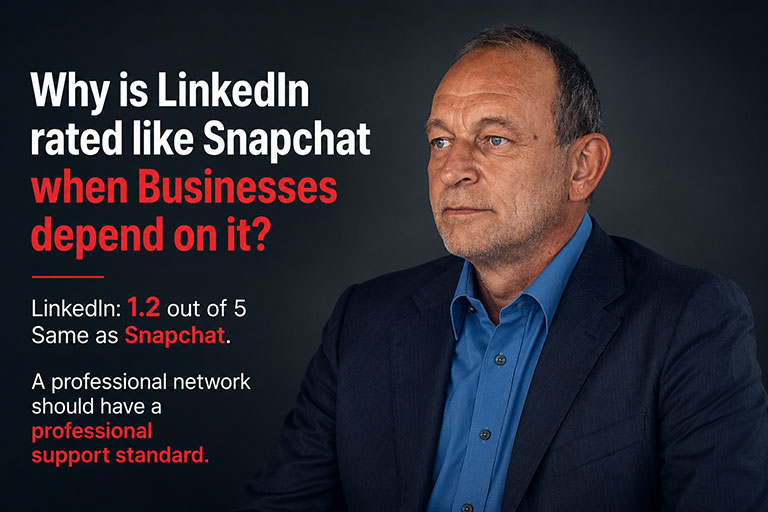
This is why LinkedIn’s Trustpilot rating is not just another bad internet score. At the time of writing, LinkedIn is rated 1.2 out of 5 on Trustpilot, with thousands of reviews and a very high share of one-star ratings. Snapchat is also rated 1.2 out of 5, which creates a comparison that should make LinkedIn deeply uncomfortable. A professional business network being rated in the same territory as Snapchat is not merely a public relations issue. It raises a structural question about whether LinkedIn behaves like the professional infrastructure it claims to be or like another consumer platform that has become too large to feel normal customer pressure.
A bad rating means something different when the platform is LinkedIn
I do not think Trustpilot should be treated as a scientific survey of every user of a platform. People who leave reviews are often people who are unhappy, and large platforms can attract a distorted complaint profile because they serve hundreds of millions of users. That caveat matters, and any serious article should include it. But the caveat does not make the signal irrelevant. A very poor Trustpilot profile still tells us something about the type of frustration that reaches the public surface.
For Facebook, Instagram, TikTok, Snapchat or X, the public may already expect a certain level of chaos. These platforms are enormous, algorithmic, automated and built around attention rather than service. Users complain about moderation decisions, advertising problems, lost accounts, weak support and unexplained restrictions. None of that is acceptable, but it also fits the public image many people already have of consumer social media. They are not exactly known for careful human support or transparent individual case handling.
LinkedIn sits in a different category because LinkedIn sells professional trust. It is not just where people share content. It is where many people establish credibility. It is where media visibility can be generated, where business contacts are managed, where commercial relationships start and where professional history becomes part of a public identity. When that kind of platform has a rating similar to Snapchat, the rating becomes more than a consumer complaint. It becomes a contradiction between brand promise and operational reality.
That contradiction is the centre of the problem. LinkedIn cannot benefit from being seen as essential professional infrastructure when selling premium subscriptions, recruiter products, advertising tools and company visibility, then behave like a normal entertainment app when users need help. It cannot claim the seriousness of business networking only when it suits the platform. If it controls access to professional visibility, it also carries a higher burden when access is restricted, verification fails or support does not respond in a meaningful way. That is not an emotional argument. It is a question of proportional responsibility.
The Snapchat comparison is so damaging because it should not exist
Snapchat is a consumer app. It is built around messaging, filters, memories and social interaction, mostly in a private or semi-private context. If users complain about lost memories, account issues, paywalls or poor support, that is obviously frustrating. Some of those issues may be very personal and emotional because users store years of memories on the platform. Still, Snapchat does not position itself as the backbone of professional identity, business development or executive reputation.
LinkedIn does. That is why the comparison matters. If LinkedIn and Snapchat are both sitting around the same Trustpilot rating level, the obvious question is not whether Snapchat is good or bad. The question is why LinkedIn is operating in the same public dissatisfaction zone as a consumer messaging app. A platform that wants to be the professional network should not be satisfied with being measured alongside platforms that nobody seriously treats as professional infrastructure.
This is not about pretending that a Trustpilot score gives us the full truth. It does not. But a rating of 1.2 out of 5 is not a small reputational scratch. It is a public complaint signal that would be alarming for almost any ordinary business. If a law firm, financial adviser, software provider, recruitment agency, media company or compliance consultant had that kind of score, potential clients would hesitate. They would ask whether the company is reliable, whether support exists and whether unresolved complaints point to a deeper operational issue.
LinkedIn seems to sit in a different reality. The platform can have a very poor public review profile while still being treated as unavoidable by many professionals. That is the privilege of network effects. People stay because their contacts are there, their audience is there, their work history is there and their business visibility may depend on it. In normal markets, a bad reputation can create customer movement. On dominant platforms, the user often cannot move without losing something valuable.
The real issue is not the rating, it is the dependency
The rating itself is only the starting point. The deeper issue is dependency. When people use LinkedIn professionally, they often build years of relationships, posts, messages, followers, company page access and commercial credibility on top of one platform account. That account can become part of their business infrastructure. It may not sit on a company balance sheet, but commercially it can still have real value. Losing access can mean losing visibility, losing conversations, losing leads and losing reputation.
This is why LinkedIn account restrictions are very different from an ordinary private social media inconvenience. If someone loses access to a private entertainment account, the damage may be limited to personal frustration. If a business owner, recruiter, consultant, publisher, journalist, executive or sales professional loses access to LinkedIn, the damage can move into the commercial sphere. It can affect communication with clients, confidence from advertisers, access to professional networks and the ability to explain publicly what has happened. That is not a small operational matter.
The platform’s power is amplified by the fact that LinkedIn is often used as a public trust signal. People check LinkedIn profiles before meetings. Clients verify professional backgrounds there. Recruiters review profiles. Journalists, suppliers, investors and partners often look at LinkedIn presence as part of their informal due diligence. A restriction, suspension or unresolved verification loop can therefore create an impression that something is wrong with the user, even when the user has not been given a clear explanation or fair process.
That reputational effect is important. Platforms often frame access problems as technical, policy-based or security-related matters. But to the outside world, a restricted profile can look like a red flag. Business contacts may not know whether the issue is administrative, mistaken, automated or serious. The platform may see a case number. The market sees absence, silence or a damaged public signal. That gap between platform process and commercial consequence is where LinkedIn should be held to a higher standard.
Account restrictions on LinkedIn can become business disruption
Account restrictions are usually described in platform language. The user is told that there has been a security issue, a policy issue, a verification issue or some other unexplained problem. The wording may sound procedural. But the commercial consequences can be much more serious than the language suggests. For a professional user, LinkedIn access is not only about scrolling through posts. It can be a communication channel, a publishing tool, a lead generation system and a credibility layer.
If a company depends on LinkedIn for visibility, a restricted admin profile can also affect company page activity. If a publisher depends on LinkedIn for traffic, a restriction can reduce audience reach. If a consultant uses LinkedIn to communicate with clients, the inbox can become inaccessible. If an executive has built reputation through years of content, that public presence can suddenly become unavailable. These are not theoretical concerns. They are the kind of practical business risks that follow when a private platform becomes central to professional activity.
That is where LinkedIn’s poor Trustpilot profile becomes more than an embarrassment. Trustpilot’s summary of recent reviews points to recurring frustration around account restrictions, identity verification, lockouts and customer service. Those are exactly the areas where LinkedIn should be strongest. A professional identity platform should have particularly clear access rules, reliable verification processes and accountable support when something goes wrong. If the platform cannot provide that, its professional positioning becomes weaker.
The problem is not that LinkedIn enforces rules. Any large platform has to enforce rules, fight fraud, manage impersonation, deal with spam and protect users from abuse. Nobody serious would argue that LinkedIn should have no restrictions or verification procedures. The issue is whether those procedures are transparent, proportionate, reviewable and commercially responsible. A professional platform can restrict accounts when necessary, but it should not leave legitimate users trapped in opaque processes with no meaningful human route to resolution.
LinkedIn benefits from professional trust while users carry the risk
One of the uncomfortable features of modern platforms is that they turn user dependency into platform strength. Users build content, networks, relationships and reputation. The platform benefits from that activity because it increases engagement, data value, advertising potential and subscription relevance. But when the account is restricted or support fails, the individual user often carries most of the immediate damage. The platform may lose little from one dispute. The user may lose access to years of professional capital.
This imbalance is not unique to LinkedIn, but LinkedIn makes it more serious because the professional stakes are higher. On TikTok, a creator may lose audience and income if an account is restricted. On Instagram, a business can also be harmed by account issues. These platforms are not irrelevant commercially, especially for creators and small companies. But LinkedIn has a particular status because it is tied directly to professional identity, recruitment, corporate credibility and business networking. Its entire brand is built around being serious.
That seriousness should come with stronger service expectations. If LinkedIn wants professionals to rely on the platform for careers, business development and company visibility, it should also accept that account access cannot be treated like a low-priority consumer app problem. When users report support loops, failed verification attempts or unclear restrictions, the issue is not just inconvenience. It becomes a governance problem. The platform is making decisions that can affect professional standing, but the affected user may not receive the level of explanation that a serious business context requires.
This is where LinkedIn’s public image starts to look fragile. The platform appears polished from the outside. It is full of professional language, corporate updates, leadership posts, hiring announcements and business content. But if the support layer underneath that image produces the same kind of frustration as the worst consumer platforms, the professional surface begins to look less convincing. A trusted business network should not only look professional when users are posting. It should behave professionally when users need help.
Why bad ratings may not matter enough to large platforms?
The obvious question is why companies of this size seem able to tolerate such poor public ratings. In a normal service business, a very low rating would be a direct commercial threat. Clients would leave. Competitors would use it in sales conversations. Management would need to explain it. But dominant platforms operate under different conditions. Their strength comes not only from service quality, but from network effects, market dependency and user lock-in.
If everyone in a professional sector uses LinkedIn, leaving LinkedIn is not a normal customer choice. It can mean leaving the place where clients, recruiters, journalists, competitors, suppliers and investors are already active. That makes the user weaker than the platform. A person may hate the support experience and still continue using LinkedIn because the alternative is commercially unattractive. In that environment, dissatisfaction can rise without immediately creating a mass exit. The platform can absorb anger because the network is more valuable than the service experience is painful.
This creates a dangerous incentive structure. If users cannot easily leave, service quality does not need to meet the same standards that would apply in a more competitive market. Support can become automated. Appeals can become slow. Verification can become rigid. Complaints can be handled as volume rather than as commercially meaningful disputes. The system may still function at scale, but it does not necessarily function fairly for users who fall into the wrong process.
LinkedIn is not alone in this. Most major platforms appear to rely heavily on automation, standardised processes and limited human support. Scale makes that understandable. No platform with hundreds of millions of users can handle every issue through individual manual review from the start. But scale does not excuse poor outcomes where professional identity and business visibility are involved. The more important a platform becomes, the more important its escalation systems become as well.
The counterargument is that Trustpilot is not the whole story
There is a fair counterargument here. Trustpilot ratings for major social platforms are often dominated by unhappy users. Satisfied users may simply use the platform without ever thinking of leaving a review. A low rating may therefore say more about complaint intensity than overall satisfaction. LinkedIn still has a huge user base, many professionals continue to find value in it and many businesses still treat it as an essential channel. That should be acknowledged.
There is also another point. Large platforms face difficult abuse problems. Fake profiles, scams, spam, impersonation, scraping, harassment and coordinated manipulation are real issues. Any platform that connects professionals at scale must protect the network from bad actors. Some legitimate users may unfortunately be caught in restrictive systems that are designed to stop abuse. That does not automatically mean the existence of restrictions is wrong.
But these counterarguments do not remove the central concern. They explain why platforms need rules and why public ratings may not represent every user. They do not explain why a professional platform should have such a poor public complaint profile around support, verification and account access. They also do not answer the practical question of what happens to a legitimate business user when the system gets it wrong. A platform can be both valuable and structurally weak in the way it handles disputes.
That is the point that matters. The argument is not that LinkedIn has no value. It clearly has value. The argument is that value increases the responsibility. The more professionals depend on LinkedIn, the less acceptable it becomes for account problems to be handled like disposable consumer support tickets. Dependency does not reduce LinkedIn’s duty to improve. It increases it.
A professional network should have a professional support standard
The word professional should mean something operationally. It should not only describe the type of content users post or the kind of audience the platform attracts. It should also describe the way the platform handles serious account problems. A professional network should have clearer explanations, better escalation routes and more reliable review mechanisms when users face restrictions that can affect their work. That should be the minimum standard.
This does not mean every user should get a personal account manager. That would be unrealistic. It does mean that users with long-standing accounts, verified identities, company page responsibilities, paid subscriptions, advertising relationships or clear commercial dependency should not be left in the same kind of generic support loop as a throwaway entertainment account. There should be tiers of seriousness. Not because some users are more important as people, but because the commercial consequences are objectively different.
LinkedIn already understands segmentation when it sells products. It has premium users, advertisers, recruiters, company pages and enterprise clients. It understands different levels of commercial value very well. The same logic should apply when something goes wrong. If the platform can segment monetisation, it should also be able to segment support risk. A restriction affecting a professional profile with business dependencies should trigger a more responsible process than an ordinary low-impact user issue.
The failure to make that distinction is what makes the Trustpilot comparison so damaging. Snapchat can be criticised for consumer app problems. TikTok can be criticised for creator and advertising problems. Facebook and Instagram can be criticised for Meta’s huge support gap. But LinkedIn should not be able to hide inside the same category of platform failure. Its own positioning places it above that. If it wants to be seen as professional infrastructure, it should meet a professional support standard.
The reputation problem goes beyond individual complaints
A poor Trustpilot score may not damage LinkedIn immediately. The platform is too embedded for that. But it does create a slow reputational problem. Every unresolved account restriction, every failed verification loop and every unanswered support issue contributes to a broader perception that the platform is powerful but not accountable. That perception can become especially damaging among business users because business users understand operational risk. They know what dependency on a single external channel can do.
For companies, LinkedIn dependency should now be treated as a risk area. If a business depends heavily on one founder profile, one executive account or one company page administrator, then the company has exposure. If the profile is restricted, hacked, wrongly flagged or trapped in verification, the business may suddenly lose access to an important communication channel. That is not just a social media problem. It is a continuity problem. It should be considered in the same way companies consider website access, domain control, email systems or advertising accounts.
This is where the article becomes more than a complaint about LinkedIn. It becomes a warning about platform dependency. Businesses have spent years building audiences on platforms they do not control. They have treated profiles as assets, but legally and technically those profiles remain subject to platform rules. When everything works, the system feels convenient. When something breaks, the imbalance becomes visible immediately.
LinkedIn should want to solve this because trust is its core product. The platform is not only selling access to posts and profiles. It is selling confidence that professional identity can be maintained there. If users begin to feel that their account can be restricted without clear process or reliable support, trust weakens. The damage may not show up immediately in user numbers, but it can affect how seriously professionals treat the platform over time.
The business community should ask harder questions
One reason large platforms get away with poor support is that users often complain individually rather than structurally. Each person sees their own account issue, appeal problem or verification failure as a personal case. The platform treats it as a ticket. The public may see it as another angry review. But when thousands of similar frustrations appear across public review platforms, the issue should be examined as a structural pattern. The question is not only what happened to one user. The question is how the system behaves when things go wrong.
Businesses should ask harder questions about LinkedIn because they depend on it more than they often admit. If a company spends money on LinkedIn advertising, it should ask what support exists when an account or page is restricted. If a recruiter depends on LinkedIn, the recruiter should ask what happens if access is lost. If a publisher relies on LinkedIn traffic, the publisher should ask whether there is a backup distribution strategy. If an executive uses LinkedIn as a primary reputation channel, the executive should understand that the account is not fully under their control.
These questions are not anti-LinkedIn. They are normal business risk questions. A serious company would not build its entire digital infrastructure on a single provider without understanding access, escalation and continuity. Yet many professionals do exactly that with LinkedIn because the platform feels informal compared with traditional infrastructure. That may be a mistake. When a platform becomes commercially important, it should be assessed with commercial seriousness.
LinkedIn also deserves scrutiny because its own importance has grown. It is no longer just an online CV database or a networking site. For many people, it is now a publishing platform, sales channel, recruitment system, media distribution tool and reputation layer. That level of importance changes the debate. The more LinkedIn becomes part of business infrastructure, the less acceptable it is for access disputes to be handled like ordinary social media noise.
LinkedIn cannot have the status of infrastructure and the accountability of an app
This is the core issue. LinkedIn cannot have the status of infrastructure and the accountability of an app. It cannot be treated as essential when users build careers and business relationships there, then act as if access problems are merely private platform matters. That gap is where frustration grows. It is also where the Trustpilot rating becomes symbolic. The number is not just a score. It is a sign of a deeper mismatch between platform power and user protection.
A professional network should be more careful with restrictions than an entertainment platform. It should be more transparent with verification than a casual messaging app. It should provide better escalation than a video-sharing platform built around fast-moving content. It should understand that a user’s professional identity is not a disposable login. LinkedIn’s entire value proposition depends on the idea that professional identity has value. The platform should therefore treat access to that identity with more care.
The comparison with Snapchat is uncomfortable because it strips away LinkedIn’s polished surface. It says, in effect, that the public complaint experience around LinkedIn is not meaningfully better than the complaint experience around a consumer app. That may not represent every user’s experience, but it is still damaging. A platform that wants to be trusted by businesses should not be comfortable with that comparison. It should see it as a warning.
This is especially true because LinkedIn is not a marginal platform. It is one of the central professional networks in the world. Its decisions can affect hiring, visibility, trust and commercial communication. When a platform of that size attracts persistent complaints about account access and support, the issue deserves more than a shrug. It deserves scrutiny from users, advertisers, businesses and perhaps eventually from regulators interested in digital dependency and platform accountability.
The forward-looking question is what standard we expect from professional platforms
The debate should not end with saying LinkedIn has a bad Trustpilot rating. That is too simple. The better question is what standard we expect from platforms that become part of professional life. If LinkedIn is just another social media platform, then perhaps the market will tolerate the same level of frustration users already tolerate elsewhere. But if LinkedIn is professional infrastructure, then the standard should be higher. It should be higher because the consequences are higher.
The answer is not to abandon LinkedIn tomorrow. That would be unrealistic for many professionals and businesses. The answer is to stop treating platform dependency as harmless. Companies should diversify visibility, protect their own websites, maintain direct mailing lists, keep independent client databases and avoid relying entirely on one platform-controlled audience. Professionals should understand that a LinkedIn profile is useful, but it is not the same as owning a business asset. It can be restricted, limited or removed by a process the user does not control.
LinkedIn also has a choice. It can continue to benefit from its market position while accepting a public complaint profile that places it beside the worst-rated consumer platforms. Or it can recognise that professional trust requires more than brand language. It requires better account governance, clearer communication, more reliable escalation and support standards that match the commercial role the platform now plays. That would not solve every dispute, but it would show that LinkedIn understands the seriousness of its position.
For me, that is the central point. A bad Trustpilot rating is embarrassing for any major platform. For LinkedIn, it is more serious because LinkedIn is not supposed to be just another social app. It is where many people conduct business, build reputation and maintain professional visibility. If LinkedIn wants to be treated as the professional network of the modern economy, it should not be comfortable being rated like Snapchat. The platform should either live up to its professional promise or accept that its public reputation is beginning to tell a very different story.
FAQs
What is LinkedIn's Trustpilot rating?
At the time discussed in the article, LinkedIn has a Trustpilot rating of around 1.2 out of 5, based on thousands of user reviews, many of which are one-star ratings.
Why does LinkedIn's Trustpilot rating matter?
Unlike consumer social media platforms, LinkedIn is widely used for careers, business networking and professional reputation, making customer support and account access especially important.
Does a low Trustpilot score represent every LinkedIn user?
No. Trustpilot reviews often reflect the experiences of dissatisfied users, so they do not necessarily represent the views of LinkedIn's entire user base.
What are the most common complaints about LinkedIn?
Users frequently report account restrictions, identity verification issues, customer support delays, account lockouts and limited access to human assistance.
How can a LinkedIn account restriction affect professionals?
An account restriction can disrupt business communication, recruitment activities, client relationships, content publishing and professional visibility.
Why is LinkedIn compared with Snapchat in the article?
The comparison highlights that both platforms have similarly low Trustpilot ratings despite LinkedIn positioning itself as a professional business network.
Why should businesses avoid relying solely on LinkedIn?
Depending entirely on LinkedIn creates business continuity risks if accounts become restricted or inaccessible. Companies should diversify their digital communication channels.
Does the article argue that LinkedIn should stop enforcing its policies?
No. The article supports fraud prevention and security measures but argues that professional users deserve clearer communication, transparent reviews and better support.
What improvements does the article suggest for LinkedIn?
It recommends improved customer support, clearer account review procedures, better escalation paths and greater transparency for account restrictions.
What is the main conclusion of the article?
The article concludes that LinkedIn should deliver support standards that match its role as a professional platform because many users depend on it for careers and business activities.
Welcome. I am an experienced writer and I am ready to help you with all forms of writing needs you require.
Education
B.A. - linguistics,
University of Wisconsin-Whitewater, United States, Graduated 2006.


















by Lisa
June 29, 2026
in Opinion & Commentary
354
LinkedIn Trustpilot Rating Under Scrutiny
There are many things I would expect from a consumer social media platform. I would expect noise, weak moderation, strange decisions, automated support and a general feeling that nobody is really responsible when something goes wrong. That may not be good, but it is also not surprising. People use platforms such as Snapchat, TikTok, Instagram, Facebook or X for different reasons, and many of those reasons are casual, personal or entertainment-driven. If something goes wrong there, it may be frustrating, but in most cases it does not immediately damage a professional reputation or disrupt a business relationship.
LinkedIn is supposed to be different. That is the entire point of LinkedIn. It is not presented to the market as another app for private entertainment, short videos, holiday photos, filters or casual updates. LinkedIn presents itself as the professional network where careers are built, companies communicate, publishers distribute content, recruiters find talent, sales teams build relationships and executives maintain visibility. That positioning creates a different level of responsibility, whether LinkedIn wants to acknowledge it or not.
This is why LinkedIn’s Trustpilot rating is not just another bad internet score. At the time of writing, LinkedIn is rated 1.2 out of 5 on Trustpilot, with thousands of reviews and a very high share of one-star ratings. Snapchat is also rated 1.2 out of 5, which creates a comparison that should make LinkedIn deeply uncomfortable. A professional business network being rated in the same territory as Snapchat is not merely a public relations issue. It raises a structural question about whether LinkedIn behaves like the professional infrastructure it claims to be or like another consumer platform that has become too large to feel normal customer pressure.
A bad rating means something different when the platform is LinkedIn
I do not think Trustpilot should be treated as a scientific survey of every user of a platform. People who leave reviews are often people who are unhappy, and large platforms can attract a distorted complaint profile because they serve hundreds of millions of users. That caveat matters, and any serious article should include it. But the caveat does not make the signal irrelevant. A very poor Trustpilot profile still tells us something about the type of frustration that reaches the public surface.
For Facebook, Instagram, TikTok, Snapchat or X, the public may already expect a certain level of chaos. These platforms are enormous, algorithmic, automated and built around attention rather than service. Users complain about moderation decisions, advertising problems, lost accounts, weak support and unexplained restrictions. None of that is acceptable, but it also fits the public image many people already have of consumer social media. They are not exactly known for careful human support or transparent individual case handling.
LinkedIn sits in a different category because LinkedIn sells professional trust. It is not just where people share content. It is where many people establish credibility. It is where media visibility can be generated, where business contacts are managed, where commercial relationships start and where professional history becomes part of a public identity. When that kind of platform has a rating similar to Snapchat, the rating becomes more than a consumer complaint. It becomes a contradiction between brand promise and operational reality.
That contradiction is the centre of the problem. LinkedIn cannot benefit from being seen as essential professional infrastructure when selling premium subscriptions, recruiter products, advertising tools and company visibility, then behave like a normal entertainment app when users need help. It cannot claim the seriousness of business networking only when it suits the platform. If it controls access to professional visibility, it also carries a higher burden when access is restricted, verification fails or support does not respond in a meaningful way. That is not an emotional argument. It is a question of proportional responsibility.
The Snapchat comparison is so damaging because it should not exist
Snapchat is a consumer app. It is built around messaging, filters, memories and social interaction, mostly in a private or semi-private context. If users complain about lost memories, account issues, paywalls or poor support, that is obviously frustrating. Some of those issues may be very personal and emotional because users store years of memories on the platform. Still, Snapchat does not position itself as the backbone of professional identity, business development or executive reputation.
LinkedIn does. That is why the comparison matters. If LinkedIn and Snapchat are both sitting around the same Trustpilot rating level, the obvious question is not whether Snapchat is good or bad. The question is why LinkedIn is operating in the same public dissatisfaction zone as a consumer messaging app. A platform that wants to be the professional network should not be satisfied with being measured alongside platforms that nobody seriously treats as professional infrastructure.
This is not about pretending that a Trustpilot score gives us the full truth. It does not. But a rating of 1.2 out of 5 is not a small reputational scratch. It is a public complaint signal that would be alarming for almost any ordinary business. If a law firm, financial adviser, software provider, recruitment agency, media company or compliance consultant had that kind of score, potential clients would hesitate. They would ask whether the company is reliable, whether support exists and whether unresolved complaints point to a deeper operational issue.
LinkedIn seems to sit in a different reality. The platform can have a very poor public review profile while still being treated as unavoidable by many professionals. That is the privilege of network effects. People stay because their contacts are there, their audience is there, their work history is there and their business visibility may depend on it. In normal markets, a bad reputation can create customer movement. On dominant platforms, the user often cannot move without losing something valuable.
The real issue is not the rating, it is the dependency
The rating itself is only the starting point. The deeper issue is dependency. When people use LinkedIn professionally, they often build years of relationships, posts, messages, followers, company page access and commercial credibility on top of one platform account. That account can become part of their business infrastructure. It may not sit on a company balance sheet, but commercially it can still have real value. Losing access can mean losing visibility, losing conversations, losing leads and losing reputation.
This is why LinkedIn account restrictions are very different from an ordinary private social media inconvenience. If someone loses access to a private entertainment account, the damage may be limited to personal frustration. If a business owner, recruiter, consultant, publisher, journalist, executive or sales professional loses access to LinkedIn, the damage can move into the commercial sphere. It can affect communication with clients, confidence from advertisers, access to professional networks and the ability to explain publicly what has happened. That is not a small operational matter.
The platform’s power is amplified by the fact that LinkedIn is often used as a public trust signal. People check LinkedIn profiles before meetings. Clients verify professional backgrounds there. Recruiters review profiles. Journalists, suppliers, investors and partners often look at LinkedIn presence as part of their informal due diligence. A restriction, suspension or unresolved verification loop can therefore create an impression that something is wrong with the user, even when the user has not been given a clear explanation or fair process.
That reputational effect is important. Platforms often frame access problems as technical, policy-based or security-related matters. But to the outside world, a restricted profile can look like a red flag. Business contacts may not know whether the issue is administrative, mistaken, automated or serious. The platform may see a case number. The market sees absence, silence or a damaged public signal. That gap between platform process and commercial consequence is where LinkedIn should be held to a higher standard.
Account restrictions on LinkedIn can become business disruption
Account restrictions are usually described in platform language. The user is told that there has been a security issue, a policy issue, a verification issue or some other unexplained problem. The wording may sound procedural. But the commercial consequences can be much more serious than the language suggests. For a professional user, LinkedIn access is not only about scrolling through posts. It can be a communication channel, a publishing tool, a lead generation system and a credibility layer.
If a company depends on LinkedIn for visibility, a restricted admin profile can also affect company page activity. If a publisher depends on LinkedIn for traffic, a restriction can reduce audience reach. If a consultant uses LinkedIn to communicate with clients, the inbox can become inaccessible. If an executive has built reputation through years of content, that public presence can suddenly become unavailable. These are not theoretical concerns. They are the kind of practical business risks that follow when a private platform becomes central to professional activity.
That is where LinkedIn’s poor Trustpilot profile becomes more than an embarrassment. Trustpilot’s summary of recent reviews points to recurring frustration around account restrictions, identity verification, lockouts and customer service. Those are exactly the areas where LinkedIn should be strongest. A professional identity platform should have particularly clear access rules, reliable verification processes and accountable support when something goes wrong. If the platform cannot provide that, its professional positioning becomes weaker.
The problem is not that LinkedIn enforces rules. Any large platform has to enforce rules, fight fraud, manage impersonation, deal with spam and protect users from abuse. Nobody serious would argue that LinkedIn should have no restrictions or verification procedures. The issue is whether those procedures are transparent, proportionate, reviewable and commercially responsible. A professional platform can restrict accounts when necessary, but it should not leave legitimate users trapped in opaque processes with no meaningful human route to resolution.
LinkedIn benefits from professional trust while users carry the risk
One of the uncomfortable features of modern platforms is that they turn user dependency into platform strength. Users build content, networks, relationships and reputation. The platform benefits from that activity because it increases engagement, data value, advertising potential and subscription relevance. But when the account is restricted or support fails, the individual user often carries most of the immediate damage. The platform may lose little from one dispute. The user may lose access to years of professional capital.
This imbalance is not unique to LinkedIn, but LinkedIn makes it more serious because the professional stakes are higher. On TikTok, a creator may lose audience and income if an account is restricted. On Instagram, a business can also be harmed by account issues. These platforms are not irrelevant commercially, especially for creators and small companies. But LinkedIn has a particular status because it is tied directly to professional identity, recruitment, corporate credibility and business networking. Its entire brand is built around being serious.
That seriousness should come with stronger service expectations. If LinkedIn wants professionals to rely on the platform for careers, business development and company visibility, it should also accept that account access cannot be treated like a low-priority consumer app problem. When users report support loops, failed verification attempts or unclear restrictions, the issue is not just inconvenience. It becomes a governance problem. The platform is making decisions that can affect professional standing, but the affected user may not receive the level of explanation that a serious business context requires.
This is where LinkedIn’s public image starts to look fragile. The platform appears polished from the outside. It is full of professional language, corporate updates, leadership posts, hiring announcements and business content. But if the support layer underneath that image produces the same kind of frustration as the worst consumer platforms, the professional surface begins to look less convincing. A trusted business network should not only look professional when users are posting. It should behave professionally when users need help.
Why bad ratings may not matter enough to large platforms?
The obvious question is why companies of this size seem able to tolerate such poor public ratings. In a normal service business, a very low rating would be a direct commercial threat. Clients would leave. Competitors would use it in sales conversations. Management would need to explain it. But dominant platforms operate under different conditions. Their strength comes not only from service quality, but from network effects, market dependency and user lock-in.
If everyone in a professional sector uses LinkedIn, leaving LinkedIn is not a normal customer choice. It can mean leaving the place where clients, recruiters, journalists, competitors, suppliers and investors are already active. That makes the user weaker than the platform. A person may hate the support experience and still continue using LinkedIn because the alternative is commercially unattractive. In that environment, dissatisfaction can rise without immediately creating a mass exit. The platform can absorb anger because the network is more valuable than the service experience is painful.
This creates a dangerous incentive structure. If users cannot easily leave, service quality does not need to meet the same standards that would apply in a more competitive market. Support can become automated. Appeals can become slow. Verification can become rigid. Complaints can be handled as volume rather than as commercially meaningful disputes. The system may still function at scale, but it does not necessarily function fairly for users who fall into the wrong process.
LinkedIn is not alone in this. Most major platforms appear to rely heavily on automation, standardised processes and limited human support. Scale makes that understandable. No platform with hundreds of millions of users can handle every issue through individual manual review from the start. But scale does not excuse poor outcomes where professional identity and business visibility are involved. The more important a platform becomes, the more important its escalation systems become as well.
The counterargument is that Trustpilot is not the whole story
There is a fair counterargument here. Trustpilot ratings for major social platforms are often dominated by unhappy users. Satisfied users may simply use the platform without ever thinking of leaving a review. A low rating may therefore say more about complaint intensity than overall satisfaction. LinkedIn still has a huge user base, many professionals continue to find value in it and many businesses still treat it as an essential channel. That should be acknowledged.
There is also another point. Large platforms face difficult abuse problems. Fake profiles, scams, spam, impersonation, scraping, harassment and coordinated manipulation are real issues. Any platform that connects professionals at scale must protect the network from bad actors. Some legitimate users may unfortunately be caught in restrictive systems that are designed to stop abuse. That does not automatically mean the existence of restrictions is wrong.
But these counterarguments do not remove the central concern. They explain why platforms need rules and why public ratings may not represent every user. They do not explain why a professional platform should have such a poor public complaint profile around support, verification and account access. They also do not answer the practical question of what happens to a legitimate business user when the system gets it wrong. A platform can be both valuable and structurally weak in the way it handles disputes.
That is the point that matters. The argument is not that LinkedIn has no value. It clearly has value. The argument is that value increases the responsibility. The more professionals depend on LinkedIn, the less acceptable it becomes for account problems to be handled like disposable consumer support tickets. Dependency does not reduce LinkedIn’s duty to improve. It increases it.
A professional network should have a professional support standard
The word professional should mean something operationally. It should not only describe the type of content users post or the kind of audience the platform attracts. It should also describe the way the platform handles serious account problems. A professional network should have clearer explanations, better escalation routes and more reliable review mechanisms when users face restrictions that can affect their work. That should be the minimum standard.
This does not mean every user should get a personal account manager. That would be unrealistic. It does mean that users with long-standing accounts, verified identities, company page responsibilities, paid subscriptions, advertising relationships or clear commercial dependency should not be left in the same kind of generic support loop as a throwaway entertainment account. There should be tiers of seriousness. Not because some users are more important as people, but because the commercial consequences are objectively different.
LinkedIn already understands segmentation when it sells products. It has premium users, advertisers, recruiters, company pages and enterprise clients. It understands different levels of commercial value very well. The same logic should apply when something goes wrong. If the platform can segment monetisation, it should also be able to segment support risk. A restriction affecting a professional profile with business dependencies should trigger a more responsible process than an ordinary low-impact user issue.
The failure to make that distinction is what makes the Trustpilot comparison so damaging. Snapchat can be criticised for consumer app problems. TikTok can be criticised for creator and advertising problems. Facebook and Instagram can be criticised for Meta’s huge support gap. But LinkedIn should not be able to hide inside the same category of platform failure. Its own positioning places it above that. If it wants to be seen as professional infrastructure, it should meet a professional support standard.
The reputation problem goes beyond individual complaints
A poor Trustpilot score may not damage LinkedIn immediately. The platform is too embedded for that. But it does create a slow reputational problem. Every unresolved account restriction, every failed verification loop and every unanswered support issue contributes to a broader perception that the platform is powerful but not accountable. That perception can become especially damaging among business users because business users understand operational risk. They know what dependency on a single external channel can do.
For companies, LinkedIn dependency should now be treated as a risk area. If a business depends heavily on one founder profile, one executive account or one company page administrator, then the company has exposure. If the profile is restricted, hacked, wrongly flagged or trapped in verification, the business may suddenly lose access to an important communication channel. That is not just a social media problem. It is a continuity problem. It should be considered in the same way companies consider website access, domain control, email systems or advertising accounts.
This is where the article becomes more than a complaint about LinkedIn. It becomes a warning about platform dependency. Businesses have spent years building audiences on platforms they do not control. They have treated profiles as assets, but legally and technically those profiles remain subject to platform rules. When everything works, the system feels convenient. When something breaks, the imbalance becomes visible immediately.
LinkedIn should want to solve this because trust is its core product. The platform is not only selling access to posts and profiles. It is selling confidence that professional identity can be maintained there. If users begin to feel that their account can be restricted without clear process or reliable support, trust weakens. The damage may not show up immediately in user numbers, but it can affect how seriously professionals treat the platform over time.
The business community should ask harder questions
One reason large platforms get away with poor support is that users often complain individually rather than structurally. Each person sees their own account issue, appeal problem or verification failure as a personal case. The platform treats it as a ticket. The public may see it as another angry review. But when thousands of similar frustrations appear across public review platforms, the issue should be examined as a structural pattern. The question is not only what happened to one user. The question is how the system behaves when things go wrong.
Businesses should ask harder questions about LinkedIn because they depend on it more than they often admit. If a company spends money on LinkedIn advertising, it should ask what support exists when an account or page is restricted. If a recruiter depends on LinkedIn, the recruiter should ask what happens if access is lost. If a publisher relies on LinkedIn traffic, the publisher should ask whether there is a backup distribution strategy. If an executive uses LinkedIn as a primary reputation channel, the executive should understand that the account is not fully under their control.
These questions are not anti-LinkedIn. They are normal business risk questions. A serious company would not build its entire digital infrastructure on a single provider without understanding access, escalation and continuity. Yet many professionals do exactly that with LinkedIn because the platform feels informal compared with traditional infrastructure. That may be a mistake. When a platform becomes commercially important, it should be assessed with commercial seriousness.
LinkedIn also deserves scrutiny because its own importance has grown. It is no longer just an online CV database or a networking site. For many people, it is now a publishing platform, sales channel, recruitment system, media distribution tool and reputation layer. That level of importance changes the debate. The more LinkedIn becomes part of business infrastructure, the less acceptable it is for access disputes to be handled like ordinary social media noise.
LinkedIn cannot have the status of infrastructure and the accountability of an app
This is the core issue. LinkedIn cannot have the status of infrastructure and the accountability of an app. It cannot be treated as essential when users build careers and business relationships there, then act as if access problems are merely private platform matters. That gap is where frustration grows. It is also where the Trustpilot rating becomes symbolic. The number is not just a score. It is a sign of a deeper mismatch between platform power and user protection.
A professional network should be more careful with restrictions than an entertainment platform. It should be more transparent with verification than a casual messaging app. It should provide better escalation than a video-sharing platform built around fast-moving content. It should understand that a user’s professional identity is not a disposable login. LinkedIn’s entire value proposition depends on the idea that professional identity has value. The platform should therefore treat access to that identity with more care.
The comparison with Snapchat is uncomfortable because it strips away LinkedIn’s polished surface. It says, in effect, that the public complaint experience around LinkedIn is not meaningfully better than the complaint experience around a consumer app. That may not represent every user’s experience, but it is still damaging. A platform that wants to be trusted by businesses should not be comfortable with that comparison. It should see it as a warning.
This is especially true because LinkedIn is not a marginal platform. It is one of the central professional networks in the world. Its decisions can affect hiring, visibility, trust and commercial communication. When a platform of that size attracts persistent complaints about account access and support, the issue deserves more than a shrug. It deserves scrutiny from users, advertisers, businesses and perhaps eventually from regulators interested in digital dependency and platform accountability.
The forward-looking question is what standard we expect from professional platforms
The debate should not end with saying LinkedIn has a bad Trustpilot rating. That is too simple. The better question is what standard we expect from platforms that become part of professional life. If LinkedIn is just another social media platform, then perhaps the market will tolerate the same level of frustration users already tolerate elsewhere. But if LinkedIn is professional infrastructure, then the standard should be higher. It should be higher because the consequences are higher.
The answer is not to abandon LinkedIn tomorrow. That would be unrealistic for many professionals and businesses. The answer is to stop treating platform dependency as harmless. Companies should diversify visibility, protect their own websites, maintain direct mailing lists, keep independent client databases and avoid relying entirely on one platform-controlled audience. Professionals should understand that a LinkedIn profile is useful, but it is not the same as owning a business asset. It can be restricted, limited or removed by a process the user does not control.
LinkedIn also has a choice. It can continue to benefit from its market position while accepting a public complaint profile that places it beside the worst-rated consumer platforms. Or it can recognise that professional trust requires more than brand language. It requires better account governance, clearer communication, more reliable escalation and support standards that match the commercial role the platform now plays. That would not solve every dispute, but it would show that LinkedIn understands the seriousness of its position.
For me, that is the central point. A bad Trustpilot rating is embarrassing for any major platform. For LinkedIn, it is more serious because LinkedIn is not supposed to be just another social app. It is where many people conduct business, build reputation and maintain professional visibility. If LinkedIn wants to be treated as the professional network of the modern economy, it should not be comfortable being rated like Snapchat. The platform should either live up to its professional promise or accept that its public reputation is beginning to tell a very different story.
FAQs
What is LinkedIn's Trustpilot rating?
At the time discussed in the article, LinkedIn has a Trustpilot rating of around 1.2 out of 5, based on thousands of user reviews, many of which are one-star ratings.
Why does LinkedIn's Trustpilot rating matter?
Unlike consumer social media platforms, LinkedIn is widely used for careers, business networking and professional reputation, making customer support and account access especially important.
Does a low Trustpilot score represent every LinkedIn user?
No. Trustpilot reviews often reflect the experiences of dissatisfied users, so they do not necessarily represent the views of LinkedIn's entire user base.
What are the most common complaints about LinkedIn?
Users frequently report account restrictions, identity verification issues, customer support delays, account lockouts and limited access to human assistance.
How can a LinkedIn account restriction affect professionals?
An account restriction can disrupt business communication, recruitment activities, client relationships, content publishing and professional visibility.
Why is LinkedIn compared with Snapchat in the article?
The comparison highlights that both platforms have similarly low Trustpilot ratings despite LinkedIn positioning itself as a professional business network.
Why should businesses avoid relying solely on LinkedIn?
Depending entirely on LinkedIn creates business continuity risks if accounts become restricted or inaccessible. Companies should diversify their digital communication channels.
Does the article argue that LinkedIn should stop enforcing its policies?
No. The article supports fraud prevention and security measures but argues that professional users deserve clearer communication, transparent reviews and better support.
What improvements does the article suggest for LinkedIn?
It recommends improved customer support, clearer account review procedures, better escalation paths and greater transparency for account restrictions.
What is the main conclusion of the article?
The article concludes that LinkedIn should deliver support standards that match its role as a professional platform because many users depend on it for careers and business activities.
Lisa
Welcome. I am an experienced writer and I am ready to help you with all forms of writing needs you require. Education B.A. - linguistics, University of Wisconsin-Whitewater, United States, Graduated 2006.
Related Posts
Gamblers Connect launches Proof of Play for transparent operator reviews
September 21, 2026
BOYLE Sports strengthens safer gambling with human connection and support
September 7, 2026
Gambling Commission reaffirms identity verification rules for operators
August 14, 2026
ClearStake launches Document Intelligence to spot AI document fraud
July 28, 2026
Would you trust LinkedIn with a 1.2 rating?
June 27, 2026
LinkedIn account restrictions need transparent appeals
June 24, 2026
EvenBet Gaming to host exclusive poker tournament at SBC Summit Malta
April 21, 2026
Malta Gaming Authority investigation reveals gambling safety gaps
February 18, 2026
Croatia gambling reforms and self-exclusion system 2026
November 17, 2025