

















Inside Gambling’s VIP System: Who Checks the Managers?
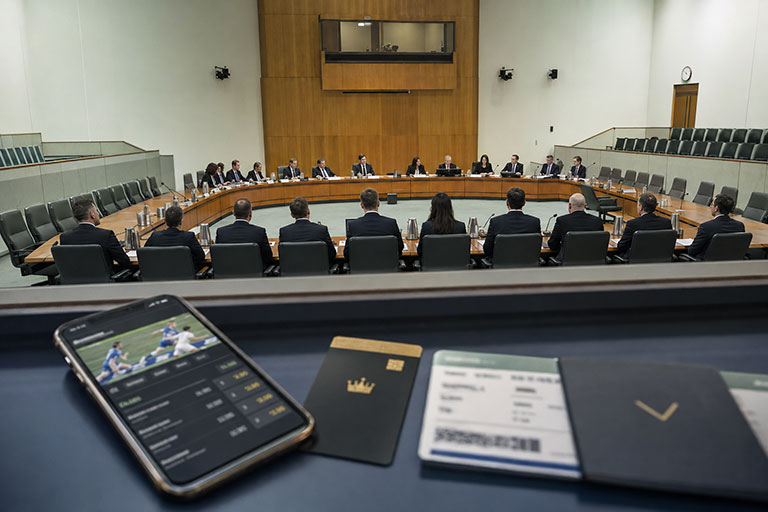
Australian bookmakers deny claims involving drugs, escorts and vulnerable customers. The evidence is untested, but the hearing has exposed how little the public knows about the industry’s most valuable private relationships.
Sportsbet and Tabcorp have rejected serious allegations made during an Australian Senate inquiry into gambling reform. The allegations remain unproven, but documented VIP marketing failures show why simple denials cannot close the wider debate. The real question is whether regulators can reconstruct every benefit, conversation and commercial incentive surrounding a high-value customer.
Australia’s betting industry is defending one of its least visible commercial practices after a former professional rugby league player and an anti-gambling campaigner made disturbing allegations before a Senate committee. Sportsbet and Tabcorp have denied that vulnerable high-value customers were supplied with drugs, escorts, alcohol or other improper benefits to keep them gambling. The claims were raised during public hearings on 3 and 4 August as part of the Senate inquiry into the Gambling Reform Bill 2026. They are allegations, not findings, and no regulator or court has established that either operator engaged in the alleged conduct.







That legal distinction must remain clear, but it cannot be used to avoid the structural issue exposed by the hearing. VIP managers work inside private relationships where marketing, hospitality, customer welfare and revenue retention meet. The public sees the bonus offer or race-day invitation, but not the internal approval, the staff target or the customer-risk warning sitting behind it. If those records cannot be reconstructed by an independent regulator, the supposedly regulated relationship becomes a matter of trust between the operator and itself.
Evidence, denials and what is still missing
Former National Rugby League player Luke Bateman told the inquiry that an unnamed gambling company had offered him extensive hospitality while he was losing heavily. According to reporting from the hearings, he alleged that drugs and alcohol were present at a private Gold Coast event involving customers and senior industry figures. Bateman reportedly described earning about A$400,000 a year, losing approximately A$1 million and accumulating debts exceeding A$250,000. The operator concerned was not identified in the available public reporting, which makes it wrong to attach his allegations to a named company without further evidence.
Anti-gambling campaigner Tim Costello raised a separate case concerning a customer who allegedly turned over more than A$20 million a month. Costello reportedly named TAB, Sportsbet and the Star casino while describing benefits said to have included accommodation, escorts, drugs and bonus bets. Sportsbet told the committee that it had no evidence supporting the claims and would not tolerate such conduct, while Tabcorp said drugs, sex workers and alcohol were not part of its customer offering. Both companies asked for supporting material to be given to the relevant authorities.
At the time this article was prepared, the official Hansard transcript and any confidential evidence supplied to the committee were not publicly available. There is no published invoice, message, staff record, police finding or regulatory determination proving the central allegations. A responsible investigation therefore has to hold two positions at once: the accusations must not be reported as fact, but the lack of published proof does not remove the need to examine how VIP benefits are recorded and controlled. The Senate now has to establish whether witnesses can produce evidence capable of being independently tested.
The VIP system has already failed basic compliance tests
The controversy did not arrive in a clean regulatory environment. On 22 July 2026, the Australian Communications and Media Authority announced that TAB had paid more than A$2.7 million after the regulator found multiple breaches of telemarketing and spam laws. The confirmed ACMA findings included 351 calls to numbers on the Do Not Call Register without consent, 82 calls outside permitted hours and nearly 4,000 calls that failed properly to identify the caller or the purpose of the call. TAB also self-reported that more than 217,000 emails and text messages had been sent over 16 days to customers who had withdrawn consent from the relevant marketing channels.
This was not TAB’s first failure involving VIP communications. In June 2025, the company paid more than A$4 million after ACMA found over 5,700 non-compliant messages sent to members of its VIP programme. The regulator said such programmes can involve customers who are not wealthy and may be experiencing significant losses, an important correction to the industry’s preferred high-roller image. Those enforcement actions do not support the drugs or escorts allegations, but they confirm that personalised VIP systems have already operated without reliable compliance controls.
Malta Media has previously examined how operators deliberately compete for the same customers through VIP transfer programmes that recognise status earned elsewhere. That business model turns a player’s historic gambling activity into a sales qualification and gives a new operator an immediate commercial reason to preserve high spending. It also makes effective financial vulnerability checks more important, including systems such as those used in Flutter-owned Tombola’s financial assessment process. The existence of a check is not enough if the employee managing the customer is rewarded for keeping that customer active.
A private market inside the regulated market
Tabcorp told the Senate inquiry that it had around 800,000 active customers, about 400 VIPs and approximately 20 VIP account managers. Sportsbet reportedly said that it employed a similar number of VIP managers, although these figures have not yet been independently audited. The numbers show how concentrated the relationship can be, with each manager potentially responsible for a small portfolio of commercially important customers. That is precisely the environment in which informal communication, hospitality and individual discretion can become more important than the public promotion terms displayed on a website.
The basic controls should be easy for an operator to describe. Every flight, hotel room, ticket, restaurant bill, rebate and non-cash benefit should have an identifiable approver, a recorded value and a clear commercial justification. Every private event should identify the employees and customers present, while communication outside approved systems should be prohibited or captured. Where a customer displays markers of harm, the welfare decision should override the account manager’s revenue target and that decision should be visible in the audit trail.
What remains unclear is whether regulators routinely inspect those records or mainly examine them after a complaint, scandal or enforcement referral. A regulator can require responsible-gambling policies and still miss the commercial pressure applied through a private relationship. It can verify that a bonus was correctly recorded while knowing little about a dinner, trip or personal favour arranged around it. The Australian allegations are so serious because they describe an extreme version of a system whose ordinary operation is already largely hidden.
Who benefits when a customer keeps losing?
The most important undisclosed figure may not be the value of VIP gifts, but the way the manager is paid. If performance is measured through customer turnover, net revenue, retention or reactivation, the account manager has a commercial interest in continued gambling. Responsible-gambling staff may be instructed to intervene, yet the colleague closest to the customer can still face a target that points in the opposite direction. A policy saying that welfare comes first means little unless remuneration, supervision and promotion decisions follow the same rule.
Operators should therefore disclose whether VIP managers receive individual or team-based incentives connected to spending, losses or retention. Regulators should establish whether customer-risk flags reduce those incentives and whether a failed intervention has consequences for the manager’s performance assessment. The same scrutiny should apply to managers who move between operators and bring knowledge of high-value customers with them. Without those answers, the industry can present VIP management as customer service while leaving its central economic purpose unexamined.
Sportsbet’s ownership makes this more than an Australian governance question. The operator belongs to Flutter Entertainment, whose international portfolio includes FanDuel, Paddy Power, Betfair, Sky Betting & Gaming and Sisal, while its acquisition of Snaitech reinforced the group’s scale in Europe. Malta Media’s earlier coverage of Flutter’s €2.3 billion Snai transaction shows how far the group’s brands and compliance responsibilities now extend. The Australian claims do not implicate the other businesses, but Flutter should be able to say whether one group-wide standard governs VIP hospitality, manager remuneration and non-cash benefits across every market.
Malta’s public rules stop short of the VIP relationship
The Malta Gaming Authority requires licensees to monitor markers of gambling harm, intervene when concerning behaviour is detected and retain evidence of investigations, decisions and responsible-gaming interactions. Its public player-protection guidance also says staff dealing with customers must be appropriately trained. These are meaningful obligations, but the public material does not explain whether an operator’s audit trail must include VIP hospitality, travel, entertainment, gifts, off-platform communication or the remuneration of account managers. That may be a gap in public guidance rather than in supervision, but only the MGA can clarify the position.
Malta has a direct interest because numerous internationally active gambling groups operate from the jurisdiction, often with centralised technology and risk functions serving several markets. A customer may interact with different brands, products or companies inside one wider group while the relevant licences remain national. The MGA should explain whether information about VIP restrictions and markers of harm is expected to travel across those internal boundaries. It should also say whether compliance audits sample hospitality records and staff incentives rather than looking only at account transactions and formal bonus entries.
The issue becomes more complicated when valuable customers move offshore. Malta Media has reported on the attraction of high-value players to crypto gambling platforms, where higher limits and fewer conventional controls may be presented as advantages. Licensed operators frequently argue that strict rules can push customers towards the black market. That channelisation concern deserves serious attention, but it cannot justify weak scrutiny of VIP practices inside the regulated market.
Britain asks for an audit trail, but what does it capture?
Britain moved earlier than many jurisdictions to impose specific requirements on high-value customer schemes. The Gambling Commission’s guidance for high-value customers requires operators to assess customers before offering special treatment and to ensure commercial pressure does not override the licensing objectives. It also expects decision-making to be supported by senior oversight and audit trails. The Australian hearing now gives the Commission a reason to explain whether those records capture every category of benefit, including hospitality arranged outside the gambling account itself.
A complete audit trail should show more than the moment a customer entered a VIP scheme. It should record who decided that the relationship could continue after losses accelerated, what the operator knew about affordability and whether the manager’s commercial target changed when risk indicators appeared. It should also allow an inspector to compare formal account notes with emails, calls, messaging applications and expense claims. Anything less leaves the regulator reviewing the version of the relationship that the operator chose to put into the compliance file.
The Senate should follow the records, not the rhetoric
The Australian Senate committee is due to report on 17 August 2026. Before then, it should obtain the evidence behind the allegations and establish whether it has been referred to police, ACMA, AUSTRAC or state wagering regulators. It should also require Sportsbet and Tabcorp to explain what internal reviews have been opened, which records are being preserved and whether independent investigators will be permitted to test the companies’ conclusions. A private assurance that nothing improper occurred would not be enough to resolve claims made in public evidence.
The committee should go further than determining whether drugs or escorts were supplied in the individual cases described. It should examine how VIP managers are selected, trained, paid and supervised, what they are authorised to spend and how operators detect benefits disguised as ordinary hospitality. The same examination should cover the moment a profitable customer begins to show signs of harm, because that is where commercial loyalty and regulatory responsibility collide. A serious reform cannot concentrate on gambling advertisements visible to everyone while ignoring the private inducements visible only to the customer and the operator.
The allegations may be substantiated, disproved or shown to concern businesses that have not yet been identified. Until evidence is published, Malta Media will not treat them as established facts. What is already established is that VIP communication systems have failed basic compliance tests and that regulators provide the public with limited information about how non-cash benefits and staff incentives are inspected. The uncomfortable question is no longer whether every bookmaker would cross the most extreme line alleged in Canberra, but whether the regulatory system would reliably detect it if one did.
FAQs
What is the main issue discussed in the article?
The article examines how gambling VIP managers are supervised and whether existing regulatory oversight is sufficient.
Why are Sportsbet and Tabcorp mentioned?
They denied allegations made during Australia's Senate inquiry regarding the treatment of VIP customers.
Have the allegations against the bookmakers been proven?
No. The article makes clear that the allegations remain unproven and have not been confirmed by regulators or courts.
What is a gambling VIP manager?
A VIP manager is responsible for maintaining relationships with high-value gambling customers through personalised services and promotions.
Why are regulators concerned about VIP programmes?
Because private relationships between operators and high-value customers may create conflicts between revenue generation and customer protection.
What role does Australia's Senate inquiry play?
The inquiry is investigating gambling reform and examining evidence relating to VIP management practices.
What previous compliance issues are highlighted?
The article references ACMA enforcement actions involving TAB's telemarketing and VIP marketing compliance failures.
How could operators improve transparency?
By maintaining detailed records of hospitality, incentives, communications and responsible gambling interventions.
What does the article say about responsible gambling?
It argues that customer welfare should take priority over commercial incentives, especially for vulnerable VIP customers.
Why is the topic relevant beyond Australia?
Many international gambling operators use similar VIP programmes, making governance and compliance an industry-wide concern.

Michael
With nearly 30 years in corporate services and investigative journalism, I head TRIDER.UK, specializing in deep-dive research into gaming and finance. As Editor of Malta Media, I deliver sharp investigative coverage of iGaming and financial services. My experience also includes leading corporate formations and navigating complex international business structures.
Related Posts

Germany regulates gambling while trading apps imitate it
July 31, 2026




Lotto BW used the World Cup to promote online slots
July 24, 2026


Germany’s €5 online slot limit lacks public clarity
July 22, 2026


Germany acted too late on FIFA sponsor ADI Predictstreet
July 20, 2026