THNDR opens its platform to third-party studios for expanded skill games
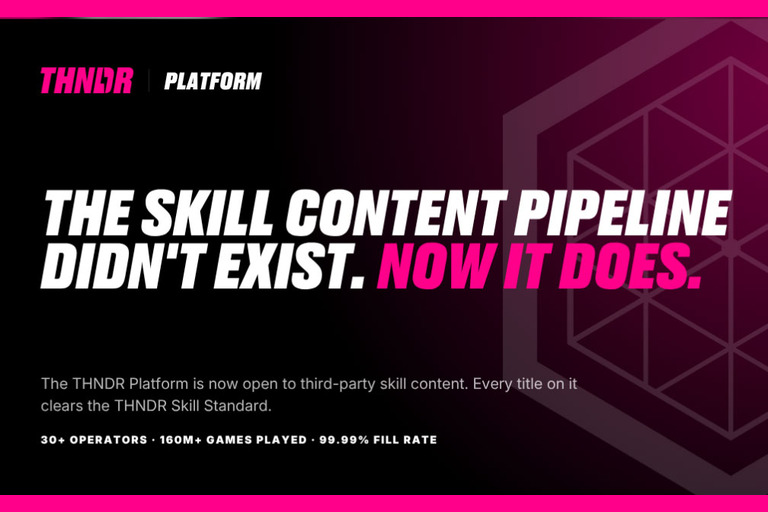
THNDR has opened its platform to third-party studios as it seeks to broaden the range of skill-based games available to operators. The move allows external developers to submit content for distribution through THNDR's existing operator network while using the platform's established processes for game evaluation, security checks and match verification.
The expansion represents a significant change in the way THNDR approaches content supply. Rather than relying solely on internally developed titles, the company is creating an environment where additional studios can contribute games while THNDR maintains control over the technical and integrity requirements applied to content before and after launch.
For operators, the central proposition is reduced integration friction. THNDR says participating operators can access approved third-party content through an existing integration instead of onboarding a separate supplier for each new title. That structure may also reduce duplicated technical work although regulatory responsibilities remain dependent on the operator, the market and the applicable licensing framework.








THNDR expands its games ecosystem
THNDR has positioned its platform around player-versus-player skill gaming for regulated operators. Its current product offering includes titles such as Skill Slots, Hit Me! 21, Blocks, Solitaire, Royal Joker, Think-O and 21 or Bust. The company's website describes the platform as a B2B solution for sportsbooks, daily fantasy platforms, lotteries and casinos.
Opening the system to external studios gives that model a wider content pipeline. For developers, distribution can potentially extend beyond a single operator relationship. For operators, the benefit is access to a broader selection of games without necessarily requiring a new technical connection for every provider.
This approach is particularly relevant for head-to-head products where player availability can influence the quality of the experience. A game may function properly from a technical perspective yet still face commercial challenges if there are not enough participants available at the same time.
THNDR has built its proposition around shared liquidity across operators. The company currently states that its network has more than 25 live partners with more than 160 million games played and a 99.99% fill rate. THNDR also says direct integrations can generally go live within five to 10 business days. These figures are company-reported metrics rather than independently verified industry measurements.
Certification remains central to the model
The expansion does not mean that every submitted title automatically becomes available to operators. THNDR says games distributed through its platform must meet its Skill Standard and pass a defined certification process.
The company describes five pre-launch checks covering platform integrity, skill evaluation, rules and design review, security assessment and quality assurance. According to THNDR's stated process, the rules and design assessment also considers potential exploits and the ability of the game to resist bot activity.
That emphasis is important for skill gaming because operators need to establish that a product's mechanics support the claimed competitive structure. The classification and regulatory treatment of gaming products can differ considerably between jurisdictions. A platform process can support an operator's assessment but does not remove the operator's obligation to comply with local law.
Independent testing is also a familiar concept within regulated gaming. For example, the UK Gambling Commission's technical standards include requirements relating to game software, security and the use of third-party software in peer-to-peer gambling. The regulator also maintains requirements covering independent testing where applicable.
Gaming Laboratories International is another established example of an organisation providing independent testing and certification services for gaming products and systems. Its work illustrates the wider industry's reliance on testing frameworks when technical compliance and product integrity must be demonstrated to regulators or operators.
Match verification extends beyond launch
THNDR's stated model also places emphasis on verification after a game is released. The company says its Match Verification system is designed to produce cryptographic evidence supporting how a match was played and how an outcome was reached.
For head-to-head games involving monetary stakes, post-match verification can form an important part of an integrity framework. Operators and players need confidence that the recorded result corresponds with the game experience presented through the front end. THNDR has described its verification technology as patent-pending and has said its broader platform uses verification mechanisms across its games.
Such controls also address the broader issue of automated assistance and unfair play. In peer-to-peer environments, regulators may require disclosures or controls concerning bots and third-party software. The UK Gambling Commission‘s Remote gambling and software technical standards specifically address situations where customers may encounter software programs or human players assisted by third-party software.
The practical implication is that certification is not simply a pre-launch exercise. For operators evaluating new games, the ability to monitor integrity during live operation can be as important as the initial technical assessment.
Desiree Dickerson outlines the operator case
Desiree Dickerson, CEO and co-founder of THNDR, has presented the platform expansion as a response to demand from operators for more skill-based content.
“Operators keep asking for more skill content, then the same two questions stop the deal: is this really skill and can it clear compliance,” said Desiree Dickerson, CEO and co-founder of THNDR and Chairman of the Skill Games Committee within the IGSA (US). “Opening the THNDR Platform to third-party studios lets us bring more games to market faster, with one integration operators can switch on. That is how you grow the skill market.”
The executive's current affiliation with the International Gaming Standards Association is also documented by IGSA. Its 2026 materials identify Dickerson as THNDR's CEO and co-founder while IGSA's recent committee information identifies her as chair of its Online Skill Gaming Committee.
The distinction matters because standardisation is increasingly relevant as online skill gaming becomes a more developed commercial category. IGSA describes itself as a non-profit trade association that creates standards and best practices for gaming stakeholders including operators, suppliers and regulators.
What the opening means for studios
For third-party studios, THNDR's proposition is centred on distribution and access to an established network. Instead of approaching individual operators separately, developers can seek to publish through THNDR and potentially reach multiple operator environments through the same infrastructure.
The publishing route is now available through THNDR's dedicated content partnerships page. The page asks prospective studios to provide company details and information about their product before a discussion with the partnerships team.
The shared-network model may also address one of the recurring commercial issues associated with head-to-head games. A newly launched title can struggle when players arrive but cannot quickly find suitable opponents. Cross-operator liquidity can reduce that dependency by connecting participants across a broader network.
THNDR has increasingly promoted this network effect as part of its proposition. Its recent materials state that the platform has surpassed 160 million games played while maintaining a 99.99% fill rate. The figures should be understood as THNDR's own reported operating metrics and may change as the network expands.
A broader content model for operators
For operators, the significance of the announcement extends beyond the number of available titles. The real change is structural. A platform that can accommodate both proprietary and third-party games can potentially give operators greater variety without requiring a separate commercial and technical process for every supplier.
That does not remove the need for due diligence. Operators still need to consider licensing scope, jurisdictional restrictions, game classification, responsible gambling obligations, payment controls, technical standards and internal risk policies before placing a title into a live environment.
The value of a centralised platform is therefore more accurately viewed as an efficiency mechanism rather than a substitute for regulatory oversight. THNDR can provide infrastructure, certification processes and distribution capabilities while each operator remains responsible for assessing whether a particular title can legally and commercially be offered to its customers.
Conclusion
THNDR's decision to open its platform to third-party studios marks a broader development in the company's content strategy. By combining external game supply with an existing operator network, THNDR is attempting to create a more scalable route for skill-based content to reach the market.
The company's certification model, security controls and Match Verification framework are intended to address the practical concerns that can arise around competitive integrity. At the same time, its cross-operator network provides a distribution structure designed to reduce the liquidity barriers that can affect head-to-head games.
For studios, the opportunity lies in gaining access to a ready-made distribution channel. For operators, the proposition is broader content through an established integration. The outcome will ultimately depend on the quality of submitted games, the effectiveness of ongoing integrity controls and the regulatory requirements that apply in each market.
As the skill gaming segment develops, the ability to combine content variety with transparent testing, technical safeguards and clear compliance responsibilities is likely to remain central to how operators assess new games. THNDR's expanded platform places those elements at the centre of its next stage of growth.
FAQs
What has THNDR changed on its platform?
THNDR has opened its platform to third-party studios so external developers can seek distribution for skill-based games through the THNDR ecosystem.
Can operators access third-party games through an existing integration?
THNDR says operators can access third-party titles through their existing THNDR integration rather than establishing a separate technical connection for every new game.
What is the THNDR Skill Standard?
The THNDR Skill Standard is the company's stated framework for assessing whether games meet its requirements for skill-based content before distribution.
What does THNDR's game certification process include?
THNDR says its pre-launch checks cover platform integrity, skill evaluation, rules and design review, security auditing and quality assurance.
Does certification replace an operator's compliance obligations?
No. Certification by a supplier does not remove an operator's responsibility to comply with the laws, licence conditions and technical requirements applicable in the market where the game is offered.
What is Match Verification?
Match Verification is THNDR's stated post-launch mechanism for checking match outcomes. The company says the system produces cryptographic proof relating to how a match was played and displayed.
Why is liquidity important for skill games?
Head-to-head games require suitable opponents. A larger shared player pool can help reduce waiting times and increase the likelihood that matches can be filled promptly.
How many partners does THNDR currently report?
THNDR currently reports more than 25 live partners. The company also reports more than 160 million games played and a 99.99% fill rate.
Who is Desiree Dickerson?
Desiree Dickerson is the CEO and co-founder of THNDR. IGSA's 2026 materials also identify her as chair of the Online Skill Gaming Committee.
How can studios apply to publish through THNDR?
Studios can use THNDR's dedicated publishing page to submit company and product information for consideration by its partnerships team.

Esther
I am a professional writer with 8 years of experience in this field and I can provide you with the best-written content you can find. Education B.A. - English, George Washington University, United States, Graduated 2011.
Related Posts
Bettortainment launches Bettortainment Hub for live sportsbook engagement
September 23, 2026

Advanced Compliance Technology launches Fraud Rings for smarter detection
September 23, 2026
DragonBet selects BVGroup for sportsbook and casino migration to BV:360
September 21, 2026
mkodo’s GeoLocs launches Fraud Shield to strengthen player risk controls
September 16, 2026
Dutch iGaming operators face shifting demand as offshore interest grows
September 16, 2026

Stake rebrands Stake Engine as Engine for wider iGaming operator access
September 15, 2026
Digitain powers LuckyBet.ee launch in Estonia with new iGaming platform
September 10, 2026
Reelsoft launches Vision Engine to simplify casino game development
September 10, 2026