
















BETBY report reveals World Cup betting trends for football’s new season
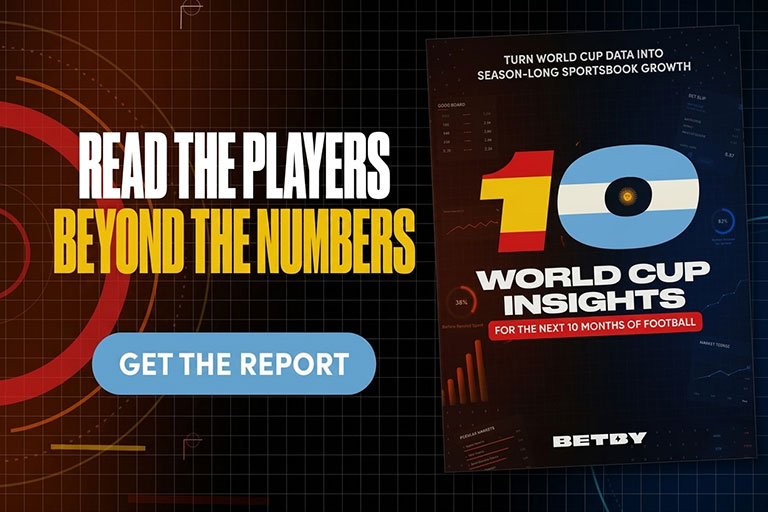
BETBY has released “10 World Cup Insights for the Next 10 Months of Football”, a new study examining how football betting behaviour changed between the 2022 and 2026 World Cup editions and what those changes could mean for sportsbooks during the new European football season. BETBY’s official report confirms that the study is intended to turn tournament data into practical insights for the months that follow the World Cup.
The report takes a broader approach than simply reviewing headline betting figures. Instead, it examines how players interacted with sportsbook products, markets and features during a major international tournament and considers which behaviours may remain relevant once the focus shifts back to domestic and European club football.
That distinction is important for operators. A World Cup creates an unusually concentrated betting environment, but the end of the tournament does not necessarily mean that interest in football betting disappears. The challenge is to identify which behaviours were tied specifically to the event and which ones could be converted into longer-term engagement.









BETBY's latest research therefore places particular emphasis on the areas that can influence sportsbook performance beyond the tournament itself. These include match-result betting, player props, product usage, event discovery, sportsbook features and promotional campaigns.
The report looks beyond headline bet growth
One of the central themes of the study is that operators should look beyond simple increases in betting activity.
Major tournaments naturally attract attention and can produce significant increases in traffic, stakes and betting volume. However, those headline numbers do not necessarily explain why customers placed bets, where they found markets or how they behaved between matches.
According to the report, average stake growth reached x2.96, illustrating the scale of the financial engagement generated around the tournament. Yet the significance of that figure lies in understanding the behaviour behind it rather than simply reporting the increase.
The report also argues that the new club season should not be evaluated solely through bet growth. Operators need to understand whether customers are discovering more markets, using more sportsbook features and remaining active when major international fixtures are no longer available.
This creates an important transition from tournament-focused acquisition to sustained engagement. A World Cup may generate exceptional activity, but the commercial opportunity for operators lies in understanding how that activity can translate into the regular football calendar.
Event discovery was not limited to the tournament page
Another notable finding concerns how players accessed World Cup betting opportunities.
Only 18.84 per cent of World Cup bets arrived through the dedicated tournament page, according to the report. That figure suggests that the event itself may have been highly visible while the dedicated page was not necessarily the primary route through which customers engaged with World Cup markets.
For sportsbook operators, this has implications for product discovery and platform design. Customers may encounter betting opportunities through homepages, personalised recommendations, live betting interfaces, market navigation, promotional placements or other sportsbook features rather than going directly to a tournament hub.
This means event merchandising cannot be treated as a single-page exercise. Operators seeking to maximise engagement during major competitions may need to make relevant markets accessible across the wider sportsbook experience.
The finding also supports the broader argument of the report that visibility and engagement are not always the same thing. A major tournament can dominate the sports calendar without becoming the exclusive destination within the sportsbook.
Desktop players generated a significant share of turnover
BETBY's data also highlights a notable distinction between player numbers and turnover.
Desktop users represented 13.14 per cent of World Cup players but generated 30.24 per cent of World Cup turnover. The difference indicates that player share alone may not provide a reliable picture of commercial value.
The finding could encourage operators to examine device behaviour more closely. Mobile remains central to modern sportsbook engagement, but desktop users may display different betting patterns or higher-value behaviour in particular circumstances.
Rather than applying identical engagement strategies across every device, sportsbooks can use behavioural data to understand where customers spend more time, how they navigate markets and how different interfaces influence wagering activity.
The report's emphasis on this distinction reinforces the value of segmenting sportsbook performance by more than customer count. Turnover, stake size, product usage and session behaviour can provide additional context when evaluating the performance of a major event.
Player props show how markets are evolving
Market behaviour is another major area addressed by the BETBY study.
The company points to stark changes in the types of markets attracting betting activity over the four-year period. One of the clearest examples is the growth of player shots on goal markets, which increased by 1,005 per cent according to the report.
At the same time, traditional 1X2 betting declined. The contrast indicates that customers are not necessarily moving away from football betting. Instead, they may be seeking more specific and personalised ways to participate.
Player props can offer more granular engagement because they allow customers to follow individual athletes and statistical outcomes rather than relying solely on the final match result.
For operators, the trend reinforces the importance of market depth and product flexibility. Customers who remain interested in football after a major tournament may expect more than conventional pre-match markets, particularly as sportsbook users become increasingly familiar with alternative betting options.
Engagement between matches remains commercially important
The report also examines what happens when no World Cup match is taking place.
Rather than activity disappearing on match-free days, BETBY says activity across BETBY.Games increased. That finding provides another indication that sportsbooks can maintain engagement through complementary products and experiences when headline fixtures are unavailable. BETBY positions its wider product ecosystem as part of this engagement strategy.
This is particularly relevant during a regular football season, when fixture schedules vary significantly from one day to another. There will inevitably be quieter periods, postponed matches and gaps between major competitions.
Products that can occupy those gaps may therefore serve a wider retention role. The objective is not necessarily to replicate the importance of live football but to give customers additional reasons to remain active within the sportsbook.
For operators, this can mean considering how esports, virtuals, games and other sports betting products fit alongside traditional football content.
Stefanos Karakidis highlights the strategic lesson
Stefanos Karakidis, Business Development Director at BETBY, said the most important lesson from the World Cup was not simply the increase in sportsbook activity.
“Most operators came out of the World Cup with better numbers, but few could explain why. The majority viewed the tournament primarily as an acquisition opportunity, when that was arguably the least interesting aspect of it.
He further stated: “The tournament reached four out of five of our players, yet generated less than half of all bets. It was everywhere, but it wasn’t everything on the sportsbook. That’s why we set out to uncover the insights that many operators might otherwise overlook.”
Karakidis's comments underline the report's central message. The value of tournament data is not limited to evaluating the tournament itself. It can also provide a framework for understanding customers when the sporting calendar returns to its regular rhythm.
The official BETBY report states that the 2026 World Cup reached 80.70 per cent of active sportsbook players across the company's partner network while generating 42.47 per cent of turnover. Those figures demonstrate both the reach of the tournament and the scale of activity that remained outside it.
Turning World Cup data into season-long strategy
The timing of the report is significant because the new football season is already underway. European football's calendar now provides operators with an extended opportunity to apply lessons from the World Cup across domestic competitions, continental tournaments and other sporting events. UEFA's official calendar confirms the continuing schedule of European competitions during the 2026/27 season.
The challenge will be to determine which World Cup behaviours were temporary and which reflect broader changes in customer expectations.
For example, rising interest in player props could influence market development throughout the season. Strong engagement outside dedicated event pages could affect sportsbook navigation and merchandising strategies. Higher turnover among desktop users could lead to deeper device segmentation while activity between matches could encourage operators to strengthen complementary products.
The report therefore presents the World Cup less as an isolated commercial peak and more as a source of behavioural evidence.
Conclusion
BETBY's “10 World Cup Insights for the Next 10 Months of Football” presents a useful reminder that major sporting events should not be judged only by the volume of bets they generate. The more valuable question is what customer behaviour reveals about the sportsbook experience.
The data highlighted by BETBY points towards a football betting environment that is becoming more diverse. Customers are exploring player-focused markets, accessing events through multiple routes and continuing to engage with sportsbook products beyond the traditional match schedule.
For operators, the post-World Cup period is consequently more than a return to normality. It is an opportunity to examine the habits formed during one of football's largest global events and apply those lessons to a much longer commercial cycle.
The strongest operators may ultimately be those that treat tournament data not as a final report card but as a blueprint for the season ahead. In that context, the real value of the World Cup could extend well beyond its final whistle.
FAQs
What is BETBY's new World Cup report about?
BETBY's new report, “10 World Cup Insights for the Next 10 Months of Football”, examines football betting behaviour around the 2026 World Cup and identifies trends that may be relevant to sportsbooks during the following season.
What is the main focus of the BETBY report?
The report focuses on player engagement, betting markets, player props, sportsbook features, event discovery, products and promotional activity.
How much did the average stake increase according to the report?
BETBY states that average stake growth reached x2.96, highlighting the increase in financial engagement identified in its analysis.
How many World Cup bets came through the dedicated tournament page?
According to BETBY's report, 18.84 per cent of World Cup bets came through the dedicated tournament page.
What share of World Cup players used desktop?
Desktop users accounted for 13.14 per cent of World Cup players, according to the data presented by BETBY.
What share of World Cup turnover came from desktop users?
Desktop players generated 30.24 per cent of World Cup turnover according to the report.
Which player prop market saw major growth?
BETBY reports that player shots on goal betting increased by 1,005 per cent between the compared World Cup editions.
What happened to BETBY.Games activity between World Cup matches?
The report states that activity across BETBY.Games increased on days when no World Cup match was running, highlighting the potential importance of complementary products.
Who is Stefanos Karakidis?
Stefanos Karakidis is Business Development Director at BETBY and provided commentary on the strategic implications of the company's World Cup analysis.
Why are the report's findings relevant to sportsbooks?
The findings can help sportsbook operators understand how users discover betting opportunities, which markets attract engagement and how activity can be maintained beyond major tournament fixtures.

Anna Amstill
I am an avid Blogger and Writer with more than 6 years of experience with Content Writing. An Online Marketing expert specializing in Blog writing, Article writing, Website content, SEO specific Keyword content and much more. Education B.A. - business management, York University, Canada, Graduated 2016.
Related Posts


BetConstruct AI Brings Its Ecosystem to SiGMA World 2026 in Rome
October 15, 2026
